
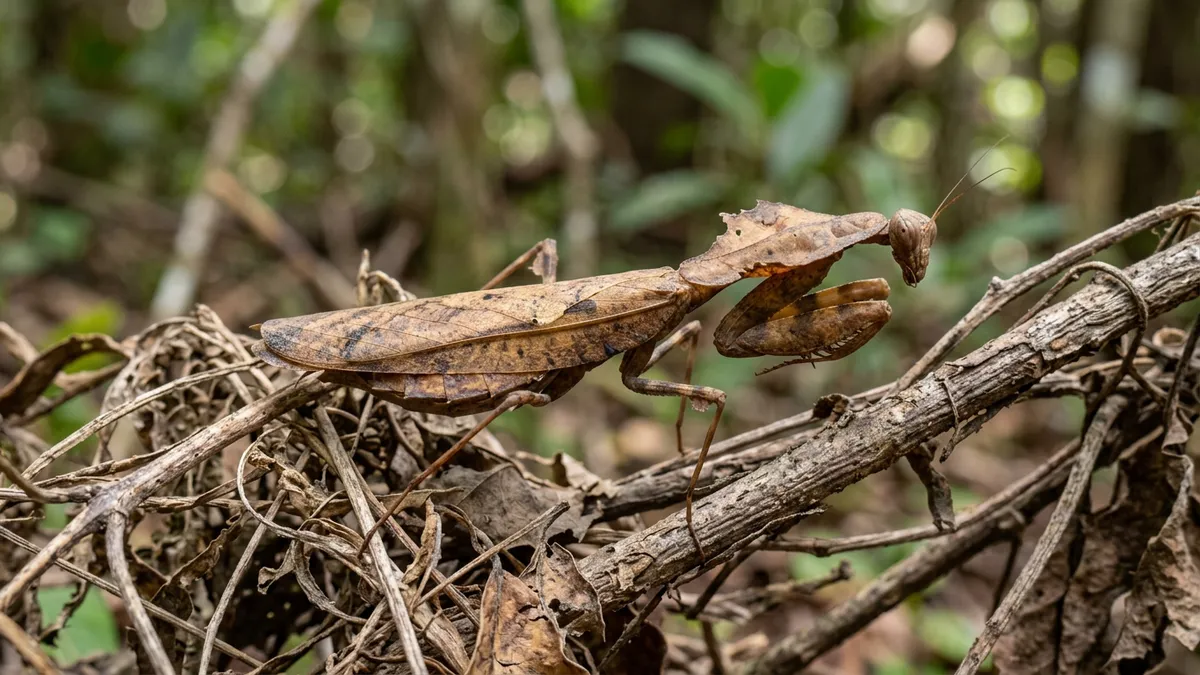
Resting on the vegetation, a leaf-mimic mantis can look like nothing more than a fragment of dry leaf carried by the wind. The resemblance is not limited to color or general shape. The insect reproduces details that complete the look of a dead leaf, including a visible vein and an edge that seems to have been torn. While it waits, it keeps its body still for long periods, giving no sign of its presence to prey that is drawing closer.
Movement begins only when the target comes within a few inches (a few centimeters). At that moment the raptorial front legs shoot forward in a fraction of a second and pin the animal before it can pull away. The scene combines two different strategies. First, the disguise lowers the chance of being noticed. Then speed turns a short distance into an advantage.
The dry leaf shows up on the insect’s body
Mimicry works because the mantis does not offer only an irregular silhouette. The simulated vein adds a line that recalls the central structure of a leaf, while the damage along the edge breaks up the regularity of the outline. These elements make the body look less like an insect and more like a piece of withered plant material. The imitation depends on the whole set, not on a single mark.
In nature, dead leaves can stay attached to branches, pile up among other leaves or lie scattered over the vegetation. An animal scanning its surroundings for movement gets less information when a predator stays still and blends into that background. The mantis does not have to disappear completely to gain an edge. It is enough that its features are read as part of the landscape until the prey comes close enough for the attack.
Long stillness prepares the strike
Waiting is an active stage of the hunt, even though it looks like an absence of behavior. The mantis holds its position and avoids movements that could reveal its outline. This prolonged stillness is especially important for a predator that relies on a short distance. If the prey notices the insect before entering its reach, the camouflage stops doing its job and the chance of a catch can vanish.
The decisive detail is the switch between waiting and acting. Instead of chasing a target over long distances, the insect stays hidden and lets the prey itself cross the space it needs. When the prey passes a few centimeters away, reaction time shrinks to almost nothing. The strategy pairs economy of movement with a fast attack, in a sequence where every phase has a role: the dry leaf disguises, stillness preserves the surprise and the raptorial legs finish the capture.
Vision calculates the distance before the catch
Stereoscopic vision takes part in the moment when the mantis decides to attack. Because the eyes view the surroundings from different positions, the brain can compare the images it receives and estimate how far away an object is. This ability is useful for a predator that must reach prey sitting very close, yet cannot throw its legs forward without judging the right moment.
The approach of the target is not enough by itself. The insect has to identify a position from which the movement of its front legs has the best chance of reaching the prey’s body. Stereoscopic vision contributes to that assessment and helps synchronize the response. The result is a hunt based on distance calculation, not on random reflexes. The imitated leaf creates the opportunity, and visual perception signals when the opportunity is ripe.
Raptorial legs close the sequence
The front legs of a mantis are specialized for capture. Held folded back, they can lash forward quickly once the target is within reach. Structures adapted for gripping help hold the prey after contact, reducing the possibility of escape. For that reason the attack has to come at the right interval, when the distance is short and the insect still holds the benefit of surprise.
The capture takes place in a fraction of a second and completes the visual transformation of the scene. During the wait, the mantis looks like a damaged leaf. In the next instant the motionless fragment turns into a predator that throws out its legs and seizes the target. The payoff of the behavior is direct: camouflage does not merely hide the insect, it places it in position to attack before the prey recognizes the danger.
The mechanism depends on the setting and has limits
Resemblance to a dry leaf does not work the same way in every scenario. It is most useful when the background holds shapes, colors and textures that match the insect’s appearance. On a uniform surface, or in a place without dead leaves, the outline can stand out. The camouflage also does not make the animal invisible, and it does not remove the need to choose a suitable spot for waiting.
That is why the strategy is better described as a match between body and surroundings than as a trick that works anywhere. The insect gains from the conditions around it, and the conditions decide how well the disguise holds.
To the prey, the sequence can seem to be paused until the moment of attack. The environment shows a dry leaf, the leaf stays motionless and nothing hints at a hunter. The combination of vein and torn edge reinforces that reading, while stereoscopic vision lets the insect follow the approach. When the target arrives a few centimeters away, the accumulated wait becomes an action lasting less than a second.
This behavior shows how survival can depend on discreet details instead of a flashy look. A line that recalls a vein, a simulated tear and the ability to stay still rearrange the relationship between predator and prey. The mantis does not have to dominate all the space around it. It only has to seem part of that space until the distance favors its legs. In the vegetation, what looks like a lifeless leaf can be, for a few moments, a trap waiting for movement.
Reporting: Natália Santos / Amazonia Mag

Editor · Amazonia Mag
Anne Silva is the editor of Amazonia Mag, the English-language edition of Revista Amazônia. She curates, translates and adapts the outlet's science and environment coverage for an international audience, reporting on Amazon wildlife, flora, rivers, climate and research. Every story she edits is grounded in peer-reviewed studies, official data and on-the-ground reporting from the Revista Amazônia newsroom in Belém, Pará, Brazil. More by Anne Silva →