
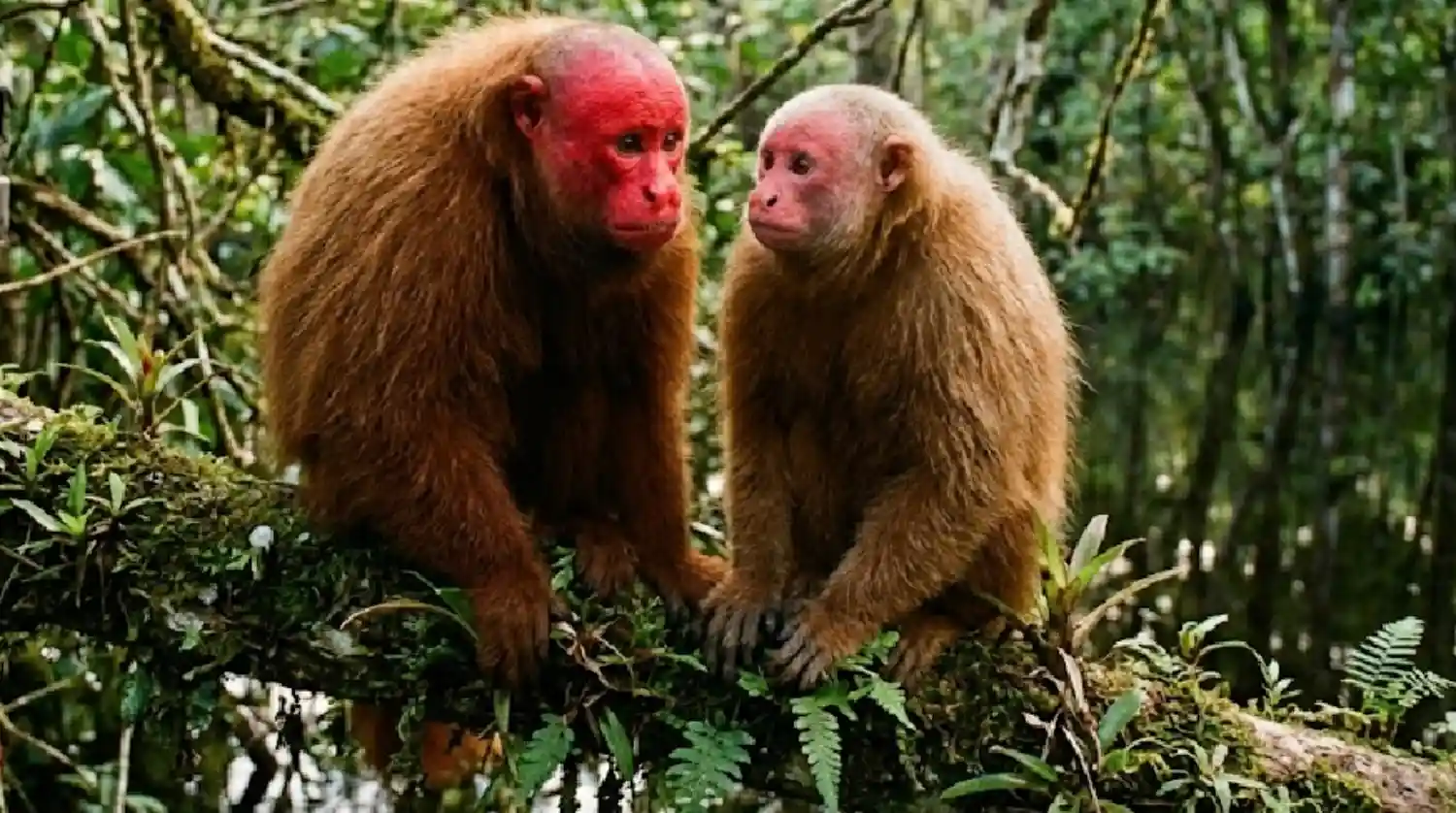
Few primates in the Amazon draw the eye like the red uakari (Cacajao calvus). This medium-sized primate lives exclusively in várzea forests, the areas that white-water rivers flood seasonally. Its most striking feature is a hairless face so intensely red that it looks hand-painted, something found nowhere else among Neotropical primates.
That color is no whim of nature. It is a biological communication system: a signal of health and vigor that plays a central role in sexual selection and in the survival of the species.
A red that does not come from pigment
The vivid red of the uakari’s face does not come from pigments in the skin. It comes from a complex network of blood vessels lying just beneath an extremely thin epidermis. Because the color depends on that network, the face becomes a window onto the condition of the animal’s body.
Brazilian scientists, including researchers at the Mamirauá Institute for Sustainable Development (IDSM), have established that the intensity of that color is directly tied to the health of the individual. The institute has studied the species for decades in the Mamirauá Sustainable Development Reserve, in the state of Amazonas.
A healthy, well-fed red uakari shows a deep, bright red face. Sick, undernourished or parasitized animals, by contrast, have a pale, whitish face or one with only a very faint red tone, a clear sign that something is wrong.
Sexual selection guided by a crimson face
That direct link between facial color and health turns the red uakari’s face into a powerful tool for sexual selection. According to the Brazilian researchers’ studies, females of the species use the intensity of the red as a key criterion when choosing a mate.
By preferring males with redder faces, females are in effect choosing the individuals with the best immune systems, free of parasites and with the greatest capacity to survive. It is not a conscious choice, but the consequences are clear: their offspring inherit more resistant genes, which raises the odds that the young will thrive in the demanding environment of the flooded forests.
Sexual selection based on honest signals of health is a central concept in evolutionary biology, and the red uakari offers one of the most emblematic and visually accessible examples of the phenomenon among primates. The signal is honest because it reflects the true condition of the animal, not a decoration that any individual could display.
Males with duller faces struggle to attract partners and, as a result, leave fewer descendants. This genetic “filtering” ensures that mostly the fittest individuals reproduce, which strengthens the health of the whole population. The red is therefore a biological investment that pays off in reproductive success, and it has shaped the evolution of the species over millennia of isolation in the Amazonian várzeas.
A species that demands long-term science
Protecting the red uakari and its habitat is a challenge that joins science and sustainability in the Amazon. Brazil’s Chico Mendes Institute for Biodiversity Conservation (ICMBio) coordinates and supports long-term research and monitoring projects to understand the population dynamics and home-range requirements of these elusive animals.
That continuous monitoring is vital because the red uakari is an extremely specialized species and is vulnerable to habitat fragmentation and to climate change. Conserving the várzea forests is therefore the foundation for the survival of what specialists call an umbrella species: protecting this primate means protecting the entire environment on which many other forms of life depend.
By decoding the color signal of the crimson face, scientists are not just counting animals. They are reading the health of the ecosystem itself. The presence of a viable population of uakaris with vibrant faces indicates that the várzea forest is in balance, with enough resources and without excessive pressure from disease or parasites.
Fragile floodplains, a richness under threat
The red uakari’s home is the várzea forest, a unique and fragile ecosystem shaped directly by the flood pulse of the great white-water rivers of the Amazon. These forests are extremely rich in nutrients, but they are also the areas most exposed to deforestation and to conversion into farmland and cattle pasture, precisely because of the fertility of their soils.
Habitat loss, hunting and the trafficking of wild animals are the main threats the species faces. Ibama, Brazil’s environmental enforcement agency, works to police and combat these illegal activities, while research and conservation institutions develop sustainable management strategies and ecotourism that value the standing forest and harmonious coexistence between local communities and the red uakari.
Brazilian science, with its expertise and innovation, keeps showing that the secrets of the Amazon can be revealed with respect and technology. That work reinforces the importance of public sustainability policies that guarantee the conservation of this symbol of biodiversity.
The red uakari, with its crimson face and its visual communication system, is a reminder of the importance of every piece in the mosaic of biodiversity. Protecting this unique primate means protecting the forest itself, so that its face can keep serving as a signal of health and vigor for generations to come. Conserving the Amazon is an ethical commitment to the future, and every creature, however elusive it may seem, plays a fundamental part in the balance of this vital ecosystem.
Reporting: Anne Silva / Amazonia Mag

Editor · Amazonia Mag
Anne Silva is the editor of Amazonia Mag, the English-language edition of Revista Amazônia. She curates, translates and adapts the outlet's science and environment coverage for an international audience, reporting on Amazon wildlife, flora, rivers, climate and research. Every story she edits is grounded in peer-reviewed studies, official data and on-the-ground reporting from the Revista Amazônia newsroom in Belém, Pará, Brazil. More by Anne Silva →