
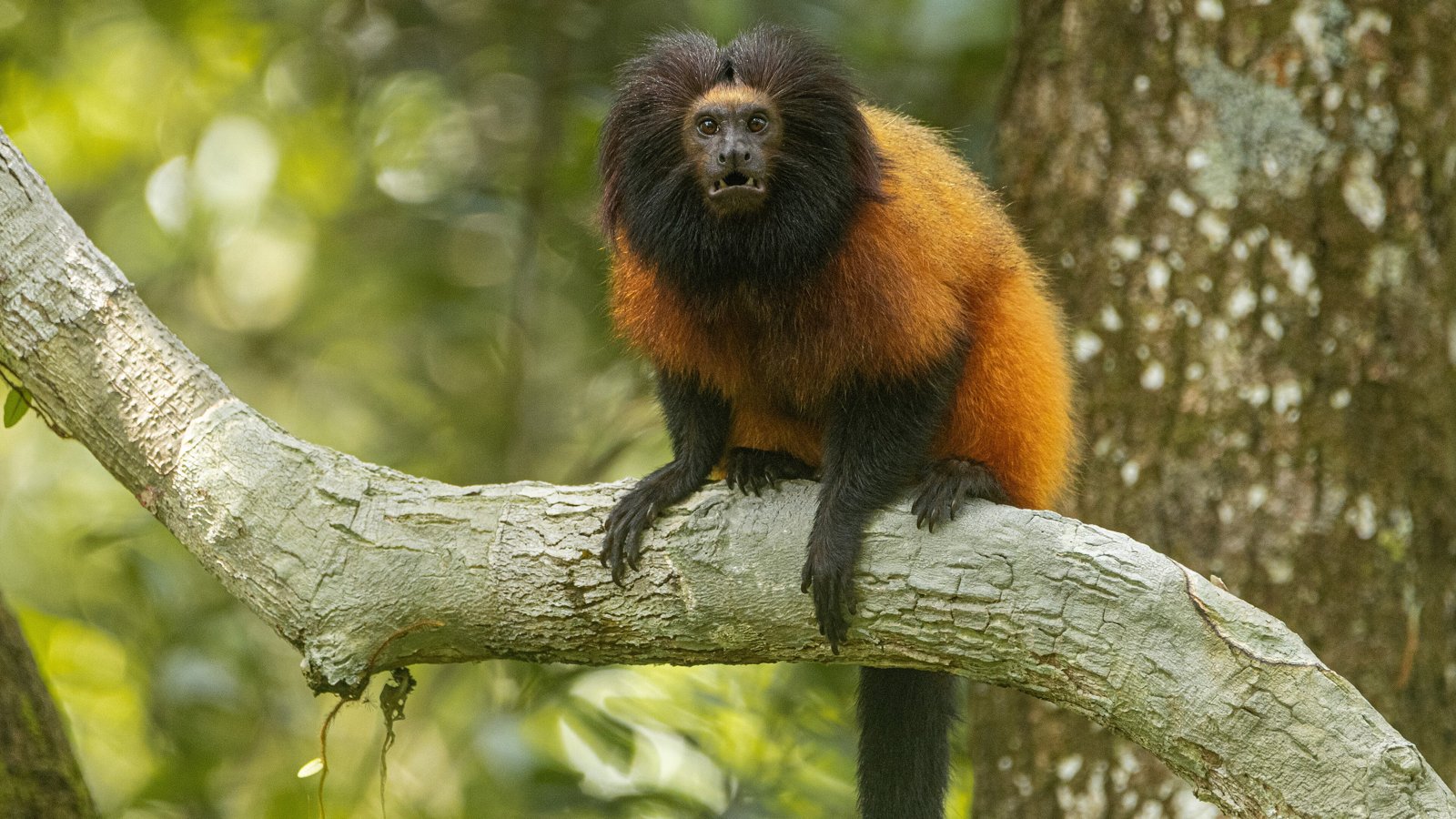
In the dense restinga of Superagui National Park, on the northern coast of Paraná, a black-faced lion tamarin (Leontopithecus caissara, known in Brazil as mico-leão-caiçara) climbed awkwardly into a tree hollow. Seconds later it poked its head out, as if checking whether it was still being watched. The image was taken by conservation photographer Gabriel Marchi in October 2026, during a five-day expedition to find again a group that had just made history.
Three months earlier, in July, these tamarins became the first of their species to be vaccinated against yellow fever. The capture, the health exams and the vaccination were carried out by researchers from the Society for Wildlife Research and Environmental Education (SPVS), in a restinga area of Guaraqueçaba.
Back to monitoring after 18 years
Before returning the animals to the forest, the team fitted the small primates with radio collars. This is the way to learn where they go, how they use their territory and whether they stay healthy. According to SPVS, the species had not been followed in the wild since 2008.
On the new expedition, carried out with SPVS authorization and guided by two local residents who had already led the July work, the photographer found the tamarins feeding on jerivá palm nuts and guamirim fruits, calling and leaping between branches. At no point did the animals try to pull off the collar. The equipment is designed not to hinder mobility, and the tamarins went about their routine as normal after the vaccination.
A collar changes what researchers can do. Without it, a group of small animals that lives in the treetops and disappears into hollows is almost impossible to find twice. With it, the team can return to the same animals, check their condition and learn from the diet and the movements of a species that very few people have ever seen in the wild.
Racing to arrive before them
Photographing a black-faced lion tamarin takes strategy. The animals travel through the canopy and sleep in tree hollows. The team had to work out which hollow the group was heading to and get there first, because once the animals go in, they vanish.
On one of the days, the group covered more than 15 kilometers (about 9 miles), and the team followed by bicycle, on foot along trails and through wetland, putting up with thorny vines, mosquitoes and ants. Following a primate that lives in the treetops through thorny vegetation is hard physical work.
A primate discovered only in 1990
The black-faced lion tamarin is one of four lion tamarin species, all of them found only in the Atlantic Forest, and it is among the rarest primates on the planet. It was described by science only in 1990, by the Brazilian researchers Maria Lúcia Lorini and Vanessa Guerra Persson, at Superagui. It also occurs in the far south of São Paulo state, in the region of Cananéia and Ariri.
Its name honors the caiçaras, the traditional residents of the coast where it lives. The coat is golden on the body, with a black head, black arms and a black tail, which explains its other popular name, mico-leão-da-cara-preta.
In 2011 the population was estimated at 392 individuals, in a study published in the scientific journal Neotropical Primates. The estimate used today is around 400 animals living free.
A canal that split the population
The main threat is habitat fragmentation. In the 1950s the Varadouro canal was opened, an artificial waterway about 6 kilometers (roughly 3.7 miles) long and 50 meters (about 164 feet) wide that links Cananéia bay, in São Paulo, to the bays of Paranaguá and Pinheiros, in Paraná.
The work separated the peninsula from the mainland and created Superagui Island. The tamarins, which move through the trees and avoid crossing water, ended up divided into subpopulations. Over time, this increases breeding between relatives and reduces genetic variability, which can lower the species’ capacity to adapt to changes in its environment and in the climate.
Why vaccinate against yellow fever
Atlantic Forest primates are among the main victims of sylvatic yellow fever. In recent outbreaks in the Southeast, populations of howler monkeys and lion tamarins were badly hit. For a species with only a few hundred individuals, a single outbreak can be devastating.
Yellow fever in the forest circulates between mosquitoes and monkeys, so the animals cannot protect themselves by avoiding people or roads. Vaccination is one of the few tools that can be applied directly to the animals before the virus arrives.
That is why vaccination and radio-collar monitoring work together: one protects the animals, and the other confirms whether the protection is working in practice.
The case also shows how small the margin is. With around 400 animals, divided by the Varadouro canal into separate groups, every subpopulation counts, and the loss of one of them would be hard to replace.
Frequently asked questions
How many black-faced lion tamarins are there? About 400 living in the wild. The estimate published in 2011 was 392 individuals.
Where does the black-faced lion tamarin live? In Superagui National Park, in Guaraqueçaba (Paraná), and in the far south of São Paulo state, in the region of Cananéia and Ariri.
Does the radio collar hurt the animal? No. The equipment is sized so as not to hinder mobility, and the monitored tamarins did not try to remove it.
Reporting: Revista Amazônia newsroom / Amazonia Mag

Editor · Amazonia Mag
Anne Silva is the editor of Amazonia Mag, the English-language edition of Revista Amazônia. She curates, translates and adapts the outlet's science and environment coverage for an international audience, reporting on Amazon wildlife, flora, rivers, climate and research. Every story she edits is grounded in peer-reviewed studies, official data and on-the-ground reporting from the Revista Amazônia newsroom in Belém, Pará, Brazil. More by Anne Silva →