
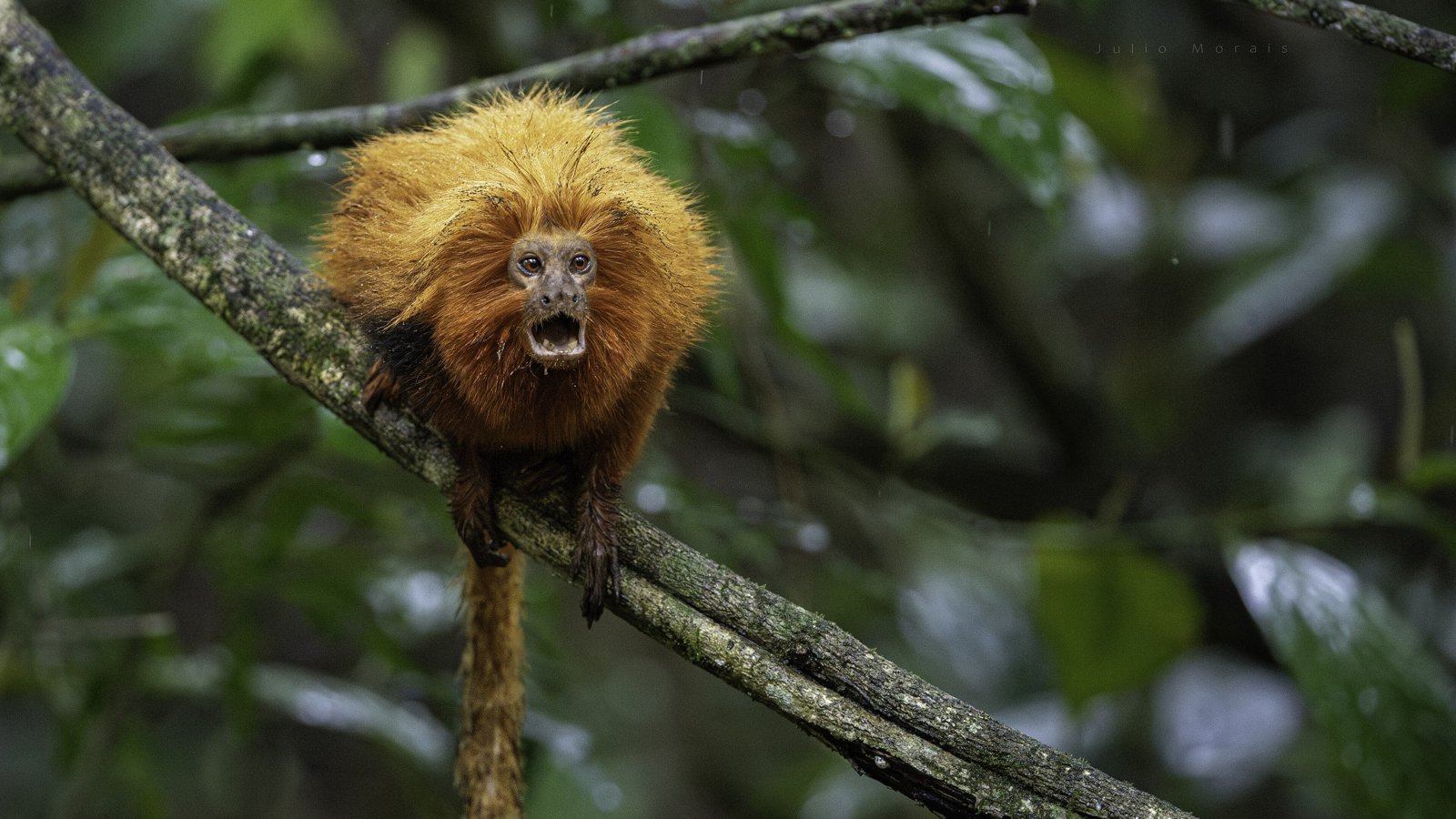
On highway BR-101, between Casimiro de Abreu and Rio Bonito in the state of Rio de Janeiro, a 72-kilometer (about 45-mile) ecological corridor holds 37 structures built so that animals can cross the road. According to Arteris, the concessionaire that manages the stretch, more than 103 species have been recorded using them. One of them is the golden lion tamarin, or mico-leão-dourado, a threatened primate found only in that part of the Atlantic Forest. More than 1,300 crossings by this species alone have been registered.
Now the same idea has reached the interior of São Paulo state. The first aerial fauna crossing in the Ribeirão Preto region was installed at kilometer 47.4 of the SP-255 highway, in the municipality of Guatapará.
A bridge six meters above the road
The structure stands six meters (about 20 feet) above the ground. It is made of wooden platforms with side screens, which prevent falls and escapes and guide the animals from one side of the road to the other. It was placed near the Mogi-Guaçu River, in a stretch of high biodiversity where the Cerrado makes the transition to the Atlantic Forest and where riparian forest still stands.
The targets are animals that travel through the treetops and avoid coming down to the ground. These include capuchin monkeys (macacos-prego), howler monkeys (bugios) and black-tufted marmosets (saguis-de-tufo-preto). Coatis and opossums, both common in the region, can also use the crossing.
The aerial passage is part of a larger set of measures. It sits alongside more than 50 underpasses, which run beneath the road and were installed in the stretches where the highway is being widened.
Why bridges for animals work
Highways cut through forest fragments and isolate populations. For a canopy animal, crossing the asphalt means climbing down to the ground, where it is exposed to being run over and to predators. Canopy bridges recreate the continuity of the trees, giving arboreal animals a way across without ever touching the road.
A road can act as a barrier even when few animals die on it. If a species refuses to cross, the groups on either side stop meeting, and each patch of forest becomes a smaller, more isolated world. That is why a crossing has two jobs: it lowers the risk of collisions, and it keeps the forest functioning as one connected habitat instead of several disconnected ones.
Underpasses serve a different group. Combined with fences that guide animals toward them, they protect the species that walk on the ground. The two designs complement each other: one reconnects the treetops, the other the forest floor.
According to Richardson Costa de Faria, environment manager at Arteris, the structures restore connectivity between natural areas separated by the highway and bring together engineering, road safety and conservation.
Fewer accidents on the road
The company says it has more than 260 fauna crossings along the stretches it manages in São Paulo, Rio de Janeiro, Paraná and Santa Catarina, in addition to more than 200 kilometers (about 125 miles) of fences that direct animals to the crossings. According to the concessionaire, the whole set helped reduce accidents involving wild animals by 27% over the past five years.
Safety is also a human matter. Collisions with medium and large animals, such as capybaras and tapirs, cause serious accidents on Brazilian roads. A crossing that keeps an animal off the asphalt protects the driver as much as the animal.
The golden lion tamarin story
The BR-101 corridor became a national reference because of the golden lion tamarin. The species dropped to only a few hundred individuals during the twentieth century and recovered through decades of conservation work, reintroduction and the reconnection of forests in the São João River basin.
The highway was a barrier in the middle of that territory. Canopy bridges and a vegetated overpass allowed groups to move between the two sides again. Each crossing caught by a camera is proof that the structure works.
For a species that depends on exchanges between groups to keep its genetic diversity, being able to cross the road makes a difference in the long term. Small, isolated groups tend to lose variation over time, and a bridge that lets individuals move between them helps counter that.
What you can do on the road
Respecting speed limits on stretches marked with animal crossing signs is the simplest measure. If you see an animal that has been run over or injured, the recommendation is to notify the concessionaire or the highway police, without trying to handle the animal.
Frequently asked questions
What is an aerial fauna crossing? It is a bridge installed over the road, linking the treetops on both sides, so that arboreal animals can cross without coming down to the ground.
Do the animals really use the crossings? Yes. On the BR-101 corridor in Rio de Janeiro, more than 103 species have been recorded, including more than 1,300 crossings by golden lion tamarins.
In Guatapará, the new crossing is the first of its kind in the Ribeirão Preto region. It shows how a design proven for one of Brazil’s best-known conservation stories can be adapted to a different landscape, where capuchins, howlers and marmosets live in forest patches cut by a busy highway.
Reporting: Revista Amazônia newsroom / Amazonia Mag

Editor · Amazonia Mag
Anne Silva is the editor of Amazonia Mag, the English-language edition of Revista Amazônia. She curates, translates and adapts the outlet's science and environment coverage for an international audience, reporting on Amazon wildlife, flora, rivers, climate and research. Every story she edits is grounded in peer-reviewed studies, official data and on-the-ground reporting from the Revista Amazônia newsroom in Belém, Pará, Brazil. More by Anne Silva →