
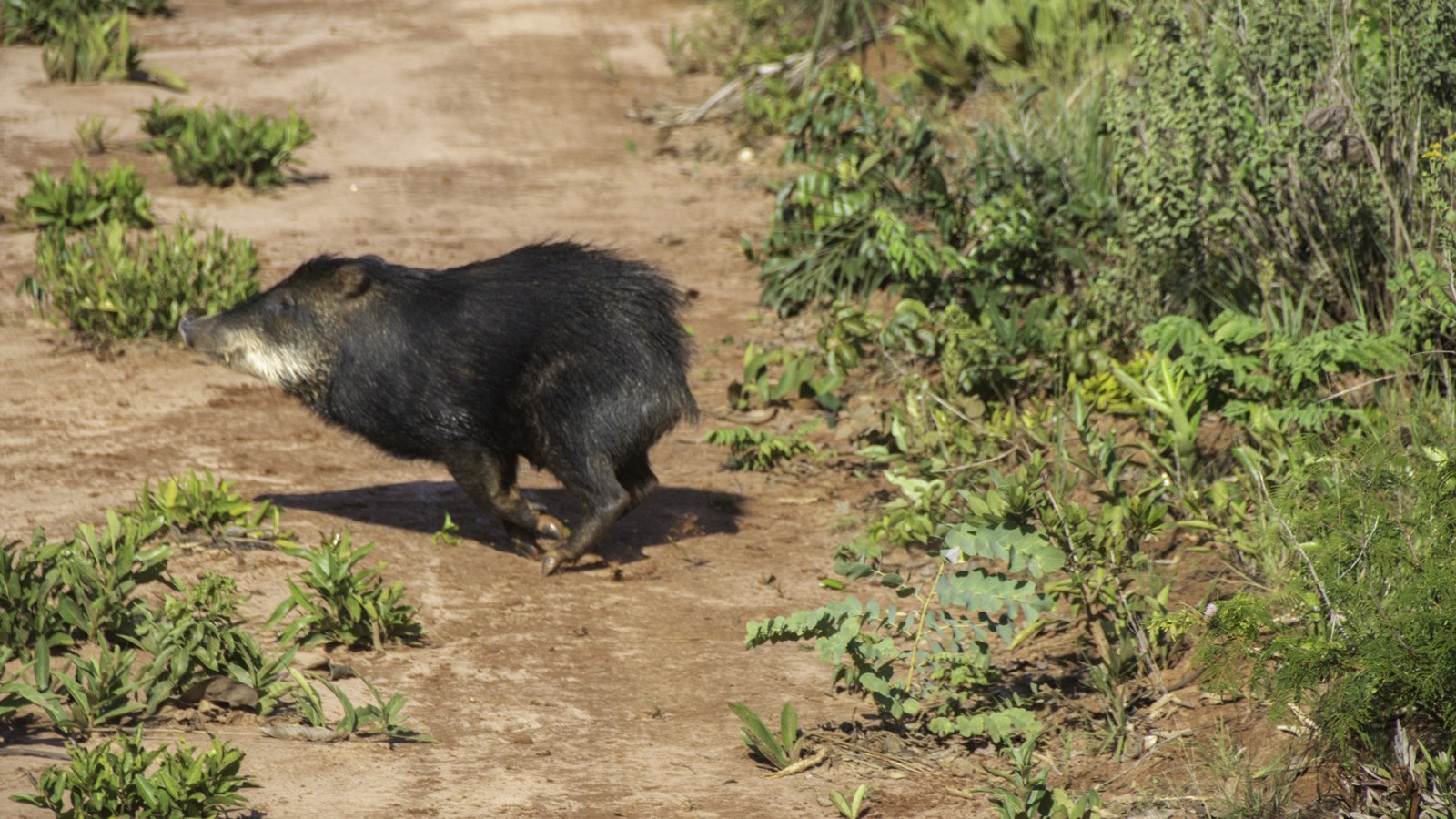
The hidden cameras in Chapada dos Guimarães National Park, about 65 kilometers (roughly 40 miles) from Cuiabá, were made to record wildlife without the animals noticing. A herd of white-lipped peccaries noticed. The footage shows the animals investigating, biting and gnawing the equipment until they brought down the stakes that held it up.
The video was recorded on August 1 and discovered on September 13, when researchers found the structure on the ground. Despite the damage to the stakes, the cameras kept working.
The monitoring is carried out by the Instituto de Mitigação de Problemas Ambientais com Comunidades Tradicionais e Onças, known as Instituto IMPACTO, with support from ICMBio, the National Center for Research and Conservation of Carnivorous Mammals, the Instituto Pró-Carnívoros and WWF-Brasil. The cameras record the presence and habits of the animals in the park, and the data help researchers understand the diversity of species in the Cerrado and plan conservation actions.
Besides the peccaries, the equipment has already caught jaguars, pumas, tapirs, anteaters and armadillos in Chapada.
Why the peccaries attacked the cameras
According to researcher Bia Naiara Xavier, of Instituto IMPACTO, the interaction is expected behavior. White-lipped peccaries are highly social, live in large groups and actively defend the area where the herd happens to be at that moment. They are also extremely curious and have a keen sense of smell, and sniffing, gnawing and biting unfamiliar objects is part of the species’ repertoire.
One hypothesis for the interest in the cameras is the human scent left on the devices after installation. For an animal that reads the world largely through its nose, a new object that smells of people is hard to ignore.
That behavior helps explain why the herd did more than sniff. A group that defends the ground where it happens to be standing is likely to treat a new object as something to be investigated or driven off, and gnawing is one way to do both at once. The fact that the stakes gave way before the cameras did shows how persistent the herd was.
There is also a lesson about the method itself. Camera traps are valued because they are hidden and triggered only by movement and heat, so researchers see animals behaving as they would if no one were nearby. When the animals notice the equipment, that illusion breaks, and the researchers learn something about the animals and about the limits of the tool at the same time.
The clicking of teeth
Anyone who watches the video with the sound on hears a dry, repeated noise. It is the clicking of teeth, a form of communication in the herd during moments of alert. The sound works as a warning to the other members of the group and as a threat to whoever approaches.
White-lipped peccaries also have a scent gland on the back, which helps keep the herd together and marks individuals. Sound and smell together hold a group of many animals as one unit in dense vegetation, where sight is limited.
A peccary is not a pig
Popularly called porcos-do-mato (bush pigs), white-lipped peccaries, Tayassu pecari, do not belong to the pig family. They are part of the tayassuids, a group native to the Americas, together with the collared peccaries. The white-lipped peccary has dark fur, a whitish patch on the chin that gives the species its name, and weighs about 30 kilograms (roughly 66 pounds). The collared peccary is smaller and has a pale collar around the neck.
Herds of white-lipped peccaries can gather dozens and even hundreds of animals. To survive, the species depends on large continuous areas of preserved vegetation, with streams and forest.
Cameras that reveal the Cerrado
Camera traps are one of the most widely used tools in science for studying animals with discreet habits. Triggered by movement and heat, they work day and night for weeks, without the presence of people. Every interaction, even those that knock the cameras down, yields information about the behavior of the animals.
In this case the footage gave researchers a record of a herd’s reaction to an unfamiliar object, including the alarm sound that the herd uses.
Gardeners of the forest
By rooting in the ground, eating fruits and spreading seeds, white-lipped peccaries change the vegetation and the chemistry of the soil where they pass. Long-term research shows that where they disappear, the composition of the forest’s plants changes. They are also an important prey for jaguars. The species is considered vulnerable to extinction in Brazil, under pressure from hunting and habitat fragmentation.
Do peccaries attack people?
In general, herds run from people. But when cornered or with young, they can react as a group, clicking their teeth and charging. Anyone who meets a herd should move away calmly and, if necessary, climb onto a high point, such as a log, until the group has passed. Never try to feed or surround the animals.
The episode in Chapada is a small reminder that wildlife research is a two-way encounter. The cameras were designed to observe without being noticed, yet the animals under observation also took notice of the cameras, and the footage records how a herd reacts to an unfamiliar object.
Reporting: Revista Amazônia newsroom / Amazonia Mag

Editor · Amazonia Mag
Anne Silva is the editor of Amazonia Mag, the English-language edition of Revista Amazônia. She curates, translates and adapts the outlet's science and environment coverage for an international audience, reporting on Amazon wildlife, flora, rivers, climate and research. Every story she edits is grounded in peer-reviewed studies, official data and on-the-ground reporting from the Revista Amazônia newsroom in Belém, Pará, Brazil. More by Anne Silva →