
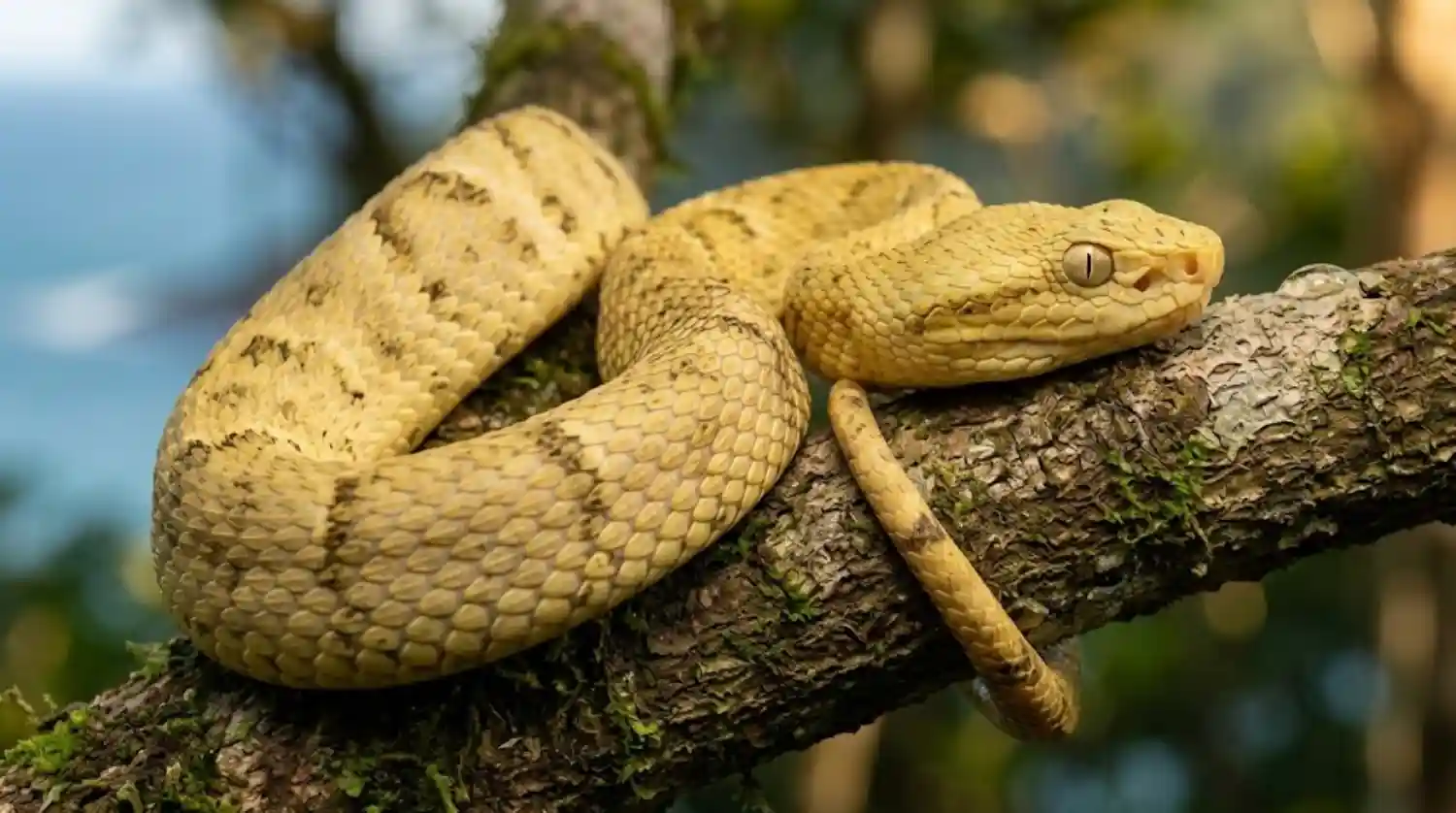
A single drop of venom from the golden lancehead, known in Brazil as the jararaca ilhoa (Bothrops insularis), can dissolve organic tissue five times faster than the venom of its relatives on the mainland. It is a drastic evolutionary adaptation with a clear purpose: to make sure that migratory birds, the snake’s main food, cannot fly away after the strike.
This snake lives on Queimada Grande Island, about 22 miles (35 kilometers) off the coast of Itanhaém, in the state of São Paulo. The island holds the highest population density of venomous snakes in the world. An estimated 2,000 to 4,000 individuals of Bothrops insularis are confined to just 43 hectares (about 106 acres) of rock and forest, which makes it one of the most restricted natural laboratories on the planet.
How a common snake became an island original
The story of the golden lancehead shows how the environment shapes biology. About 11,000 years ago, the last glacial era came to an end and sea level rose. A group of common lanceheads, the jararacas of the mainland, was left isolated on top of what is now the island.
There were no small mammals to hunt on the ground. The snakes had to climb into the trees, and they developed a prehensile tail that lets them hold on to branches safely. This shift from a ground-dwelling to a tree-dwelling lifestyle is a classic example of speciation, in which selective pressure turned a common species into a unique creature, found only on that fragment of land surrounded by the Atlantic Ocean.
Lanceheads on the mainland are mostly nocturnal. The golden lancehead adapted to be active during the day. The reason is its prey: passerine birds that use the island as a resting point on their migratory routes, and these birds are daytime animals.
To immobilize a bird instantly and keep it from falling into the sea, the venom of Bothrops insularis became extremely potent and fast-acting. This toxicity is not a “weapon of aggression”. It is a highly specialized survival tool that secures food for the species in an environment where resources are scarce.
A forbidden island under ICMBio care
Queimada Grande is classified as an Area of Relevant Ecological Interest (ARIE, in the Brazilian system), and landing by civilians is strictly prohibited by law. Its management and protection fall to the Chico Mendes Institute for Biodiversity Conservation (ICMBio), which coordinates scientific expeditions and monitors the health of the snake population.
Access is limited to authorized researchers and to Brazilian Navy personnel, who maintain the island’s automatic lighthouse. The restriction matters for human safety, given how lethal the venom is. But its main purpose is to prevent the introduction of invasive species or diseases that could wipe out the endemic population within weeks.
Enforcement also fights biopiracy, one of the biggest threats to the golden lancehead. Because the snake is rare and its venom has pharmacological value, specimens are often targeted by the international trafficking of wild animals. Keeping Queimada Grande intact means protecting a genetic heritage that cannot be replaced.
Constant monitoring lets scientists understand population fluctuations and the effects of climate change on the island’s microclimate. The goal is that the “Queen of Queimada Grande” keeps reigning in her safe isolation for many thousands of years to come.
What the venom may offer medicine
Many people fear the bite of the golden lancehead, but Brazilian science sees immense potential for modern medicine in these toxins. Researchers at the Butantan Institute have spent decades studying the proteins in the venom of lanceheads. Historically, the study of the venom of a Brazilian lancehead led to captopril, one of the most widely used drugs in the world for controlling high blood pressure.
The chemical cocktail of the island’s snake carries peptides that could lead to the discovery of new powerful painkillers or of drugs to treat complex circulatory problems. The molecular complexity of the venom of Bothrops insularis is the subject of proteomic and transcriptomic studies.
By mapping how these toxins interact with the human body, scientists can isolate compounds that, in controlled doses and modified in the laboratory, act beneficially. Brazilian biodiversity works as a chemical library that is still little explored. Each time a restricted habitat like Queimada Grande is protected, the door stays open to biotechnological innovations that could save millions of lives in the future, turning fear into cure and isolation into shared knowledge.
A fragile balance and the risk of extinction
Protecting the golden lancehead does not stop at the island’s shoreline. It depends on the health of the whole marine ecosystem and on the migratory routes of birds along the Brazilian coast. Ocean pollution and predatory fishing around Queimada Grande can indirectly affect the availability of resources.
The species also faces low genetic variability, which is natural in isolated populations and makes it more vulnerable to sudden environmental change. Ex situ conservation projects, carried out at institutions such as the Butantan Institute itself, keep populations under human care to ensure the species survives if a natural catastrophe strikes the island.
Life on Queimada Grande is a fragile and poetic balance. The snakes depend on the birds, the birds depend on preserved vegetation, and the forest depends on the nutrient cycle that takes place on that rock. Understanding this interdependence is at the core of modern sustainable thinking. A place where humans are not the protagonists, only cautious observers, reinforces the importance of humility toward nature.
Wildlife trafficking is the third largest illicit activity in the world, moving billions of dollars every year. In the case of the golden lancehead, pressure from international collectors and from clandestine laboratories interested in its unique venom places the species at critical risk of extinction. A single snake can be sold for astronomical sums on the black market. Stronger coastal enforcement and support for agencies such as IBAMA are essential so that Brazilian biodiversity is not plundered, preserving the country’s scientific and environmental sovereignty.
Why a small, isolated place matters
Brazil is the country with the greatest biodiversity on the globe, and cases like the golden lancehead show the level of specialization that its fauna can reach. Valuing endemic species builds a sense of national pride and environmental responsibility. Educating the public about these snakes also helps dispel the negative image attached to reptiles.
In the context of sustainability, the protection of small, isolated areas serves as a model for conservation strategies in larger forest fragments, where human pressure is more intense. The golden lancehead is, therefore, a symbol of resistance and adaptation.
When we look at the silhouette of Queimada Grande on the horizon of the São Paulo coast, we should see not a “forbidden place” but a monument to biological evolution. Science and conservation walk together so that the golden shine of the scales of Bothrops insularis keeps existing among the bromeliads and the branches of the trees. Nature does not need us to prosper; it only needs us to respect its space and its integrity.
Protecting what is unique is an act of respect for evolutionary history and an ethical commitment to the generations still to come.
Reporting: Anne Silva / Amazonia Mag

Editor · Amazonia Mag
Anne Silva is the editor of Amazonia Mag, the English-language edition of Revista Amazônia. She curates, translates and adapts the outlet's science and environment coverage for an international audience, reporting on Amazon wildlife, flora, rivers, climate and research. Every story she edits is grounded in peer-reviewed studies, official data and on-the-ground reporting from the Revista Amazônia newsroom in Belém, Pará, Brazil. More by Anne Silva →