
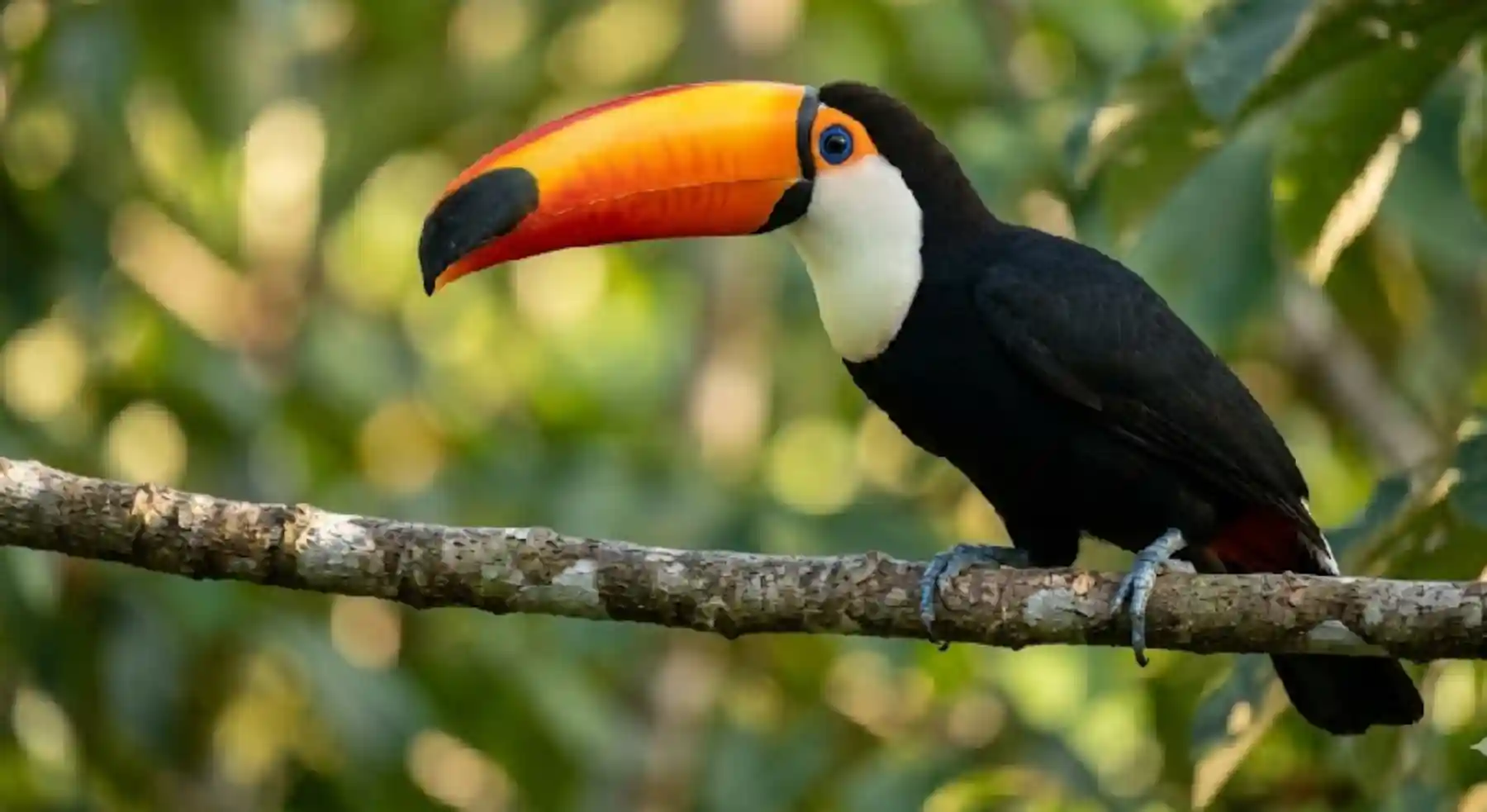
The word “toucan” is one of the most emblematic examples of how Brazilian Portuguese was shaped by the descriptive richness of Indigenous languages. It derives from the Tupi term tukana, and it shows that the native peoples of the Amazon basin and the Atlantic Forest already had a detailed system of biological classification long before any European naturalist set foot on the continent.
A name that is more than a label
For the Tupi peoples, the name was not just a tag. It was a synthesis of observation of the bird’s behavior and body. It is believed that the root of the word is linked to the sound the animal makes, or to the characteristic “beating” of its bill against tree trunks.
That detail matters. It means the name carries a piece of field knowledge: someone listened, watched and remembered how the bird behaves, and condensed that into a word that is still in use today.
The engineering of the bill
The toucan’s bill is one of the most remarkable structures in the animal kingdom. It looks heavy and massive, yet it is very light. Inside, it is made of a network of bony keratin fibers that resembles the structure of a rigid sponge. This “natural technology” gives the bill the strength to break hard fruit and to repel predators, without upsetting the bird’s balance in flight.
Modern science has found one more function for the bill, one that Indigenous observers perhaps sensed from watching the habit of these birds of taking shelter in the heat: thermoregulation. The bill is richly supplied with blood vessels and works as a biological thermal radiator. On hot days, the bird increases blood flow to the bill so that heat can escape into the air. On cold nights, the flow is reduced to conserve body energy. It is estimated that the bill can radiate up to 100% of the heat produced by the animal’s body, an efficiency greater than that of elephant ears.
One of the most curious images in wildlife is that of a toucan asleep. To protect its bulky bill and reduce heat loss during the night, the bird performs an anatomical contortion: it turns its head back, rests the bill on its back and covers it with its wings and with its tail, which is folded forward. This “ball of feathers” minimizes the surface area exposed to cold night air. The bill, a thermal radiator by day, becomes a reservoir of heat protected by the insulation of the feathers. The strategy saves energy in birds that have a high metabolic rate and must keep a constant internal temperature in environments that can cool considerably after sunset.
Feathers, seeds and the “winged farmer”
For Tupi-speaking peoples, the toucan was not only a beautiful bird but a being with spiritual and practical meanings. Its vibrant feathers were used in feather art to make mantles and headdresses that symbolized status and a connection with the deities of the forest.
Indigenous observation went beyond appearance. These peoples understood the toucan’s role as an important seed disperser. When it feeds on fruits such as açaí and bacaba, the toucan swallows the fruit whole and, after some time, either regurgitates the seed intact or passes it in its droppings at places far from the mother plant.
This process, known as endozoochory, is essential for maintaining the genetic diversity of the forest. The term tukana carried with it the recognition of this “winged farmer”, whose movements dictated the regeneration of the native orchards that sustained the tribes.
A mosaic of species and colors
The family Ramphastidae includes more than forty species, ranging from the large toco toucans to the small araçaris. Each species has a unique chromatic signature on its bill, which works as a code for visual communication. Amid the dense green vegetation of the Amazon, the vibrant colors act as signals for recognition among members of the same species and to attract mates during the breeding season.
The geographic distribution of these birds was also mapped by Indigenous peoples. The black-billed toucan, for example, is more common in areas of closed forest, while the toco toucan prefers transition zones and forest edges. This spatial perception let ancient peoples know what type of ecosystem they were in just by watching the birds around them, turning the fauna into a kind of living map of Brazilian biodiversity.
Threats, and a debt to traditional knowledge
Today the heir of the tukana lineage faces challenges that the ancient Tupi could never have imagined. The trafficking of wild animals is one of the greatest threats: the exotic beauty of the toucan makes it a constant target for the illegal trade in ornamental birds. In addition, the fragmentation of forests shrinks the ecological corridors these birds need to move in search of seasonal food.
The loss of large trees, which provide the natural cavities where toucans nest, compromises the breeding success of the species. Unlike other birds, toucans do not build complex nests. They depend on holes left by woodpeckers or on the natural rotting of wood. Without primary forest, the toucan’s life cycle is interrupted. Preserving the “bird of the sun bill” is therefore inseparable from protecting Indigenous territories and environmental reserves.
The Tupi etymology reminds us that scientific knowledge did not begin in the laboratories of Europe. It began with bare feet on the forest floor, in attentive listening to birdsong and in observing the cycles of nature. Valuing the name tukana means recognizing the intellectual property of the original peoples over Brazilian biodiversity. Contemporary science has much to gain from integrating traditional knowledge with genetic and ecological research.
Bird monitoring programs often use guides that include popular names of Indigenous origin, which eases communication with local communities and promotes more participatory conservation. The toucan is a symbol of Brazilian fauna that joins the ancestral past to the future of sustainability. To respect the toucan is to respect the language that named it and the land that sustains it.
When we see a toucan today, we should look beyond its flawless plumage. We should see an ancient survivor and a precision thermal radiator, the guardian of seeds and the symbol of a culture that knew how to read nature without destroying it. Preserving the toucan is an act of historical and ecological justice.
Do not buy wild animals, and report the trafficking of birds. Support reforestation projects that use native species, so that the toucans of the future find food and shelter. By keeping the toucan in flight, we keep alive the Tupi word and the promise of a vibrant forest. It is worth reflecting on how a simple name can carry so much history and responsibility.
To learn more about Tupi etymology and the biology of Brazilian birds, readers can consult the Illustrated Tupi-Guarani Dictionary and the records of the Emílio Goeldi Institute.
Reporting: Anne Silva / Amazonia Mag

Editor · Amazonia Mag
Anne Silva is the editor of Amazonia Mag, the English-language edition of Revista Amazônia. She curates, translates and adapts the outlet's science and environment coverage for an international audience, reporting on Amazon wildlife, flora, rivers, climate and research. Every story she edits is grounded in peer-reviewed studies, official data and on-the-ground reporting from the Revista Amazônia newsroom in Belém, Pará, Brazil. More by Anne Silva →