
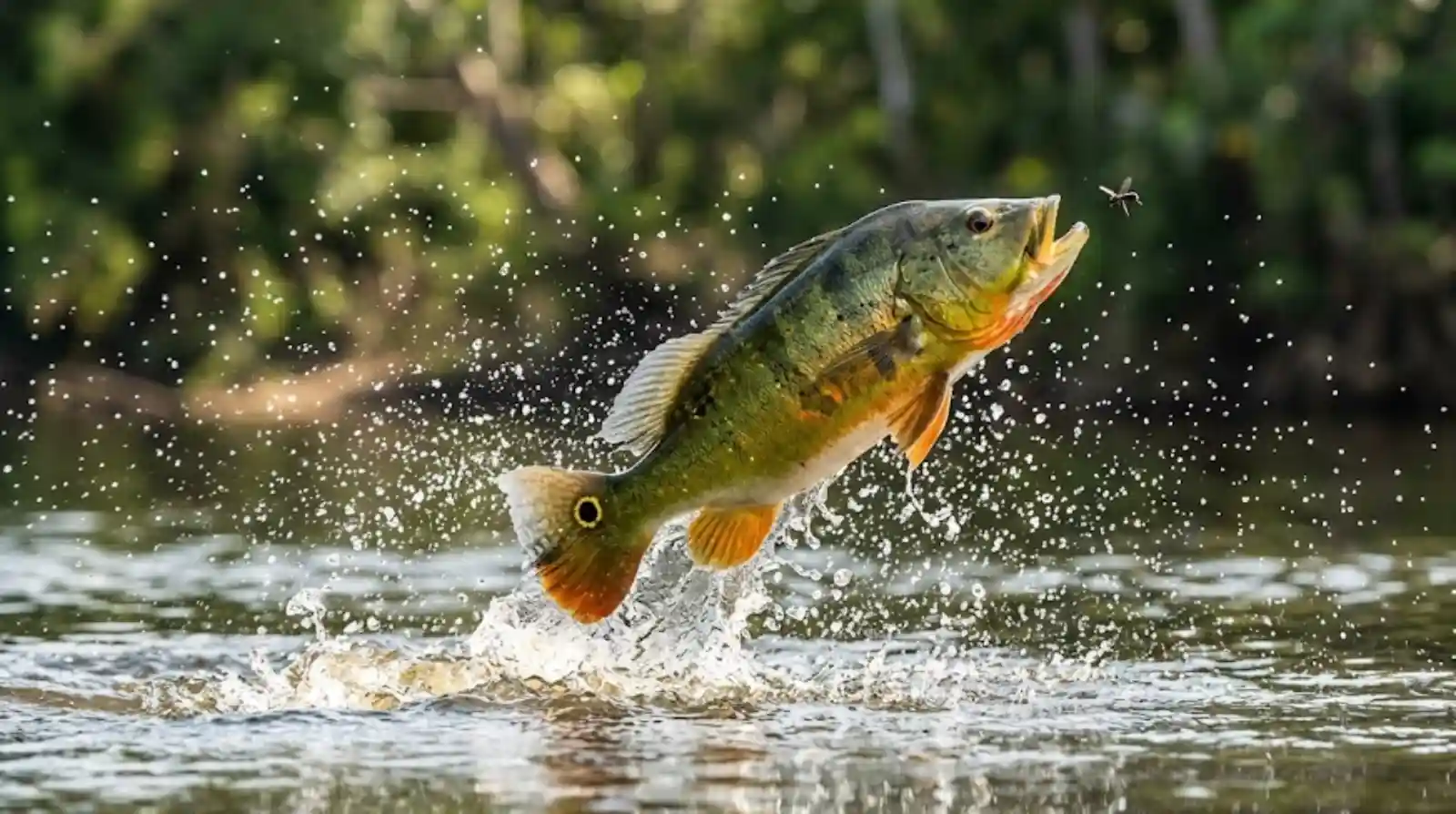
In the rivers of the Amazon and across the Araguaia and Tocantins basin lives a hunter that refuses to be confined by its own element. The peacock bass, a fish of the genus Cichla and represented by species such as Cichla ocellaris, does not limit itself to chasing prey underwater. It leaves the water entirely. It launches itself into the air to seize insects and small birds passing close to the surface, and it does so with an accuracy that seems to argue with physics. Before it can land that strike, it has to solve an optical problem that fools almost every human observer: the refraction of light.
Refraction is an everyday effect, easy to verify at the kitchen table. Put a spoon in a glass of water, look at it from the side, and the handle appears to break exactly at the waterline. The same distortion works in reverse for a fish looking upward. An insect resting on a leaf or flying low over the river is not where the animal sees it. The image arrives shifted, displaced from its true position. If the peacock bass jumped at the point its eyes reported, it would miss again and again, and aerial hunting would be a waste of energy rather than a strategy.
A correction made in fractions of a second
The verifiable and genuinely surprising biological fact is that the visual system of the peacock bass compensates for that distortion. The fish does not act on the world as it arrives at its eyes, but on the world as it actually is. Its brain performs complex, instantaneous calculations and adjusts the trajectory of the leap so that it intercepts the prey at the exact point where the prey really sits in the air, not where it appears to sit. The correction happens with no pause, no rehearsal and no second attempt, because insects rarely wait. That neurological and optical compensation is what turns an ordinary jump into a precise attack.
None of this is an isolated trick. It is a survival strategy refined across millions of years of evolution, in which anatomy, nervous system and muscle operate as a single mechanism. The motor and visual coordination has to be flawless. A small error in the angle or in the force of the thrust leaves the fish out of the water with nothing in its mouth and briefly exposed. That is why biologists treat this adaptation as one of the most remarkable in the aquatic animal kingdom, comparable to the finest targeting systems nature has produced anywhere.
The anatomy of an upward gaze
Part of the explanation lies in the placement of the eyes. In the peacock bass they sit laterally, as in most fish, but they are angled slightly upward and forward. That tilt gives the animal good binocular vision in the upper region of its visual field, precisely the band of space where aerial prey appears. Binocular vision is what allows distance and depth to be calculated accurately, and without that calculation no reliable leap would be possible. Research indicates that this ocular arrangement, combined with the neurological processing of refraction, is the secret behind its hunting above the waterline.
The attack sequence begins long before the jump. The fish patrols shallow stretches or water close to marginal vegetation, where insect life is abundant and branches lean out over the river. It spots an insect resting on a leaf or flying low, weighs distance and angle, and prepares itself. Then everything becomes an explosion of energy. Powerful musculature drives the body upward, the fish breaks the surface, closes its wide mouth, lined with small villiform teeth, around the target, and returns to the river with a vigorous splash. The whole event lasts fractions of a second.
A top predator holding the balance
The tactic does more than diversify a diet. It hands the peacock bass a clear advantage over predators restricted to whatever moves below the surface. While others compete for the same submerged resources, this fish opens an entire pantry that almost nothing else in the river can reach. Its strength and aggression have also made it a prized target for sport fishing, though its significance reaches well beyond recreation. As a top predator in the food chain, it plays a decisive ecological role in controlling populations of other fish and invertebrates, and in keeping the aquatic ecosystem in balance.
Healthy peacock bass populations tend to signal a balanced environment with good availability of resources. The reverse is also true. When the species is introduced into river basins where it is not native, it causes serious imbalance, because it can wipe out local fish populations that never evolved alongside a hunter of this kind. Those fish have no defensive answer to a predator that strikes from unexpected angles, including from above the waterline. That is why responsible management and respect for the natural distribution of species matter so much, a point too often overlooked.
There is also a lesson here about how observation works. The straight, obvious reading of a scene is frequently the wrong one, and the animal that survives is the one whose senses have learned to distrust the raw image. The peacock bass does not see better than other fish in any simple sense: it interprets better. Evolution did not hand it a window free of distortion, it handed it a correction. That distinction is worth holding on to, because it describes much of what living systems actually do when they face a physical world that misinforms them.
Watching the fish work also changes how the river reads from the bank. A splash near the marginal vegetation is not random noise, it is the visible end of a calculation that began underwater, in an eye tilted just far enough upward to see a world it was never built to trust. The strike is brief, the physics behind it is not, and the animal solves the problem every single time it feeds.
The vision of the peacock bass is only one of the many wonders that Brazilian biodiversity keeps quietly in place. Studying these adaptations helps us grasp the complexity of life and the connections between living beings and their environments. Every species, however ordinary it may look, carries millions of years of evolutionary history, and preserving it is fundamental to the health of the planet. Contemplating this fish forces a question: how many other invisible strategies are unfolding right now beneath the surface of our rivers, waiting patiently for our attention and our protection?
Reporting: Anne Silva / Amazonia Mag. Source: Revista Amazônia.

Editor · Amazonia Mag
Anne Silva is the editor of Amazonia Mag, the English-language edition of Revista Amazônia. She curates, translates and adapts the outlet's science and environment coverage for an international audience, reporting on Amazon wildlife, flora, rivers, climate and research. Every story she edits is grounded in peer-reviewed studies, official data and on-the-ground reporting from the Revista Amazônia newsroom in Belém, Pará, Brazil. More by Anne Silva →