
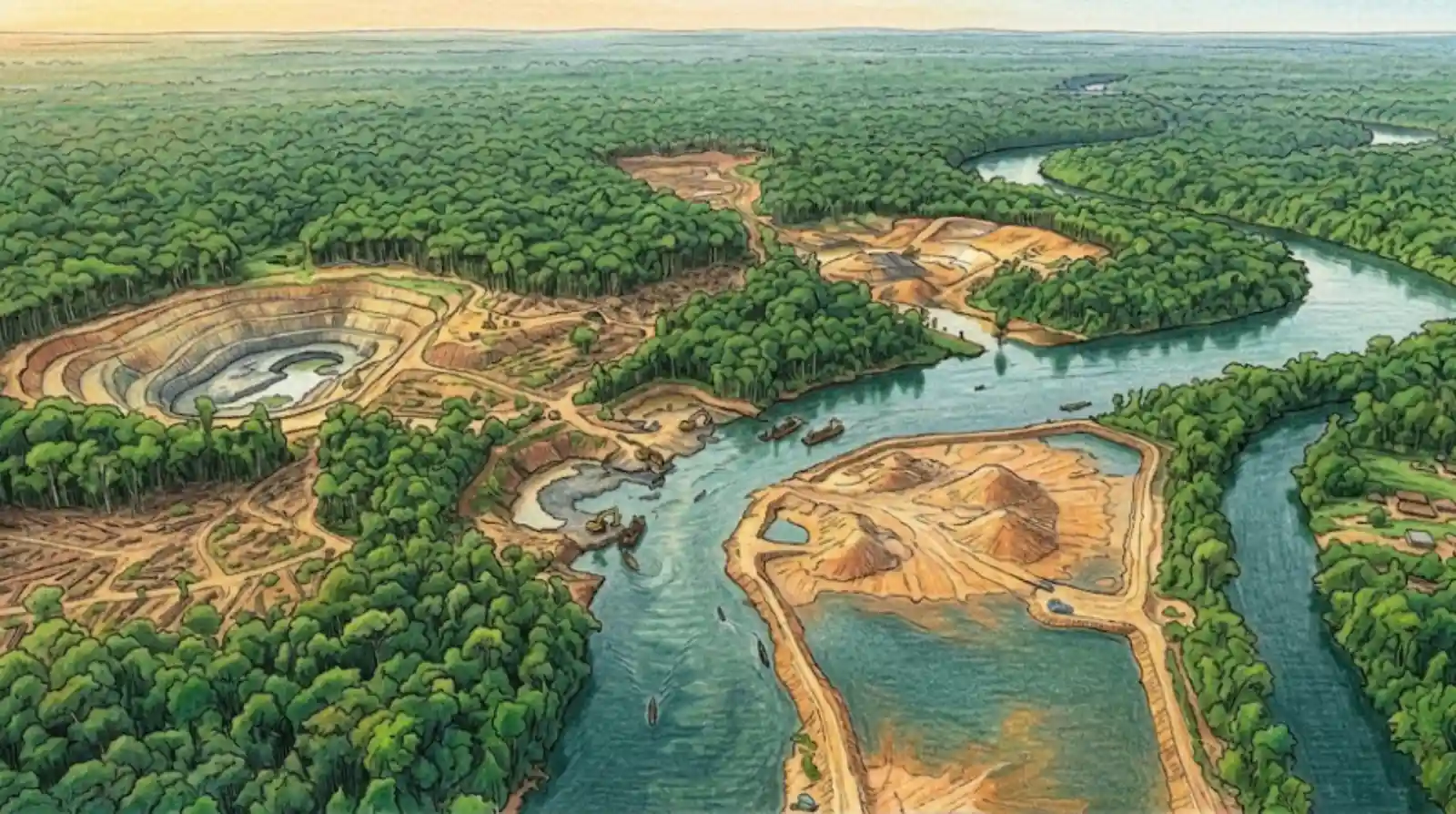
The Amazon holds the greatest freshwater fish biodiversity on the planet and works as a river circulatory system that regulates the climate of the entire South American continent. That biological balance, built over millennia, rests on two conditions now under direct pressure: the purity of the sediments and the stability of the riverbanks. When a riverbed is churned up, the turbidity of the water blocks the photosynthesis of algae, the base of the food chain, and sets off a domino effect that runs from microorganisms to large predators and to the human populations that depend on that protein.
The advance of gold extraction across Amazonian riverbeds, therefore, does not fit inside a purely economic debate. The rising value of the metal on international markets puts unprecedented pressure on a sensitive ecosystem, and that pressure translates into direct interference in the geology and the biology of the forest. Grasping the full complexity of the impact requires steady monitoring of extractive activity through public bodies such as Ibama, the Brazilian institute responsible for environmental oversight.
A churned riverbed loses its nurseries
Studies indicate that large scale earth moving alters the natural course of the igarapés, the small water channels that branch through the forest, and destroys the natural nurseries of endemic species. This is one of the most delicate points of the whole problem: those channels work as birthing rooms for aquatic fauna, and without them the replacement of fish stocks is interrupted. Science recognises that the recovery of an area of alluvial forest degraded by mineral extraction can take decades, such is the complexity of the interactions between soil, tree roots and the flood regime.
In the Xingu region, biodiversity faces significant structural challenges. The proposal of large mining interventions, such as the Volta Grande project, carries the risk of substances such as cyanide being used in industrial processes. Consolidated biological knowledge does point to nature’s capacity for regeneration, yet that resilience has clear limits, and nothing guarantees that a river system will return what it lost once the threshold has been crossed.
The integrity of a river such as the Xingu is essential to sustain the humidity that feeds the so called flying rivers, air masses loaded with water vapour that guarantee the rains of the Centre West and the Southeast of Brazil. What happens on the bed of an Amazonian tributary, in other words, can be read later in the rainfall regime of regions thousands of kilometres away.
Public health and food security
The impact of extractive activity also reaches the health of local populations. Biology teaches that certain elements, when introduced artificially into the aquatic environment, enter the trophic chain through bioaccumulation: they concentrate inside organisms and climb from level to level until they arrive at the plate of the people who fish. That means the conservation of the Amazon is not an isolated question of protecting trees, but a matter of food security and global public health. Keeping the forest standing is the most advanced technology available to guarantee rainfall stability and the fertility of Brazilian agricultural soils.
Watching over the headwaters of Roraima
In Roraima, on the lands that make up Raposa Serra do Sol, constant vigilance is needed to protect the headwaters of the rivers. Public policies for climate and the environment, often coordinated by the Brazilian Ministry of Environment and Climate Change, are crucial to that protection. Science recognises that the contamination of springs compromises the whole stretch of river below them and affects fauna and flora in a systemic way. The presence of mining infrastructure inside conservation areas also changes the behaviour of wild fauna, which frequently abandons its original ecological niches in search of refuge, unbalancing seed dispersal and the natural regeneration of the forest.
Bioeconomy and territorial rights as an answer
Sustainability in the Amazon demands a transition towards economic models that value ancestral knowledge and biotechnology. Positive impact journalism seeks to show that viable alternatives exist in the bioeconomy, where the forest is worth far more for its ecosystem services than for the finite exploitation of its mineral resources. Strengthening environmental protection networks, supporting the communities that guard the territory and securing indigenous land rights, a central agenda of the National Foundation of Indigenous Peoples (Funai), are effective strategies to mitigate the damage of the gold rush.
Amazonian biodiversity works as a giant genetic database that science is only beginning to decode. Every plant or animal species that loses its habitat represents a lost opportunity for a cure or for a technological innovation. Protecting those territories against predatory logic is, as a result, an investment in the future of humanity. The economy has to serve life rather than the other way round, so that coming generations inherit a functional and biodiverse world.
The water the forest pumps every day
The hydrological system of the Amazon is one of the most vital gears in the Earth system. It works through a process called evapotranspiration, in which the trees of the forest pump trillions of litres of water into the atmosphere every day. That humidity forms the flying rivers that cross the continent. When mining and gold digging advance, they do not merely destroy the local vegetation: they compromise the quality of the water in circulation. Excessive sedimentation in the rivers kills freshwater corals and impairs the breathing of fish through their gills.
Each of those effects is easy to describe on its own and hard to contain once they combine. A river that loses light loses its algae, a river that loses its algae loses the fish that feed on them, and an alluvial forest that loses its flood regime loses the roots that hold the bank in place. That is the sequence behind the warning that resilience has clear limits: not one catastrophic event, but a series of small ruptures that arrive at the same destination.
Science also recognises that removing the vegetation cover alters the albedo of the region, changing the way the soil absorbs heat and affecting the local microclimate. Preserving the Amazon basin is fundamental to avoid the point of no return, the moment at which the forest would stop producing its own rain. Keeping the biological balance of this ecosystem is what guarantees that the cycle of life will go on sustaining agriculture, energy generation and the water supply of large urban centres.
Any vision of development for the region needs to align itself with these unquestionable biological facts, prioritising regeneration and the intelligent use of biodiversity instead of an extraction that leaves behind only a trail of mud and the loss of natural heritage. The Amazon is a living organism, and every drastic intervention in its body is reflected in the health of the whole planet, which demands an attitude of respect and care that goes beyond the immediate interests of the market.
The precious metal piled up in distant vaults will never replace the purity of a water source or the shade of a centuries old Brazil nut tree, the Bertholletia excelsa that structures much of the life around it. The true wealth of the Amazon flows through its veins of water and beats in the diversity of its peoples, a reminder that life is the only asset that accepts no substitutes.
Reporting: Anne Silva / Amazonia Mag. Source: Revista Amazônia, with information from Ibama, the Brazilian Ministry of Environment and Climate Change and Funai.

Editor · Amazonia Mag
Anne Silva is the editor of Amazonia Mag, the English-language edition of Revista Amazônia. She curates, translates and adapts the outlet's science and environment coverage for an international audience, reporting on Amazon wildlife, flora, rivers, climate and research. Every story she edits is grounded in peer-reviewed studies, official data and on-the-ground reporting from the Revista Amazônia newsroom in Belém, Pará, Brazil. More by Anne Silva →