
Mining leaves a heavy mark on the land. In the Carajás region of Pará, in the Brazilian Amazon, an area of great industrial and social importance, large mining complexes have reshaped the ground, and recovering that ground is one of the region’s long-term challenges.
Researchers from the Vale Technological Institute (ITV) and partner universities have been studying a small native plant that could help. It is Crotalaria maypurensis, known in Portuguese as crotalária-da-canga, a species that belongs to the Carajás landscape itself.
A native plant in a field dominated by a foreign one
The crotalarias are already widely used to recover soil in Carajás. The species most often chosen is an exotic one, Crotalaria spectabilis, which is not native to the region and is the one most commonly sold. Its popularity comes with a question that few studies had asked: could a native crotalaria do the same job?
The ITV team set out to answer that. According to the researchers, this is one of the few studies that compares a native crotalaria with a commercial one for use on mined land. The results were published in the Journal of Forestry Research.
How the two species were compared
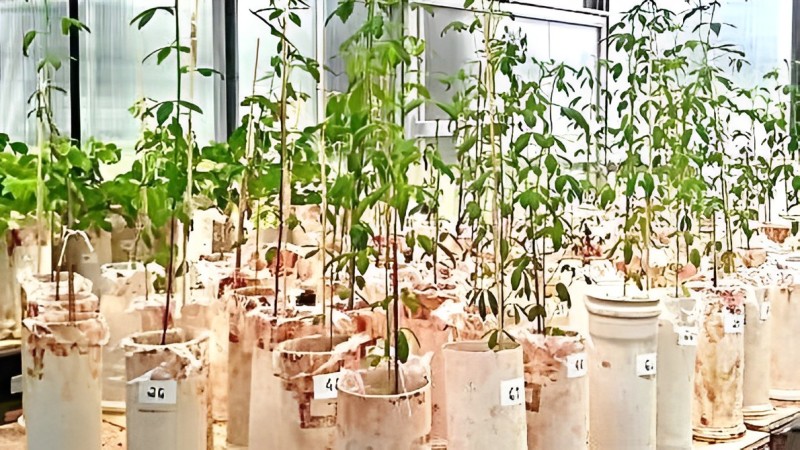
The experiment compared the effects of mineral and organic fertilization on the growth of the two crotalarias, and on their carbon and nitrogen metabolism. These are the processes by which a plant builds its tissues and uses the nutrients that are scarce in poor soil, so they offer a good picture of how well a species can establish itself.
The plants were established in an iron mine area in Carajás, and six types of fertilizer were tested on the samples. Using real mine ground, rather than a greenhouse substrate, makes the results far more relevant to the people who plan restoration in the field.
Comparing mineral and organic fertilization also matters in practice. Mineral and organic inputs are different ways of supplying nutrients to poor ground, and knowing how each species responds to them helps restoration teams decide what to apply, and where, when they plan to cover a degraded area.
The team measured two things at once: how much each species grew, and how each one handled carbon and nitrogen. Looking at both growth and metabolism helps reveal not only which plant gets bigger, but also why.
What the results showed
The findings showed that the local species performs comparably to the exotic one at covering the soil, and the exotic one is the more commercialized of the two. In the comparison, the exotic crotalaria tended to accumulate more biomass, yet the native species grew well enough to be considered a real alternative.
Researcher Silvio Junio Ramos, of ITV, explained what the two plants have in common: “Both species grow quickly and produce seeds, which are important criteria for selecting species to recover mined areas.”
Fast growth matters because bare ground needs cover quickly. Seed production matters because a plant that sets seed can spread and renew itself after it is established. Together, the two traits explain why crotalarias are used in recovery work, and why the native species deserves a place alongside the exotic one.
Why choosing a native species matters
The use of Crotalaria maypurensis may bring more benefits from an environmental point of view, because it shows greater tolerance to local conditions. A native plant has been shaped by the same climate and soils that it is asked to restore, and that familiarity is an advantage in a project that depends on the plants surviving.
There is also a social benefit. The native species can generate more income for seed collectors, who are organized in cooperatives in the region. Because the native species can be collected in the region, part of the value of recovery work can stay in the hands of the people who live there.
The choice of species therefore touches several layers of a restoration project at once: how well the plants establish themselves, how they fit the local environment and who benefits from the work. A plant that scores well on all three is more valuable than one that performs well on only one.
This combination is what makes the research stand out. It treats land recovery as both an ecological task and an economic one, and it asks which plants can serve the soil and the communities at the same time.
More research to match a varied landscape
Ramos stresses the need for more studies on the use of native species to recover mining areas in Carajás, taking into account the diversity of the soils’ composition. A species that thrives on one kind of mine ground may not do the same on another, so the answers need to be tested across the different conditions that mining leaves behind.
“We must keep investing in the recovery of areas affected by mining and look for answers and alternatives for greater efficiency of this process in this region, which has great industrial and social importance in the Amazon,” Ramos concludes.
For now, the work offers a clear starting point. A small native legume with fast growth, abundant seeds and a good fit with local conditions has shown that it can stand beside the exotic species most used today. If further studies confirm it across more soils, Crotalaria maypurensis could become a regular tool for recovering the land that mining has opened in the heart of the Amazon.
Reporting: Revista Amazônia newsroom / Amazonia Mag

Editor · Amazonia Mag
Anne Silva is the editor of Amazonia Mag, the English-language edition of Revista Amazônia. She curates, translates and adapts the outlet's science and environment coverage for an international audience, reporting on Amazon wildlife, flora, rivers, climate and research. Every story she edits is grounded in peer-reviewed studies, official data and on-the-ground reporting from the Revista Amazônia newsroom in Belém, Pará, Brazil. More by Anne Silva →