
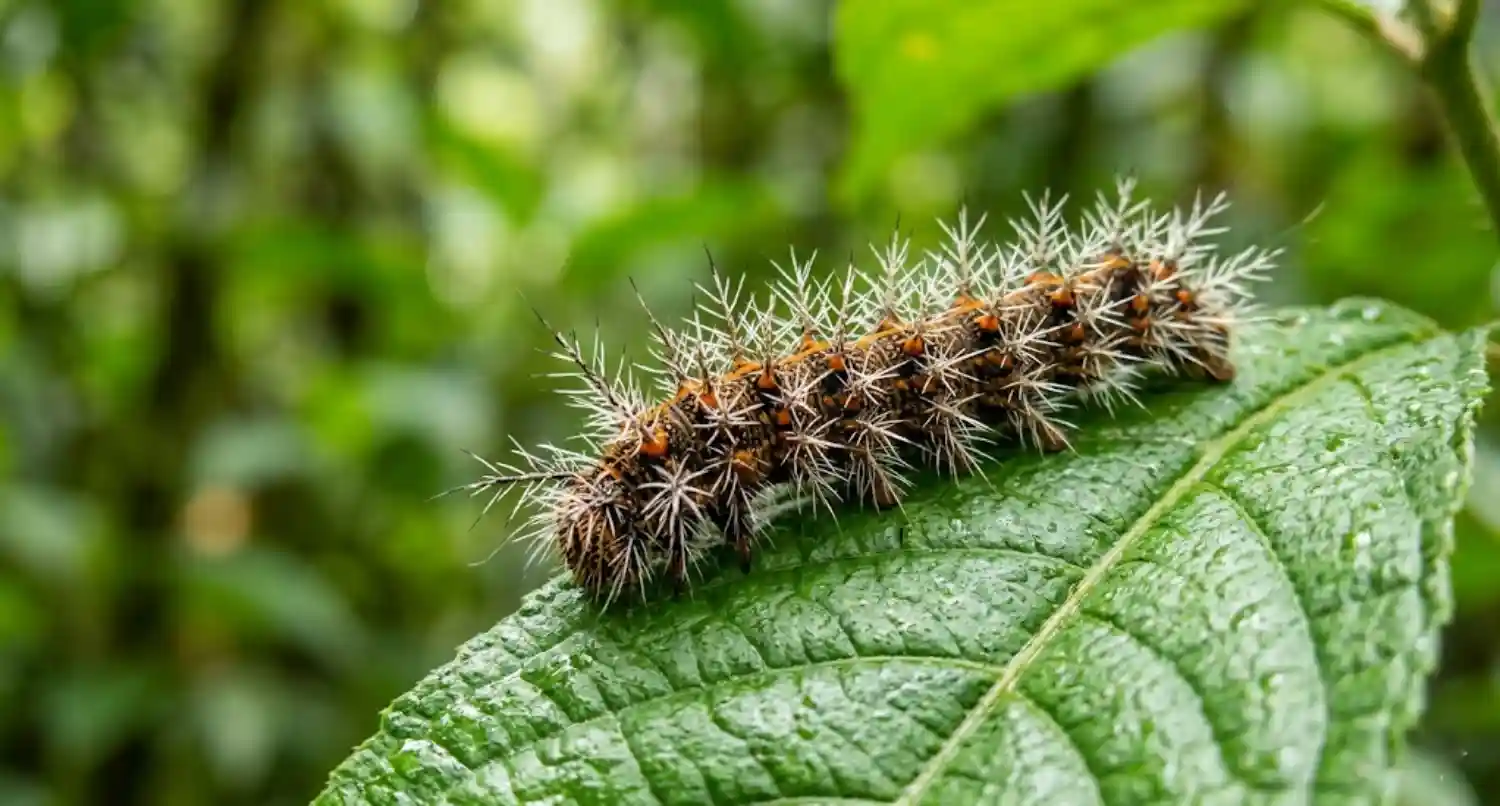
Deep in the Amazon, some of the most sophisticated defence systems belong to the smallest animals. Among the dense foliage and the vivid green of the forest live the stinging caterpillars known in Brazil as fire caterpillars, insects that carry a biological protection system driven by physical pressure and capable of injecting potent toxins into human skin. What happens after contact is not an ordinary allergic reaction. It is active envenomation, in which hollow bristles behave like hypodermic microneedles ready to fire at the slightest touch.
A miniature injection system
Contrary to a widespread belief, the burning sensation does not come from brushing against external chemicals sitting on the surface of the animal. The defence system of these lepidopterans is built around structures called scoli: branched, sharply pointed bristles connected directly to venom glands located at the base of the caterpillar’s body. Each branch works, in practice, as a loaded reservoir waiting for a mechanical stimulus to release what it holds.
When a predator or a human hand presses those bristles, the tip breaks and the toxic fluid is injected by capillary action and mechanical pressure, reaching the deeper layers of the dermis within milliseconds. That speed explains why the pain is immediate, and why rubbing the area makes the situation worse: the movement snaps more bristles and multiplies the entry points of the venom.
Lonomia obliqua and the risk of bleeding
Within the vast scenario of Brazilian biodiversity, Lonomia obliqua stands out as the most dangerous species for public health because of its haemorrhagic potential. While other caterpillars cause only local pain and redness, the venom of Lonomia carries enzymes that interfere directly with the blood clotting of the affected person. Studies carried out by research institutes show that the severity of an accident depends on the contact area and on the number of spines that penetrated the skin, and that the condition can progress to systemic effects when there is no proper treatment with the specific serum.
The species is the subject of intense research at Instituto Butantan precisely because of its unique ability to cause haemorrhagic syndromes. The serum produced in Brazil is a global benchmark and saves hundreds of lives every year. An accident involving this animal is considered a medical emergency and requires immediate hospital monitoring.
Learning to spot them first
For anyone living in or passing through forested areas and gardens, visual identification is the first effective line of defence. Fire caterpillars usually display striking colours such as lime green and orange, or patterns that resemble small pine trees, a visual warning that the ecosystem reads clearly. Recognising that pine pattern on green or greyish bristles is the best way to avoid contact with this highly dangerous animal.
During the day they tend to gather on tree trunks, mimicking the texture of the bark to escape birds. The same camouflage turns them into an invisible hazard for the rural worker and for the distracted visitor who reaches out for support on a tree without checking where the hands land.
What to do after contact
Knowing how to react after touching a stinging caterpillar is crucial to minimise the damage and the prolonged pain. The essential first step is to wash the affected area exclusively with cold running water, without rubbing the skin, so that the bristles still lodged there are not broken any further. Cold compresses help promote vasoconstriction, which slows the absorption of the venom and offers palliative relief for the intense pain, which can last for several days.
It is important to stress that home remedies, such as abrasive substances or urine, must be avoided entirely, since they can cause secondary infections and mask the real symptoms. The standard medical recommendation is to seek a health unit immediately, preferably taking a photograph of the animal, or the specimen itself carried safely, so that it can be identified. Health professionals may prescribe antihistamines and painkillers and, in cases involving Lonomia obliqua, the antilonomic serum, which is the only way to reverse the effects of the toxin in the blood.
Predator food and pollinator parent
The existence of these animals should not be met with fear, but with the respect that the complexity of wildlife demands. They play a vital ecological role as part of the diet of many birds and wasps, and they are the larval stage of moths that are essential for pollinating several plant species in the forest.
Preserving their natural habitat is what keeps that balance in place and prevents them from seeking shelter in backyard orchards and urban areas, where encounters with people become inevitable and dangerous. Distance, in this relationship, is a form of protection for both sides.
Venom as a research frontier
Biotechnology has also turned its attention to these toxins with considerable scientific interest for the development of new medicines. Substances found in the venom of these caterpillars are being studied for the creation of anticoagulant drugs and even for cancer treatments, proof that what hurts us may also hold the key to curing complex diseases. The living forest is an open air laboratory offering solutions to humanity, as long as we learn to coexist with its rules and with its natural protection systems.
Every walk into nature is a visit to a world governed by survival rules that have been in place for millions of years. Paying full attention on a trail or while tending a garden is not only a safety measure. It is an exercise in connection and humility before a piece of biological engineering of remarkable precision. Once we understand that the danger lies in not knowing, apprehension turns into conscious vigilance, and it becomes possible to admire the beauty of these life forms without interfering with their space.
Knowledge about the species that share our own backyard remains the most powerful tool to keep the relationship between people and Brazilian biodiversity safe and thriving.
Reporting: Anne Silva / Amazonia Mag. Source: Revista Amazônia, with information from research institutes and Instituto Butantan.

Editor · Amazonia Mag
Anne Silva is the editor of Amazonia Mag, the English-language edition of Revista Amazônia. She curates, translates and adapts the outlet's science and environment coverage for an international audience, reporting on Amazon wildlife, flora, rivers, climate and research. Every story she edits is grounded in peer-reviewed studies, official data and on-the-ground reporting from the Revista Amazônia newsroom in Belém, Pará, Brazil. More by Anne Silva →