
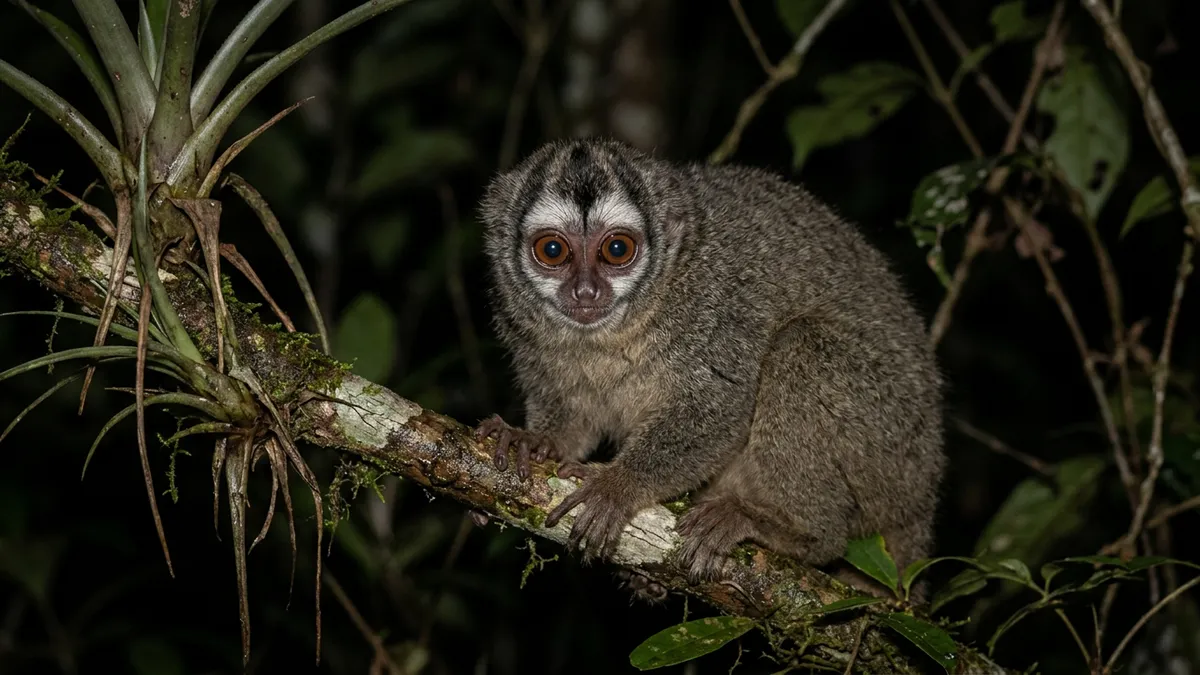
When the light disappears, the owl monkey depends less on color and more on its ability to collect every small amount of available illumination. Its eyes are large in proportion to its face, a trait that widens the intake of light and helps form images in nighttime conditions. The animal belongs to the group of owl monkeys, known scientifically as Aotus, and it is considered the only truly nocturnal primate in the Americas. That routine sets it apart from many other primates, which concentrate their activity in the daytime or in the transition between light and dark.
The adaptation is not only in the size of the eyes. The retina of the owl monkey is dominated by rods, cells specialized in sensing brightness and movement when lighting is low. In exchange, trichromatic vision was lost, the ability that lets an animal tell apart a wide range of color combinations. The result is a visual perception better suited to darkness but less geared to separating hues. It is not an accidental deficiency but a sensory setup tied to the animal’s nocturnal way of life.
The retina favors brightness and does without trichromatic vision
Rods work as low-light sensors. They are far more efficient than cones, the cells linked to color vision, when the environment grows dark. A rod-dominated retina lets the owl monkey make use of faint visual signals, locate shapes and follow movement during the hours when most primates would struggle to see. This organization helps explain how the animal can keep an active life at night without relying on sunlight.
The adaptation, however, involves a functional trade-off. By losing trichromatic vision, the owl monkey no longer has the same ability to tell colors apart that daytime primates have. Visual information comes to favor brightness, outline and movement.
The large eyes help in that process, but there is no tapetum, a reflective layer present in other nocturnal animals that sends part of the light back to the retina. Even without that structure, the combination of broad eyes and a large number of rods supports vision in dim light.
The couple stays together and the male carries the infant
Night life is not the only thing that sets the owl monkey apart. The animal forms a monogamous pair, an association in which the two adults stay bonded in raising the infant. In this arrangement, the male carries the youngster during much of the parental care. Carrying brings the infant close to the father’s body and frees the female from a task that, in many mammals, falls mostly on her. For an observer, the scene is one of the most concrete marks of the species’ behavior.
Paternal care also changes the common image of a nocturnal primate that simply moves alone through the dark. The relationship among the adults and the infant involves contact, coordination and recognition within a family group. The monogamous pair is not just a reproductive unit but the core of the animal’s routine.
A male carrying the infant shows that the survival of the young depends on a division of tasks, while the family finds its way by visual and sound signals in an environment where identifying things by color is of little use.
Low calls help keep contact in the dark
Because vision is limited by the lack of light, sound communication gains importance. The owl monkey produces low-frequency vocalizations, deep sounds that take part in communication among individuals. Communication no longer depends only on what the eyes can detect.
This combination of senses organizes the animal’s routine. Large eyes capture the little light there is, rods register brightness and movement, and deep calls allow members of the pair or the family group to exchange signals. None of these elements works alone.
Reduced color vision does not mean an absence of perception, just as a nocturnal life does not mean silence or isolation. The owl monkey brings together different sensory and behavioral solutions to stay active after dusk.
What is known, and what should not be overstated
The description of the owl monkey as the only truly nocturnal primate of the Americas should be read in the ecological sense in which it is given, without turning the phrase into a claim about every animal with nocturnal habits on the continent. The central point is that Aotus combines a markedly nocturnal routine, large eyes, a rod-dominated retina and the loss of trichromatic vision.
It would also be wrong to say that the animal sees perfectly in the dark. Rods increase sensitivity to dim light, but they do not remove the limits imposed by the absence of illumination.
Another caution concerns the link between each trait and the evolution of the behavior. Nocturnal life is associated with the specialized retina, but a detailed evolutionary history is not yet known, nor is it known when trichromatic vision was lost.
A sensory solution that also reorganizes the family
The species should not be reduced to a photograph of big eyes. Its visual mechanism shows how night activity selects priorities different from those found in daytime primates. Perceiving faint light and movement can matter more than separating colors, while deep calls help preserve contact among individuals.
At the same time, the family behavior shows that an adaptation to darkness does not end with anatomy. The male who carries the infant, the monogamous pair and the low-frequency calls are all part of the same nocturnal routine. Color vision was reduced, but other ways of perceiving and staying connected gained ground.
In the owl monkey, seeing in the dark is not only a matter of eyes. It is a way of organizing travel, communication and care around the night.
Reporting: Natália Santos / Amazonia Mag

Editor · Amazonia Mag
Anne Silva is the editor of Amazonia Mag, the English-language edition of Revista Amazônia. She curates, translates and adapts the outlet's science and environment coverage for an international audience, reporting on Amazon wildlife, flora, rivers, climate and research. Every story she edits is grounded in peer-reviewed studies, official data and on-the-ground reporting from the Revista Amazônia newsroom in Belém, Pará, Brazil. More by Anne Silva →