
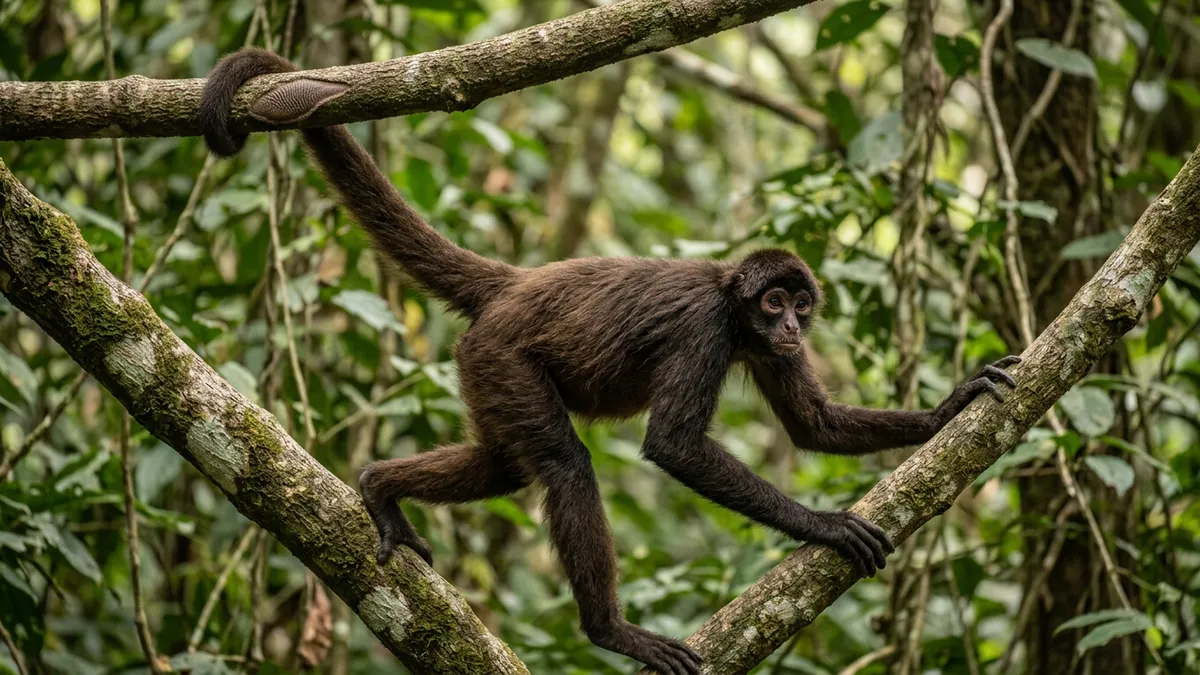
A spider monkey can look as if it hangs only from its arms as it crosses the canopy, but the tail takes an active part in that travel. Prehensile, it coils around branches and gives an extra point of support while the animal moves its body between the structures of the tree. That role explains the comparison with a fifth hand, although the tail is not a limb with fingers and does not replace the arms in every task.
The movement combines long arms, support on the branches and the ability to grip with the tail. Instead of relying only on its hands to advance, the primate keeps part of its weight anchored to the vegetation and frees its limbs to reach another point. The strategy is especially useful in locomotion between branches, where balance, reach and firmness all have to work together. The tail is not an isolated detail of the body. It is part of the system that makes the crossing possible.
A bare tip increases contact with the surface
The end of the tail has a bare area, without the cover of hair found on other parts of the body. This exposed region has grooves, marks that can resemble a fingerprint when seen up close. The likeness is only visual. What matters for travel is the texture formed by the grooved surface and its direct contact with the branch.
When the tip wraps around a structure, the bare, grooved area helps increase friction. Friction makes it harder for the tail to slip, which helps keep the support in place while the spider monkey reaches for another branch.
The function does not depend on a suction cup or on some supernatural stickiness. It results from contact between a specialized surface and the substrate, through a combination of pressure, shape and texture. The grooves, in short, play a mechanical role in how the tail is used.
The functional thumb is not part of this solution
Another feature helps explain why the tail matters so much: the spider monkey has no functional thumb. The absence reduces the ability to form a grip like that of primates that close the hand around an object with an opposable thumb. That does not stop the animal from using its arms, but it changes how it supports itself and moves through the vegetation.
Instead of concentrating all its security in the hand, the spider monkey combines its arms with the prehensile tail. The bare, grooved end offers a complementary way to hold the body in place while the forelimbs reach for the next support. Locomotion therefore depends on a division of labor among different structures. The hand does not have to do the work of grabbing, stabilizing and allowing forward motion all at once.
Travel happens as a sequence of supports
A route through the branches can be understood as a sequence of coordinated movements. First, the tail fastens part of the body to a structure. Next, the arms reach another point in the canopy and carry the progress forward. When the new support is secure, the tail can change position and repeat its function on another branch. The result is a way of moving that uses the four limbs and the tail in an integrated way.
This sequence also reduces dependence on a single support. If the hands were always busy holding up the body, every change of direction would call for a more limited reorganization. With the tail acting as an anchor point, the arms are free to look for distance and continuity along the path.
None of this means that all movements are the same or that the tail holds the animal up in every situation. The function varies with the branch, the position of the body and the need to move on.
The same mechanism helps spread seeds
The tail does not serve only for locomotion. The spider monkey also acts as a seed disperser for large trees. By moving through the canopy and eating or carrying plant resources, the animal can take seeds away from the parent tree and help them reach other parts of the forest. The link to the tail lies in the travel that makes this circulation possible, not in any supposed role of the grooved tip on the seed itself.
Large trees depend on processes that carry their seeds beyond the area directly under the crown. An animal able to move among branches and cover different stretches of vegetation can take part in that natural transport.
Dispersal does not guarantee that every seed will germinate, because the establishment of a new plant depends on conditions at the site. Even so, the spider monkey’s role brings biomechanics and forest renewal together: the same structure that improves support during travel is part of the routine of a disperser.
What the fingerprint comparison really tells us
Calling the tip of the tail similar to a fingerprint helps picture its grooves, but it should not lead to a wrong reading. The region is not a complete extra hand, it has no fingers and it does not serve to identify the animal the way human fingerprints do. Its importance lies in the bare area, the texture and the ability to increase friction when the tail wraps around a branch.
The fact at hand is a functional adaptation of the spider monkey: the arms lead the locomotion, the prehensile tail reinforces support, the grooved tip improves contact, and the animal takes part in the dispersal of seeds from large trees. There is no dated event to record, only a bodily feature seen in the natural history of the species.
Looking at that tail, the forest stops seeming like a mere set of branches and begins to show a network of supports, movements and seeds in circulation.
Reporting: Natália Santos / Amazonia Mag

Editor · Amazonia Mag
Anne Silva is the editor of Amazonia Mag, the English-language edition of Revista Amazônia. She curates, translates and adapts the outlet's science and environment coverage for an international audience, reporting on Amazon wildlife, flora, rivers, climate and research. Every story she edits is grounded in peer-reviewed studies, official data and on-the-ground reporting from the Revista Amazônia newsroom in Belém, Pará, Brazil. More by Anne Silva →