
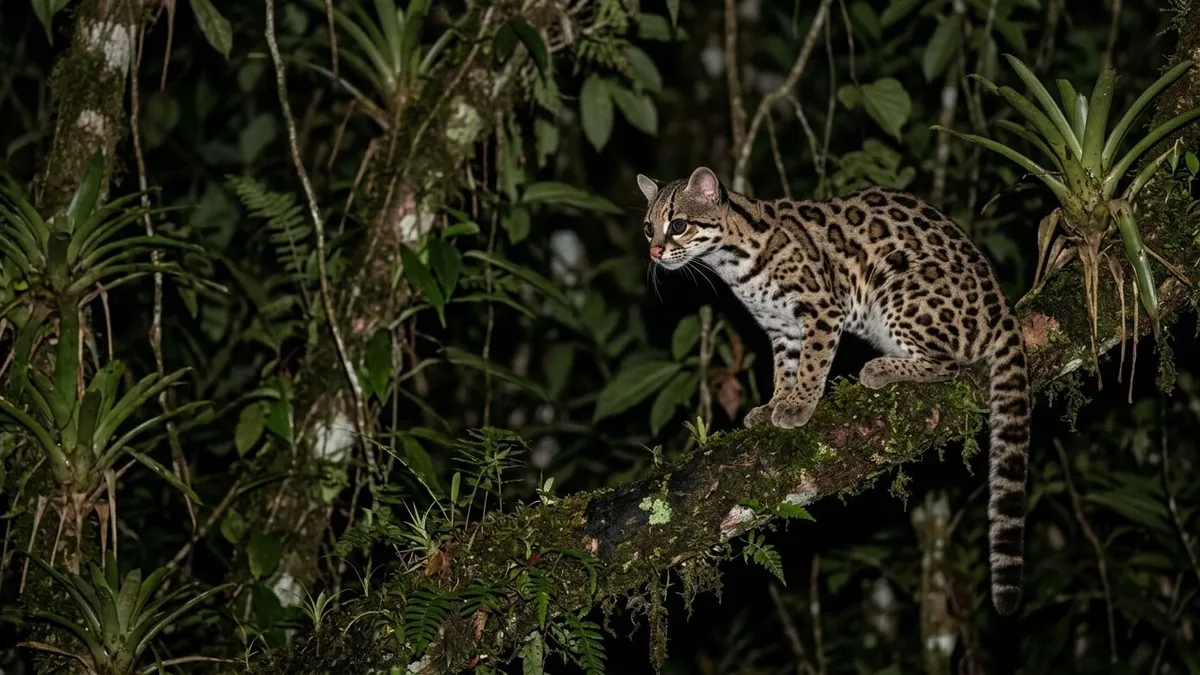
In the darkness of the Amazon forest, researchers recorded a scene that depended more on sound than on appearance. A margay made vocalizations similar to those of a baby monkey, drawing the attention of an adult female. The cat did not have to show itself right away. By reproducing a signal associated with the presence of an infant, it exploited the mother’s protective response and brought a possible prey closer to its hunting ground. The episode documented vocal mimicry in a predator that normally moves unnoticed among branches and leaves.
The margay, Leopardus wiedii, is a small, nocturnal, tree-dwelling cat found in forests of Central and South America, including the Brazilian Amazon. The scene recorded by the researchers shows an unusual behavior because it combines voice, location and a chance to attack. The call is not just a noise made during the hunt. It works as an imitation aimed at another animal, in a situation where the mother’s reaction can put the primate within reach of the predator. The record does not allow the conclusion that every individual of the species uses the same strategy.
The cat turns its own anatomy into an advantage among the branches
The margay hunts mainly at night, when its spotted coat helps break up the outline of its body in low light. The cat combines hearing, sight and silent movement to look for small vertebrates in the trees and on the ground. Compared with close relatives such as the ocelot, it is known for greater specialization in tree-dwelling life. That difference shows in how it uses branches, in the joints of its limbs and in its ability to control its body on sloping trunks.
One of its most striking features is the ankle, which can rotate so that the animal can descend a trunk headfirst. That position widens its routes for escape and approach, and it reduces the need to leap between unstable surfaces. Its paws and claws also help it grip the bark and keep its balance on the way down.
The margay can therefore approach nests, hollows and groups of primates from angles that other ground predators do not use as easily. Anatomy alone does not explain the call, but it sets the stage for the vocal imitation to be put to use.
The mimicry depends on the mother’s response, not on a foolproof trap
When a primate hears the sound of an infant, it may shift its attention, interrupt its search for food and look for the source of the call. That response gives the predator an opportunity, but it does not guarantee a capture. The monkey may recognize the inconsistency of the call, stay protected within the group or flee before the cat gets close. For that reason, the record should be understood as evidence of a hunting strategy observed in the field, not as proof that the margay always fools its prey.
The episode also helps separate an ordinary vocalization from mimicry. Many animals call to keep in touch, warn of danger, defend territory or find mates. In the case described, researchers identified a likeness between the sound made by the cat and the call of a baby monkey, followed by the approach of a mother. The sequence is the important part of the observation.
Even so, without a broad series of controlled records, it is not possible to measure how often the tactic is used, to tell whether it is learned or innate, or to determine how long each cat needs to perfect it. The safest hypothesis is that the behavior raises the chance of drawing in vulnerable prey.
A white mark, a vertical forest and information that is still limited
Besides its voice, the margay has a visual signal associated with communication between individuals. Behind each ear there is a white ocellus, a marking that can be noticed when the animal moves its head or changes position among the vegetation. Marks of this kind are studied as possible signals of contact or recognition, although their exact function may vary with distance, lighting and social context.
The ocellus should not be mistaken for an extra eye, and it has no proven direct link to the imitation of a monkey’s call.
The field record was made by researchers in the Amazon and reported as documentation of vocal mimicry in the margay. Even though the scene does not allow generalizations, it broadens the understanding of how a predator can combine anatomy, silence, nocturnal life and acoustic communication.
What the record adds to the picture of the margay
Taken together, the pieces fit a coherent portrait. The margay is a nocturnal cat built for life among the branches, with a coat that breaks up its outline, limbs that let it handle sloping trunks and an ankle that turns for a headfirst descent. To that physical toolkit the record adds a behavioral one: a voice that can resemble the call of a young monkey.
None of these traits is a guarantee of success. Each one simply raises the odds in a setting where every approach is a gamble. A monkey group that stays alert, or a mother that is not fooled, can end the attempt at any moment. What the observation shows is that the margay has more than one way of closing the distance, and that sound can be as useful to a hunter as stealth.
In the forest, survival does not depend only on being fast or strong. Sometimes it depends on making the right sound at the moment another animal decides to investigate.
Reporting: Natália Santos / Amazonia Mag

Editor · Amazonia Mag
Anne Silva is the editor of Amazonia Mag, the English-language edition of Revista Amazônia. She curates, translates and adapts the outlet's science and environment coverage for an international audience, reporting on Amazon wildlife, flora, rivers, climate and research. Every story she edits is grounded in peer-reviewed studies, official data and on-the-ground reporting from the Revista Amazônia newsroom in Belém, Pará, Brazil. More by Anne Silva →