
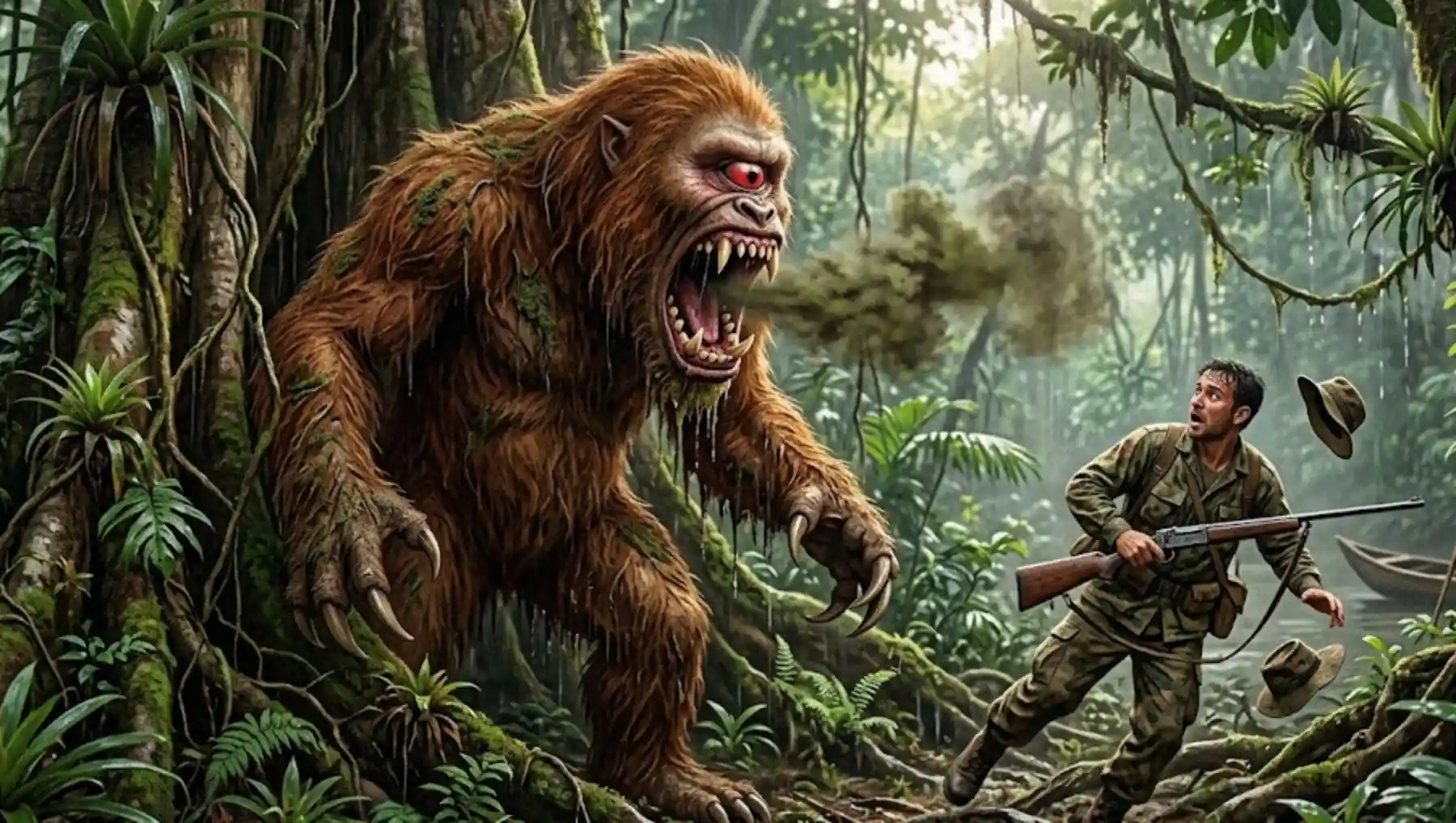
Deep in the Amazon rainforest, where sunlight barely reaches the ground through the canopy of giant trees, lives one of the most imposing figures in Brazilian folklore: the Mapinguari. Riverside communities and Indigenous peoples have carried the story down through generations as the true guardian of the forest. Unlike other legendary beings whose only job is to frighten, the Mapinguari has a specific mission inside the narrative: to protect biodiversity from plunder, to punish hunters who kill more than they need, and to drive off intruders who destroy the vegetation.
It is worth stating plainly in the opening lines: the Mapinguari is a figure of oral tradition. There is no scientific record confirming that such a creature lives in the forest. What does exist, and it is considerable, is the cultural force of the story and the real effect it has on how people behave in the woods. That effect can be observed in daily practice, even though the character itself belongs entirely to the realm of myth.
How the storytellers describe it
The description shifts subtly from one part of the Amazon to another, but certain traits repeat with striking consistency. The creature is described as enormous, capable of standing more than two metres tall, covered in thick reddish fur that many narrators compare to the bark of old trees. Some accounts give it a single central eye, cyclops fashion, and hooves turned backwards, a detail that exists in the story to explain why its tracks can never be followed in the right direction.
The most memorable feature, however, is not visual but olfactory. The Mapinguari smells. It smells terrible. The accounts describe a mixture of rotting flesh and spoiled garlic that can be sensed kilometres away and that paralyses its victims through disgust before fear even arrives. Within the internal logic of the legend, the stench works as both a warning and a weapon: whoever catches it still has time to turn back, and whoever ignores it no longer has an exit. It is an elegant narrative device, because it turns the monster into an alarm that arrives before the encounter does.
A code of conduct told as a story
The legend of the Mapinguari is not merely a tale for scaring children around a fire. It carries a deep social and ecological function inside Amazonian culture. In a territory where state law often fails to arrive with any real force, beliefs and myths operate as ethical codes for living alongside nature. Fear of the guardian installs an almost religious respect for the forest. Traditional hunters know they must not take pregnant females or young animals, and that they must never remove more from the forest than the family needs to survive, at the risk of drawing the guardian’s fury.
Read this way, the Mapinguari is the personification of nature’s revenge. It is the symbolic answer to deforestation, illegal burning and biopiracy. The figure of the foul smelling guardian is a standing reminder that the forest is not an infinite resource and that its invisible laws weigh as much as the written ones. Conservation work carried out by institutions such as Instituto Mamirauá and Instituto Socioambiental often finds an echo and a foothold in these ancestral beliefs, which encourage sustainable management of natural resources. This is not decorative folklore. It is governance delivered in the form of a story.
The giant ground sloth hypothesis
Although it remains firmly a figure of oral tradition, the Mapinguari attracts the interest of a peculiar field: cryptozoology. Some researchers and enthusiasts suggest that the legend may have been inspired by giant ground sloths, prehistoric animals of the genus Megatherium that inhabited the region and were contemporaries of the first human groups there. The physical description of the character, with its great size, thick fur, enormous claws and upright posture, bears notable similarities to palaeontological reconstructions of those animals.
Precision matters here, because this is exactly the point where popular narrative and scientific work touch each other without merging. This is a hypothesis, not a finding. There is no consolidated scientific evidence proving that giant ground sloths survive in the Amazon today. No specimen, no body and no verifiable record has ever been presented. Cryptozoology, moreover, is not an established discipline within biology, and its proposals do not carry the weight that conclusions from palaeontology or zoology do.
Cultural memory is not the same thing as proof
What the hypothesis actually suggests is something more subtle, and in some ways more interesting, than the hunt for a hidden animal. It suggests that the legend might preserve the memory of an animal that genuinely existed and then went extinct, carried orally across thousands of years until it turned into something else entirely. If that were the case, the Mapinguari would not be a living creature but a very long memory, distorted and reworked by generations of storytellers. It is an appealing idea, and it remains, to this day, an idea without confirmation.
The persistence of the story and the anatomical precision of the details described by local communities keep the debate alive. Whether it is the ancient memory of an extinct animal or a purely mythological creature, the Mapinguari continues to exert a real influence over human behaviour inside the forest. That influence is the verifiable part of this whole account: not the creature, but its effect. Treating this knowledge as mere superstition would be a misreading, because the body of understanding that Amazonian peoples hold about cycles, animals and the limits of the forest is precise, practical and far older than any manual.
From the forest to the classroom
The figure of the Mapinguari has travelled well beyond the limits of the forest and now occupies a meaningful place in contemporary Brazilian culture. It appears in literature, in the visual arts and in audiovisual productions, frequently reinterpreted as a symbol of ecological resistance. Environmental education projects in schools across the Amazon region use the legend as a teaching tool, showing children why respect for nature and sustainability matter. Rather than a monster, the Mapinguari is presented there as a defender of life, a powerful metaphor for the need to keep ecological balance.
Valuing the Mapinguari and other Amazonian legends is essential to preserving Brazil’s cultural diversity. These stories are part of the identity of forest peoples and they offer a distinctive perspective on the relationship between people and the natural world. The documentation and dissemination work carried out by museums and cultural centres helps ensure that this oral tradition is not lost as urbanisation advances and cultural homogenisation spreads.
There is also a lesson here for anyone who writes about science for a general audience. A story can be culturally true and factually unverified at the same time, and the honest way to handle it is to say exactly which part is which. The Mapinguari is not an animal awaiting discovery. It is a narrative with a real job to do, and the scientific speculation attached to it is a separate question that has never been settled.
The legend teaches something that no regulation achieves on its own: that respect can also rest on a shared story, and that the communities living with the forest built their own instruments for looking after it long before the word sustainability existed. The giant, foul smelling guardian does not walk through the rainforest, but the idea of a guardian still walks through the minds of the people who live there, and in conservation terms that is not a small thing.
Reporting: Anne Silva / Amazonia Mag. Source: Revista Amazônia.

Editor, English Edition — Amazonia Mag
Anne Silva is the editor of Amazonia Mag, the English-language edition of Revista Amazônia. She curates, translates and adapts the outlet's science and environment coverage for an international audience, reporting on Amazon wildlife, flora, rivers, climate and research. Every story she edits is grounded in peer-reviewed studies, official data and on-the-ground reporting from the Revista Amazônia newsroom in Belém, Pará, Brazil. More by Anne Silva →