
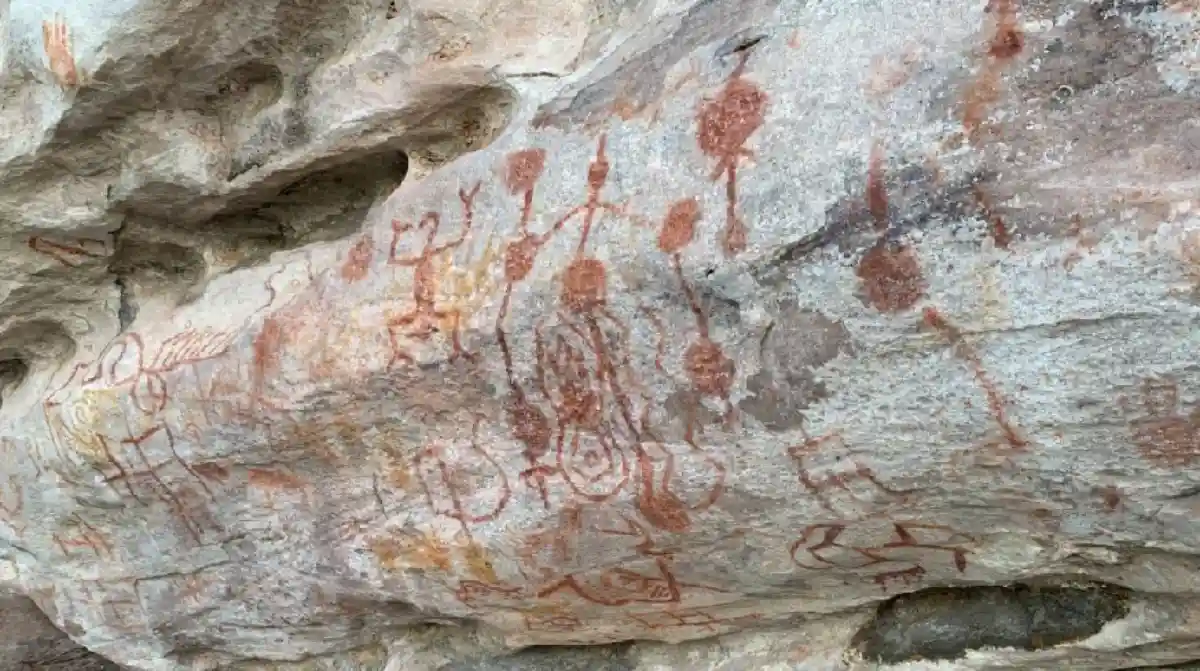
In the north of the Brazilian state of Pará, on the left bank of the Amazon River and inside the Lower Amazon region, Monte Alegre State Park holds some of the strongest evidence that the Amazon rainforest was never an empty land. Its sandstone cliffs preserve rock paintings tied to a human occupation that goes back more than 11,000 years, placing this stretch of the Brazilian Amazon among the oldest and most important archaeological sites anywhere in the Americas. Far from the familiar picture of a pristine and untouched forest, the rock walls of the park work as open air galleries, places where the first inhabitants of the continent recorded their view of the world in vivid tones of red and ochre.
Serra da Lua, an ancestral gallery under Amazon light
The geological formation known as Serra da Lua is the heart of archaeological tourism in Monte Alegre. Its sandstone faces carry a remarkable concentration of pictographs that have survived for thousands of years thanks to the natural shelter of the relief and to the stable composition of the pigments, many of them made from iron oxide. The paintings show human figures, animals, complex geometric patterns and images that suggest rituals or celestial bodies, all made with a technique that reveals deep command of the environment and of the available materials. Seen under the golden light of late afternoon, filtered through the vegetation, these works take on an ancestral quality that stays with first time visitors.
Archaeological research in the area suggests that the artists of Serra da Lua were nomadic hunter gatherers who used the place as a shelter or as a ceremonial space. Preserving these paintings means keeping open an archive of human ingenuity in the humid tropics. That is why a visit to Serra da Lua is not only a tourist activity: it is an exercise in environmental and historical education. Visitors walk the area with local guides, many of them Indigenous, who share the etymology of place names and the mythology attached to the paintings, and who at the same time strengthen cultural sustainability and the economy of nearby communities.
Archaeological tourism with clear rules
Archaeological tourism in Pará finds one of its main pillars in Monte Alegre. The state park administration has been working on sustainable management plans that allow public visits without compromising the integrity of the rock paintings. Interpretive trails and viewpoints were installed at strategic spots, designed to offer angles of observation that respect the rock surface, and the presence of accredited guides is mandatory. The rule is meant to keep visitor behaviour compatible with the conservation of an 11,000 year old heritage, so that tourist flow becomes a force in favour of local culture rather than a source of damage.
Beyond Serra da Lua, other sites inside the park have already been excavated. That is the case of the Pedra Pintada rock shelter, where archaeologists found flaked stone artefacts, ancient ceramics and food remains that made it possible to establish the 11,000 year date through carbon 14. Those results put the Amazon of Pará at the centre of global discussions about biological corridors and prehistoric migration routes across the Americas. Recognising Monte Alegre as a place of such early and continuous occupation helps to value Brazilian environmental heritage and to strengthen regional cultural pride, since it shows that the history of Brazil began long before Europeans arrived.
The challenges of conservation
Despite that recognition, the conservation of the Monte Alegre rock paintings faces concrete obstacles. Climate change can alter the microclimate of the rock shelters and shift the humidity and temperature that have preserved the pigments until now. Deforestation in gallery forests and the advance of predatory activity in the transition zones between forest and rural areas are indirect but persistent threats. Against that background, environmental education emerges as the most powerful tool available, both against physical degradation and against the prejudice that still surrounds the deep history of the region.
The management of Monte Alegre State Park has invested in environmental education projects inside neighbouring communities, aiming to combine traditional knowledge with the scientific rigour of archaeology. Valuing regional products such as the tucumã palm fruit, along with the local production chain, is part of the same strategy: when people make a living from the standing forest and from the heritage around them, watching over archaeological sites stops depending on the state alone. Teaching visitors and residents why Monte Alegre matters is, in practice, a way of raising guardians of an ancient heritage.
A legacy that reshapes the story of a continent
The rock paintings of Monte Alegre stand as a symbol of the biological and cultural complexity that thrives in the heart of Brazil. They teach that the Amazon has always been home to inventive and adaptable societies, and they dismantle the notion that the forest is a place of isolation or hardship. Protecting an archaeological site 11,000 years old is, in that sense, a commitment to global history and to the future of sustainability on the planet, because what is at stake is not only painted rock, but the memory of how humanity learned to live in the humid tropics.
The variety of the pictographs reinforces that argument. While some paintings show human figures and animals that resemble rodents and fish, others suggest celestial bodies and elaborate rituals. Such diversity indicates that the site worked as a meeting point and a place of cultural exchange, which means intelligence and creativity flourished in the Amazon thousands of years ago, long before any outside presence reached the region. Each panel, in that reading, is less an isolated drawing than a page in a much longer conversation between groups who moved through the landscape.
Continuous study of these prehistoric interactions also helps researchers understand how future generations can live in balance with the Amazon biome. The image of Serra da Lua, with its paintings observed by visitors and guides under golden light, sums up the present challenge well: respect for a distant past lighting the path towards a sustainable future. Monte Alegre protects far more than a set of decorated cliffs, it protects the record of the earliest chapters of life on this continent.
Reporting: Anne Silva / Amazonia Mag. Source: Revista Amazônia.

Editor · Amazonia Mag
Anne Silva is the editor of Amazonia Mag, the English-language edition of Revista Amazônia. She curates, translates and adapts the outlet's science and environment coverage for an international audience, reporting on Amazon wildlife, flora, rivers, climate and research. Every story she edits is grounded in peer-reviewed studies, official data and on-the-ground reporting from the Revista Amazônia newsroom in Belém, Pará, Brazil. More by Anne Silva →