
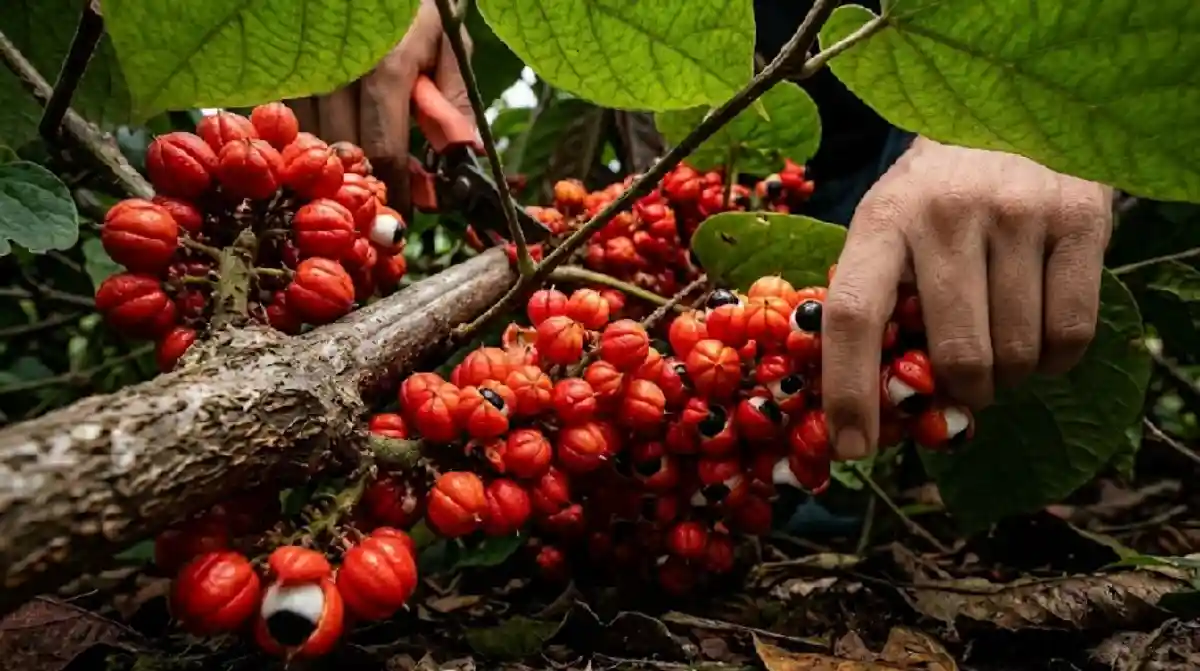
Guarana is a climbing vine native to the Brazilian Amazon, known to science as Paullinia cupana. Its round red fruit splits open to reveal a dark seed set in white pulp, and that seed carries the highest caffeine load recorded in any commonly used plant: up to 5% of its dry weight, roughly five times the concentration found in coffee beans. That figure has turned guarana into a global commodity, printed on the labels of soft drinks, energy shots and dietary supplements. Yet the number is only the surface of a much older story, one that belongs to the Sateré-Mawé people, who domesticated the plant, made it food, medicine and political symbol, and still run a production chain that creates value without dismantling the forest around it.
Maués, the world capital of green gold
The town of Maués, in the state of Amazonas, is widely recognised as the world capital of guarana. Fed by whitewater rivers and ringed by dense forest, the region offered the climate and soil conditions that allowed the species to reach its fullest expression. For the Sateré-Mawé, however, guarana was never simply discovered. Their oral tradition holds that the plant was born from the sacrifice of a sacred child, whose eyes gave rise to the species. That account is not a folkloric footnote. It explains the care that surrounds every harvest, because each opened seed, white flesh around a black pupil, is read as the watchful gaze of the ancestors keeping guard over the forest and over their descendants.
Guarana anchors the local economy, and the way it is harvested protects both biological corridors and the traditional bioindustry built around the crop. Unlike predatory agriculture, Sateré-Mawé cultivation takes place inside agroforestry systems that mimic the architecture of the surrounding forest, so that Paullinia cupana grows alongside other species such as açaí and tucumã palms. The method keeps the soil fertile and prevents biological diversity from being eroded. Studying guarana therefore becomes a lesson in applied ecology, since protecting the species cannot be separated from protecting the territory and the culture that sustains it.
Defensive chemistry: why the plant makes so much caffeine
The seed’s caffeine concentration is not an accident of nature. It is a defensive strategy refined across millions of years of evolution inside the Amazon biome. In a crowded, highly competitive environment, caffeine works as a natural insecticide and a form of biological control, repelling predators and shielding the seeds that carry the next generation. For the human body, that same potency demands respect, and it also explains a practical difference between guarana and coffee. Guarana seeds are rich in tannins, compounds that slow the absorption of caffeine and produce a longer, steadier state of alertness, without the sharp peaks and crashes associated with a roasted coffee bean.
The traditional preparation is called çapó. A hardened stick of processed guarana is grated against a stone, and the resulting powder is mixed with water. The drink is served during rituals, but also during assemblies and political debate, where it stands for unity and resistance. Modern industry has tried to reproduce that strength, though it frequently isolates caffeine in the laboratory and loses the benefits of the whole seed matrix. Recognising and protecting this traditional knowledge is part of cultural sustainability, and it helps ensure that the strength of guarana serves health and life rather than profit alone.
A production chain that holds territory together
For the Sateré-Mawé, guarana is far more than an economic product. It operates as a tool of cultural sustainability and of resistance. Over centuries, the traditional bioindustry of Maués allowed the people to hold on to their identity and their land even under pressure from degrading activities pushing into the region. Cultivation is carried out without agrochemicals and without burning, respecting natural cycles and allowing the forest to regenerate. That commitment to the land is a practical demonstration of positive impact, evidence that a development model can value bioindustry and biological diversity at the same time.
Sustainable management and fair trade projects in Maués have worked to add value to Sateré-Mawé guarana, including certification as a Denomination of Origin. The seal is meant to guarantee that buyers are acquiring a product that respects the mythology and the etymology attached to the plant, and that earnings are reinvested in the local communities. Protection of guarana is, in that sense, inseparable from protection of Indigenous rights and from conservation of the Amazon biome. Valuing the seed means supporting the people who grow it.
Threats facing the crop
Despite its potential, guarana faces challenges tied to climate change and environmental degradation. Shifts in rainfall patterns affect the plant’s cycle and the stability of traditional production, which depends on predictable wet and dry seasons. Keeping rivers and floodplain forests connected is a condition for future generations of guarana to keep growing under the protection of the canopy. Deforestation and the advance of predatory agriculture are additional threats, and they call for constant vigilance and for biological corridors that allow seeds to disperse across the landscape.
What the future depends on
The future of the species rests on a commitment to sustainable bioindustry and to the cultural diversity of the Amazon. Investment in research and environmental education is needed, along with guarantees that local communities remain the primary beneficiaries of their own resources. Guarana is not merely a source of caffeine. It is a jewel found in the fertile ground of Tupi and Sateré-Mawé memory, and a symbol of the vitality of Brazilian flora and fauna.
The history of guarana teaches that Amazonian nature, when it is cared for, offers answers to questions of food, health and economy at the same time. Choosing products derived from the fruit, or simply valuing its presence in the market, means supporting a development model that puts life and planetary health first. The potency of guarana is the potency of the Amazon itself, and it asks for respect and continuous protection, all of it contained within a single orange husk.
Reporting: Anne Silva / Amazonia Mag. Source: Revista Amazônia.

Editor · Amazonia Mag
Anne Silva is the editor of Amazonia Mag, the English-language edition of Revista Amazônia. She curates, translates and adapts the outlet's science and environment coverage for an international audience, reporting on Amazon wildlife, flora, rivers, climate and research. Every story she edits is grounded in peer-reviewed studies, official data and on-the-ground reporting from the Revista Amazônia newsroom in Belém, Pará, Brazil. More by Anne Silva →