
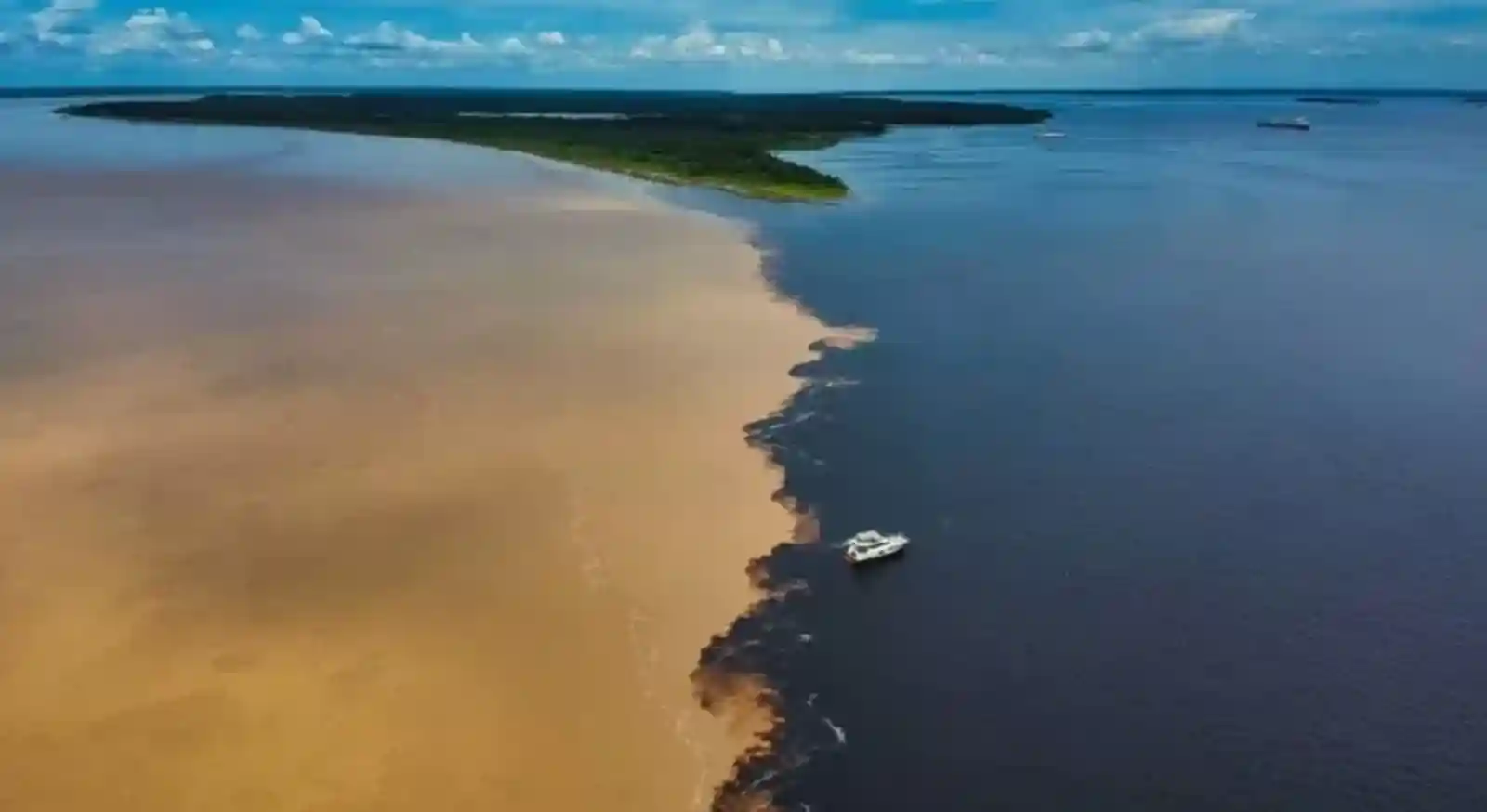
A few kilometres from Manaus, the capital of the Brazilian state of Amazonas and the largest city built in the heart of the rainforest, two enormous rivers run alongside each other for kilometres without mixing. On one side moves the almost black current of the Rio Negro. On the other, the clay coloured flood of the Rio Solimões. The line between them is sharp enough to photograph from a small boat and wide enough to be picked out from space. It is not an optical illusion or a trick of the light: it is fluid physics playing out on a continental scale.
What makes the Meeting of the Waters worth more than a photograph is what sits underneath that line. The dark, acidic water of the Negro holds a different set of fish species from the muddy, alkaline water of the Solimões. Studies indicate that this physical and chemical barrier stops many species from crossing from one river to the other, so two distinct aquatic communities travel side by side without ever merging. The spectacle that draws thousands of visitors from every continent each year is only the surface of that arrangement.
The physics behind the line
Three variables explain why the two rivers refuse to blend on contact: temperature, current speed and density. The Rio Negro is the warmer of the pair, averaging around 28 degrees Celsius, and it moves slowly, at roughly 2 kilometres per hour. Its dark colour comes from the decomposition of organic matter shed by the surrounding forest, which loads the water with humic and fulvic acids and pushes its pH down into acidic territory. In the strictest sense it is a forest river: the vegetation around it writes its chemistry.
The Solimões runs on an entirely different logic. It is colder, at about 22 degrees Celsius, and considerably faster, travelling between 4 and 6 kilometres per hour. It carries an immense load of sediment washed down from the Andes, and that suspended material gives the river its milky brown colour while also making it denser and shifting its pH towards neutral or alkaline values. When the two bodies of water meet near Manaus, the combined differences in density, temperature and speed prevent instant homogenisation. Mixing does happen, but slowly, kilometre by kilometre, further downstream.
Two rivers, two biological worlds
The chemical split translates directly into biology. In the Rio Negro, high acidity and low nutrient levels keep mosquito populations down, which visitors tend to appreciate, but they also sustain a less productive food chain. Even so, the river shelters species adapted to those demanding conditions, among them the pink river dolphin, Inia geoffrensis, a regular presence in the meeting zone and one of the sights most sought after by people arriving by boat.
The Solimões is biologically far more generous. Its Andean sediments are rich in calcium, magnesium and other nutrients that fertilise the seasonally flooded plains known as várzeas, supporting a much larger biomass of fish and aquatic plants. Commercially important species such as tambaqui, Colossoma macropomum, and pirarucu, Arapaima gigas, depend on that nutritional wealth. Research cited by specialists indicates that productivity in the várzeas fed by the Solimões clearly outstrips that of the igapó forests along the Negro.
That contrast is why the Meeting of the Waters is better understood as a transition zone than as a viewpoint. It is here that nutrients and organisms from two very different fluvial systems begin to mix gradually, which makes the stretch one of the richest and most complex areas in the whole Amazon basin. Protecting that dynamic band is not an aesthetic preference: regional fisheries and a good share of the local ecological balance depend on it, a point educational tourism could make far more often than it currently does.
Manaus as the gateway
Manaus concentrates the logistics of the entire phenomenon. The capital of Amazonas is a metropolis planted in the middle of the forest, its history shaped by the rubber boom, and today it provides the infrastructure needed to receive international visitors. The boats that carry people out to the edge where the colours touch leave from there, and so do the longer trips towards jungle lodges and sustainable development reserves deeper inside the forest.
The city is also a scientific hub. Manaus hosts the National Institute of Amazonian Research, known by its Brazilian acronym INPA, whose work underpins much of what is understood about the behaviour of both rivers and of the basin as a whole. Folding that knowledge into the visitor experience is the obvious next step for tourism in the region: turning a photograph into something closer to a lesson.
Tourism that needs rules
The Meeting of the Waters is one of the biggest attractions in Amazonas and moves a significant economy in and around Manaus. Boats of every size take visitors out to the liquid border, where they can put a hand into each current and feel the temperature difference for themselves. That direct contact carries real potential for environmental education: seeing the natural barrier at close range makes the fragility and complexity of the system much harder to treat as an abstraction.
For the activity to remain a positive force, sustainable practice has to travel with it: controlling oil and fuel pollution from boats, handling solid waste properly and minimising disturbance to wildlife, particularly the dolphins that frequent the area. Managed well, tourism can fund research and conservation while giving local communities an economic reason to protect the environment they live from. Treated as a responsible asset, biodiversity helps pay for its own defence.
Pressures from upstream and next door
The phenomenon is not safe by default. Sitting close to an industrial and densely populated city brings concrete risks, including untreated sewage and industrial waste entering the system. Larger scale pressures add to that, among them climate change and deforestation in the headwaters of both the Solimões and the Negro. Andean sediment transport and the acidity of the black water are dynamic processes, and large human interventions such as hydroelectric dams are capable of altering them.
Protecting the Meeting of the Waters therefore cannot stop at the point where the photographs are taken. It requires whole basin management, making sure that activities upstream do not degrade the quality or the dynamics of these two giants, along with continuous monitoring of water quality and of the health of fish populations. By attaching economic value to keeping the spectacle intact, responsible tourism becomes a useful ally in that argument and a source of pressure for better urban infrastructure in Manaus.
Thinking about the Meeting of the Waters means thinking about the Amazon as a whole: a complex, dynamic and interconnected system in which a visible boundary conceals deep ecological differences. The phenomenon draws people in through beauty, but its real value lies in what it teaches about the richness and the fragility of everything running below the surface. If every visitor who touches those two waters leaves understanding why they need protecting, the trip has done its job.
Reporting: Anne Silva / Amazonia Mag. Source: Revista Amazônia.

Editor, English Edition — Amazonia Mag
Anne Silva is the editor of Amazonia Mag, the English-language edition of Revista Amazônia. She curates, translates and adapts the outlet's science and environment coverage for an international audience, reporting on Amazon wildlife, flora, rivers, climate and research. Every story she edits is grounded in peer-reviewed studies, official data and on-the-ground reporting from the Revista Amazônia newsroom in Belém, Pará, Brazil. More by Anne Silva →