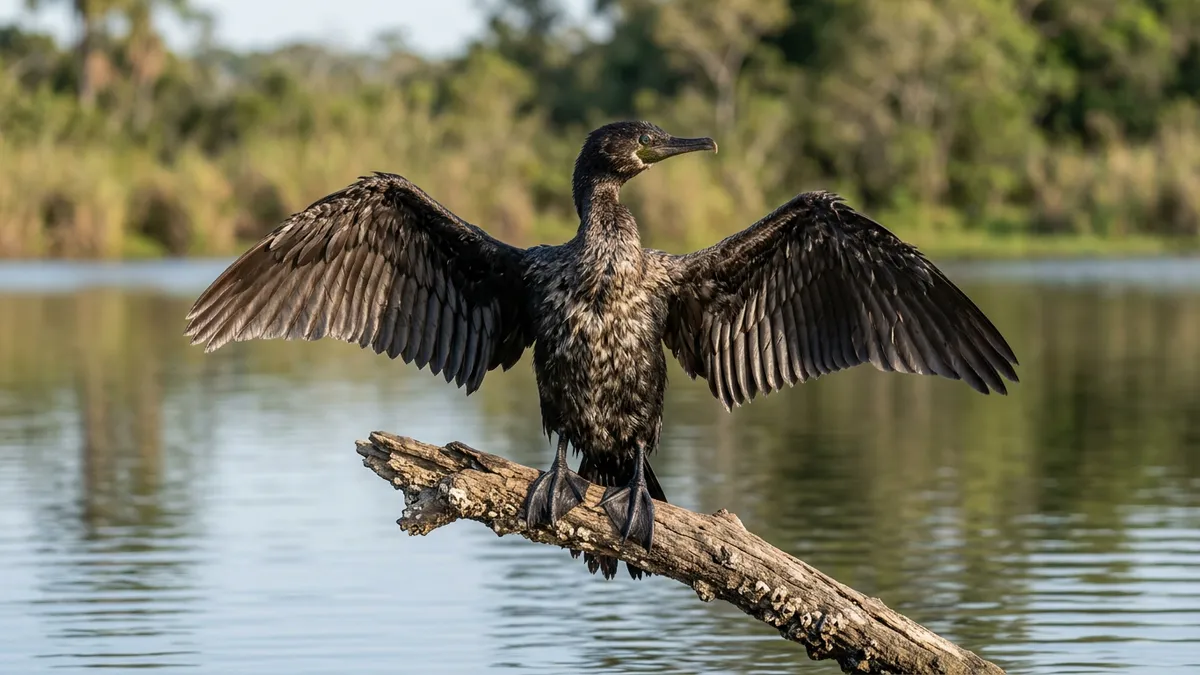
The Neotropic cormorant (known in Brazil as biguá) keeps plumage that is less waterproof than that of many other aquatic birds, and this trait reduces the amount of air trapped between the feathers. With less buoyancy, it can sink and chase fish more easily during a dive. The same adaptation explains the common sight of an individual perched with its wings open to the sun after fishing.
The water that partly soaks into the plumage is not an accidental flaw but part of how this bird’s body works. After swimming and catching food, the cormorant must get rid of the moisture it has accumulated to restore proper flight and insulation. In rivers, lakes, estuaries and coastal areas, it can also gather with other individuals to surround schools of fish and make the catch more efficient.
How the plumage makes diving easier
The feathers of aquatic birds usually hold a layer of air that contributes to buoyancy. In the Neotropic cormorant, this waterproofing is relatively low. Water fills part of the spaces between the feathers, replacing some of the air that would help keep it at the surface. The result is a body that offers less resistance to sinking when the bird drives its legs and body toward a fish.
This trait does not mean the cormorant is unable to float or that its plumage is completely soaked. It reflects a balance between staying on the water and being able to submerge quickly. The bird keeps control of its body position and uses its feet to move forward during the chase. Unlike an animal that depends only on the surface, the cormorant turns the water into a pursuit space, where it can follow prey at different depths.
What happens to the feathers during fishing
During a dive, water comes into direct contact with the outer feathers and with the layer of plumage close to the body. This contact reduces the trapped air and increases the weight of the plumage while it is wet. The bird gains a condition favorable to staying submerged, but then has to deal with the cost of the process. Wet feathers make flight harder and change the thermal insulation that protects the body from heat loss.
That is why drying is part of the routine after fishing. The cormorant lands on branches, rocks, logs, posts or other exposed structures and opens its wings. In this position it increases the area of plumage in contact with air and with solar radiation. The wind also helps carry the moisture away. The posture is not a threat display or an attempt to look bigger, but a way of restoring the condition of the plumage.
Why it opens its wings in the sun
With its wings open, the cormorant exposes the feathers on both surfaces to the environment, instead of leaving them pressed against the body. Sunlight warms the plumage, while moving air favors the evaporation of water. The bird may stay in this position for a while, adjusting its body to the angle of the sun and the conditions of the spot. The behavior is most obvious after a series of dives.
Drying has to happen without completely giving up vigilance. The cormorant keeps its head in a position that lets it watch its surroundings and can fold its wings if it senses a threat. In areas with several individuals, the birds alternate between fishing, resting and airing their plumage. Choosing an open spot, above the water or close to it, combines two needs: making drying easier and staying near the place where the food is.
How group fishing surrounds a school of fish
When they find fish gathered together, cormorants can act as a group, moving through the water in a coordinated way. The birds advance in one direction and reduce the escape routes open to the school. The movement of several individuals creates a front of pursuit, making the fish bunch up or change position. Each bird takes the opportunity to dive and catch a prey.
The mechanism does not depend on a fixed division of tasks, as if some individuals were assigned permanent roles. The advantage lies in the simultaneous presence of several birds and in the movement of the whole. A surrounded school tends to become easier to reach with successive dives, and fish that escape one bird may come within reach of another. The behavior lowers the effort needed to find each prey separately and takes advantage of the natural concentration of the fish.
The ecological advantage of this strategy
The combination of partly waterproof plumage, diving and collective fishing lets the cormorant exploit a food source that is not available to birds restricted to the surface. It can follow fish inside the water, while other species occupy shores, sandbars, treetops or shallow areas. This separation of strategies lessens direct competition for some resources and widens the range of roles that birds play in aquatic environments.
By catching fish, the cormorant takes part in the transfer of energy between the aquatic community and the predators that use the water and its margins. Its presence also shows that resting and feeding spots are available nearby. The effect should not be mistaken for an automatic control of fish populations. The amount caught depends on the availability of prey, on space, on the season and on local conditions, but the species is a regular part of the food web of rivers, lakes and coastal areas.
Where the behavior can be seen
In Brazil, the biguá occurs in a range of aquatic habitats, including rivers, lagoons, reservoirs, estuaries and coastal areas. The open-wing posture can be seen on structures close to the water, mainly after periods of diving. Watching from a distance makes it possible to follow the sequence: the bird enters the water, chases fish, returns to a perch and exposes its plumage to dry.
This scene helps read the environment more accurately. Open wings do not necessarily mean the animal is injured, trapped or trying to fly. In many cases they show that the bird is dealing with the direct consequence of an adaptation to diving. The cormorant accepts getting its feathers wetter to reach food, then uses the sun and wind to recover its ability to fly.
The Neotropic cormorant turns an apparent disadvantage into a fishing tool. Feathers that let in more water reduce buoyancy, and the posture in the sun makes up for the cost of diving with damp plumage. Between water and air, its behavior shows how one trait of the body can connect feeding, rest and survival.
Reporting: Natália Santos / Amazonia Mag

Editor · Amazonia Mag
Anne Silva is the editor of Amazonia Mag, the English-language edition of Revista Amazônia. She curates, translates and adapts the outlet's science and environment coverage for an international audience, reporting on Amazon wildlife, flora, rivers, climate and research. Every story she edits is grounded in peer-reviewed studies, official data and on-the-ground reporting from the Revista Amazônia newsroom in Belém, Pará, Brazil. More by Anne Silva →