
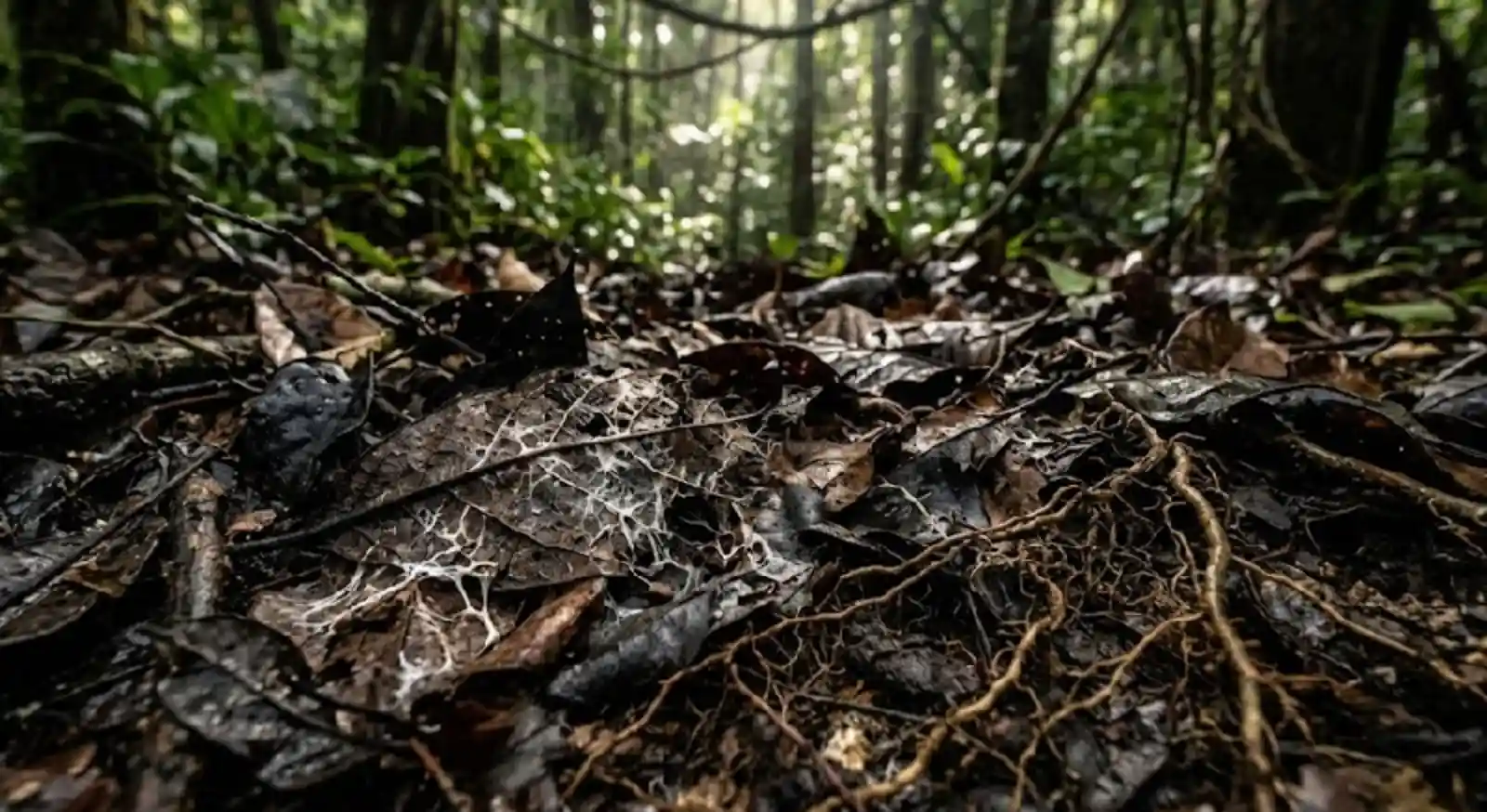
Talk about the Amazon and one image takes over: the canopy, a green ocean visible from orbit, measured by satellites and quoted at every climate conference. Yet much of the forest’s real durability never shows up in an aerial photograph. It sits underneath, in a dark, humid and permanently crowded layer where biological activity reaches an intensity that is hard to picture. Estimates gathered by research on Amazonian soils indicate that a single gram of primary forest soil can hold billions of microorganisms, among them bacteria, fungi and archaea, and that a vast share of that assembly still has no scientific name. The Amazon that holds up the Amazon begins below the boots.
A whole ecosystem fits in a handful of earth
For decades, tropical ecology treated soil as a support, a passive substrate on which the important things grew. That reading is now obsolete. Amazonian soil behaves like an ecosystem with its own rules, with decomposers, consumers and predators arranged in layers that change centimetre by centimetre. In the top few centimetres, where leaf litter piles up, the density of life reaches its peak. Deeper down the community shifts entirely: different bacteria, different fungi, different strategies for surviving on less oxygen and less food. It is not one habitat but a stack of overlapping habitats, connected by water, by roots and by tunnels dug by very small animals.
That vertical architecture explains why the forest tolerates a soil that is, in mineral terms, poor. Much of the basin’s soil is ancient and leached, washed by millennia of rain that carried nutrients downward and into the rivers. The chemical fertility inherited from bedrock is low. What sustains the colossal biomass above ground is not the wealth of the substrate but the speed at which the underground community recycles everything that falls.
The fauna nobody photographs
Under the broad label of underground biodiversity live two worlds that need each other. One is microscopic: bacteria, archaea and fungi, including the mycorrhizal formers such as the Glomeromycota, which attach to fine roots and work as an extension of the root system itself. The other world is soil fauna, invertebrates operating at visible scale: earthworms, mites, springtails, termites, beetles, millipedes and larvae of every description. This fauna is not decorative background. It is what breaks litter into small fragments, opens galleries that ventilate the soil profile, and drags organic matter from the surface into deeper layers.
The dependence between the two worlds is total. Without the mechanical labour of the invertebrates, the microbiota would have far less surface to work on and the chemistry would run slower. Without the microbiota, the invertebrates would have nothing to eat and no way to digest much of what they swallow. In practice, the fauna fragments, mixes and transports, while the microorganisms handle the fine chemistry, releasing nitrogen, phosphorus and other elements in forms a plant can actually absorb. It is a division of labour as old as the forest, and it runs without pause, day and night, all year round.
The fastest recycling system on the planet
In the steady heat and humidity of the Amazon, a fallen leaf can vanish in weeks or a few months. In a temperate forest the same process would take years. That acceleration is the direct work of the underground legion. What is truly remarkable, though, is not the speed of decomposition but what happens immediately afterwards: the released nutrients barely accumulate in the soil at all, because they are recaptured almost instantly by a dense mesh of fine roots and mycorrhizal fungi that operates as a biological trap.
That near perfect closing of the loop is why a mineral poor soil manages to carry one of the largest volumes of plant biomass on Earth. It is also the most fragile part of the system. When the cycle breaks, through deforestation, compaction or fire, nutrients stop being recaptured and are lost quickly with the rain. What collapses then is not only the visible vegetation, but the entire mechanism that kept it standing.
Drought, heat and the invisible buffer
Rising temperatures and shifting rainfall patterns confront the Amazon with a challenge without precedent. Extreme droughts such as those recorded in 2005 and 2010, and those repeated in recent years, test the limits of the ecosystem’s resilience. Research suggests that certain bacterial and fungal soil communities can adapt to drier and hotter conditions and help plants tolerate that stress. Some plant growth promoting bacteria produce compounds that shield roots from dehydration, while others assist in taking up phosphorus, a critical and scarce nutrient across much of the region’s soils.
The microbiota also holds together the physical structure of the soil, and in a dry season that detail becomes decisive. Well aggregated soil retains moisture, resists erosion and lets roots reach deeper water reserves. Soil impoverished of life compacts, sheds water and multiplies the vegetation’s vulnerability to fire. Underground biodiversity is, in that sense, a climate buffer that appears in no inventory and on no conservation map.
What is lost when the soil breaks
For all its capacity to adapt, this underground life is sensitive to severe human disturbance. Deforestation, burning and conversion to cropland or pasture change the physical, chemical and biological properties of the soil abruptly. Stripping the vegetation cover exposes the ground directly to sun and rain, driving compaction, erosion and loss of organic matter. Fire in particular can sterilise the surface layers, wipe out much of the beneficial microbiota and sever nutrient cycles that took centuries to tune.
The damage does not stop at biodiversity. Healthy forest soils store massive amounts of organic carbon, and once degraded they can turn into net sources of CO2 emissions to the atmosphere, worsening the very climate problem the forest helped to contain. A forest with wounded soil regenerates more poorly, burns more easily and takes far longer to recover its original structure.
Restoration that starts from below
Faced with the urgency of recovering degraded land, soil science has stopped being a second tier discipline. Current research concentrates on isolating and identifying native microorganisms that can be used as bioinoculants, living allies that speed up the growth of native tree seedlings and improve the quality of the ground. Understanding in detail how plants and microorganisms interact opens the door to restoration strategies that are more effective, tailored to local conditions and matched to a climate that is no longer the one of thirty years ago.
The bioeconomy of restoration is a concrete promise, but it demands continuous investment in basic and applied research. Treating Amazonian soil as biological heritage, rather than merely as a substrate for producing commodities, is a condition for any long term sustainability project in the region. Science states it plainly: looking down matters as much as looking up.
Public policy needs to look underground
Securing the resilience of the Amazon calls for an integrated view, one that recognises the interdependence between the visible forest and the invisible world feeding it. Protecting underground biodiversity is not a secondary agenda, it is the foundation of regional and global climate balance. Conservation and sustainable management policies should carry explicit guidelines on soil health, avoid the activities that cause severe degradation, and favour practices that let native microbiota regenerate.
There is also a practical measurement gap. Forest monitoring programmes count trees, map deforestation and estimate above ground carbon with growing precision, yet the living community under the surface remains largely uncounted. Naming what lives down there, mapping which groups disappear first after a fire and which return during regrowth, would give restoration projects a far sharper diagnosis than the one available today. Soil biology is the part of the Amazon that science has barely begun to describe, and it is precisely the part that decides whether a recovering forest becomes a forest again or stalls halfway.
The remaining task is also a social one: to back the science and defend policies that protect the Amazon in full, without separating the crown from the root. Every gram of preserved soil is a reservoir of life and of recovery capacity. Knowing that hidden wealth, naming it and telling its story is the first step towards keeping the green heart of Brazil beating against a climate in full transformation.
Reporting: Anne Silva / Amazonia Mag. Source: Revista Amazônia, based on scientific research into Amazonian soil ecology.

Editor, English Edition — Amazonia Mag
Anne Silva is the editor of Amazonia Mag, the English-language edition of Revista Amazônia. She curates, translates and adapts the outlet's science and environment coverage for an international audience, reporting on Amazon wildlife, flora, rivers, climate and research. Every story she edits is grounded in peer-reviewed studies, official data and on-the-ground reporting from the Revista Amazônia newsroom in Belém, Pará, Brazil. More by Anne Silva →