
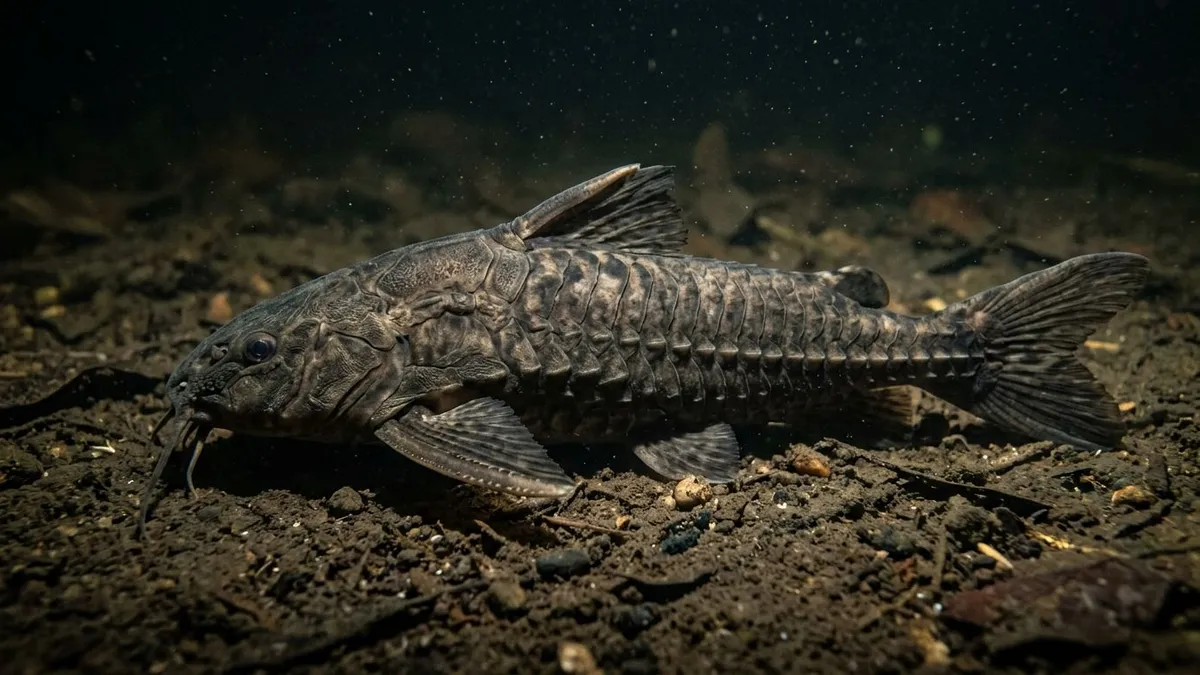
The cuiu-cuiu produces a creaking sound by stridulation, a mechanism in which the spine of the pectoral fin rubs against a cavity of the shoulder girdle. Contact between these structures generates a mechanical vibration that turns into sound, audible even out of water. It is not a vocalization made by the mouth, but a noise created by one rigid part of the body moving against another surface.
The fish combines this mechanism with an anatomy protected by bony plates, a habit of staying near the bottom and nocturnal activity. This combination helps explain why the sound can be produced while the fish moves or works its fins in low-visibility surroundings. The creak is an observable physical effect of friction, while its specific function should not be assumed without further evidence.
Friction turns movement into sound
Stridulation begins when the spine of the pectoral fin moves relative to the cavity in the girdle. Because both structures are rigid, the movement does not happen in complete silence. The spine meets resistance, slides and produces a sequence of tiny frictions. These contacts make the structures vibrate and give rise to the creak associated with the cuiu-cuiu.
The principle is similar to the noise made when a hard surface is scraped by another, but it takes place in an anatomical arrangement specific to the fish. The fin provides the moving element, the spine acts as the rigid contact structure and the cavity of the girdle takes part in producing the sound. Water changes how vibrations travel, but it does not prevent the mechanism from existing. That is why the creak can also be heard when the animal is out of the water.
Spine and girdle form the sound-making set
The spine of the pectoral fin does not work only as an isolated rod. It is built into the fin and relates to the girdle, the structure that supports this region of the body. When the fin moves, the spine can come into contact with the cavity of the girdle. The geometry of this set determines where the friction occurs and lets a muscle action be converted into vibration.
The mechanism depends on coordination between moving and rigid parts. The fish does not need to open its mouth or expel air to make the creak. The energy of the fin movement is directed to the contact between spine and cavity, and the sound appears as a result of that interaction. The observation matters because it sets stridulation apart from other aquatic noises, such as those linked to water flowing past the body or to sediment shifting on the bottom.
Bony plates protect the body in bottom-dwelling life
The body of the cuiu-cuiu is covered with bony plates, a feature that adds stiffness and protection to the body surface. This covering should not be mistaken for an immobile shell that would prevent any movement. The fish still uses its fins to move and adjust its position, while the plates form a protective layer over the body.
The presence of the plates also helps in understanding why friction between spine and girdle occurs in an animal with several rigid structures. The body offers protection but keeps joints and fins able to move. In this arrangement, body defense and sound production are different aspects of the anatomy. The bony plates cover the fish, while the sound depends specifically on the mechanical meeting of the pectoral fin spine and the cavity of the girdle.
Nocturnal activity changes the context of the mechanism
The cuiu-cuiu is active at night and lives associated with the bottom. In that period, sensing vibrations and sounds may gain importance in an environment where light is reduced, but the mere existence of the creak does not allow us to say that the fish uses it for a particular purpose. What can be said with confidence is that moving the pectoral structures can produce a characteristic sound.
In life near the bottom, the animal moves through a zone where contact with the substrate and the presence of obstacles are part of the environment. The pectoral fin takes part in these body adjustments, and its spine remains linked to the set that can generate stridulation. The sound is therefore tied to a physical action of the fish during its active period. Night provides the behavioral context, but it does not justify assigning the creak a function of communication, defense or orientation without specific studies.
The creak should not be mistaken for a vocalization
A vocalization is produced by organs and movements associated with emitting sounds, whereas the cuiu-cuiu’s stridulation arises from friction between rigid body structures. The distinction is essential for describing the behavior correctly. The fish does not need to create the sound with its gills or mouth. The spine of the pectoral fin and the cavity of the girdle are the components directly involved.
It is also important to separate the production of the noise from its possible ecological function. The mechanism shows how the sound is generated, but it does not reveal on its own whether it serves to drive away another animal, signal presence, help individuals make contact or fulfill any other task. Without a specific demonstration, the creak should be treated as an acoustic signal produced by friction. This caution avoids turning a verifiable anatomical explanation into a behavioral interpretation with no basis.
A bottom fish that reveals functions in its own movement
The combination of bony plates, a spiny pectoral fin, a girdle and nocturnal activity shows how different traits can act in the same animal without necessarily sharing the same function. The plates protect the body, the movement of the fins allows locomotion and the contact of the spine with the cavity produces the creak. The result is a body in which defense, movement and sound production are tied together by anatomy.
For the bottom environment, observing this mechanism widens the ways of recognizing the presence of the cuiu-cuiu. Not every signal from wildlife depends on visible colors or conventional vocalizations. A noise produced by a body structure is also part of the animal’s experience of its habitat. At the same time, the creak should not be used in isolation to define the ecological role of the species. It offers a clue about its body mechanics and about the interaction between form, movement and nocturnal life.
The cuiu-cuiu shows that a sound can arise from a simple body action, without depending on a voice. The creak appears when the spine of the pectoral fin meets the cavity of the girdle, while the bony plates protect the rest of the body. In the dark, where sight loses reach, each contact between structures can reveal a side of the environment that usually goes unnoticed.
Reporting: Natália Santos / Amazonia Mag

Editor · Amazonia Mag
Anne Silva is the editor of Amazonia Mag, the English-language edition of Revista Amazônia. She curates, translates and adapts the outlet's science and environment coverage for an international audience, reporting on Amazon wildlife, flora, rivers, climate and research. Every story she edits is grounded in peer-reviewed studies, official data and on-the-ground reporting from the Revista Amazônia newsroom in Belém, Pará, Brazil. More by Anne Silva →