
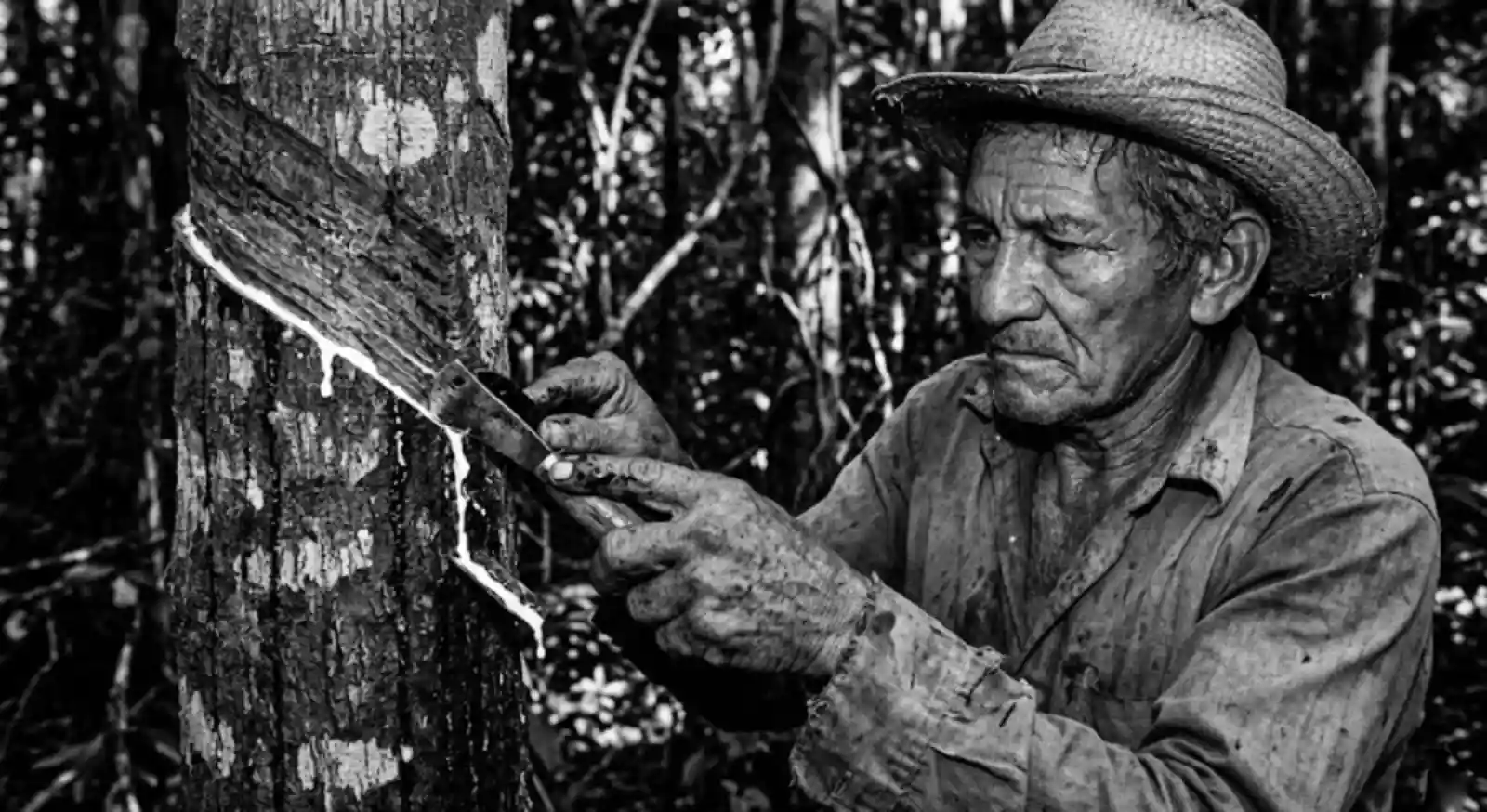
There is a quiet biological fact about the rubber tree (Hevea brasiliensis) that is essential for understanding the social history of the Amazon. Latex, the milky white fluid that pours from the bark when it is cut, is not the tree’s sap, the fluid that carries nutrients. It is a defence substance. It is produced in specialised channels called laticiferous vessels, located in the inner bark. When the tree is wounded by a predator, such as an insect, or by a human cut, the latex leaks out to seal the injury, acting as a healing and antimicrobial agent.
Studies indicate that this adaptation is so efficient that rubber trees can survive decades of controlled tapping, as long as the bark recovery cycles and the intensity of the cut are respected. This is knowledge that the forest’s traditional populations have mastered for generations: cut without killing, extract without exhausting, return to the same tree year after year. The plant defends itself, and the human being learns to live alongside that defence instead of destroying it.
That traditional knowledge, joining biology and sustainable use, was the pillar on which the resistance movement of the Amazonian rubber tappers was built in the 1980s. For decades, these workers were subjected to a brutal system of exploitation known as aviamento, or debt semi-slavery. They were forced to live in isolated areas of the forest, the seringais, buying provisions at abusive prices in the bosses’ company stores, the barracões, and selling rubber for derisory sums. The debt never ended, and that open account was the chain that tied them to the place.
The forest against the fire
In the late 1970s a new threat arrived. The opening of major highways in the Amazon, such as the Transamazônica and the BR-364, together with government incentives for extensive cattle ranching, opened the door to large-scale deforestation driven by land grabbers and large ranchers. What the government saw as an economic frontier was, for rubber tapper families, home, pantry and workplace all at once.
The rubber tappers’ resistance, led by iconic figures such as Chico Mendes in Acre, was not born only of economic survival. It grew out of a deep system of cultural knowledge about Amazonian ecosystems. They understood that the development model imposed by the military dictatorship, between 1964 and 1985, centred on replacing forest with pasture for cattle, was ecologically unsustainable and socially exclusionary. Biodiversity was not an obstacle: it was the foundation of their lives. The latex, the nuts, the fibres and the medicinal plants they gathered all depended on the forest being left standing.
Research in the field of political ecology stresses that this movement was a pioneer in linking the struggle for social rights, such as access to land and education, with the struggle for environmental conservation. From that link came the concept of socio-environmentalism, the idea that a forest cannot be protected without also protecting the people who live inside it.
What the empates were
To defend their territories, the rubber tappers developed innovative direct action tactics known as empates. The Portuguese word means, roughly, a standoff or a stalemate, and that is exactly what the tactic produced. When the chainsaws and the burning came close, entire rubber tapper families, men, women and children, formed human barriers, placing themselves in front of the trees that were about to be felled. With patience and determination, they talked with the ranchers’ hired hands, many of them also poor and exploited, and persuaded them not to destroy the forest that was home and livelihood for so many people.
Those empates were not merely physical confrontations. They were acts of resistance grounded in a deep respect for biodiversity and in the certainty that sustainable use of the forest was the only viable alternative for the region, a body of knowledge that large landowners and the government ignored.
Extractive reserves: a new global paradigm
The struggle of the Amazonian rubber tappers had a profound global impact and inspired the creation of a new category of protected area: the extractive reserves, known in Brazil by the acronym RESEX. In plain terms, an extractive reserve is a protected forest where people are not removed. The land stays public, the forest stays standing, and the families who already live there keep the right to harvest its renewable products. That innovative model, made official by the Brazilian government in 1990, represented a paradigm shift in the conservation of the world’s biodiversity.
Until then, the dominant conservation model, imported from the northern hemisphere, was based on human exclusion, meaning national parks or biological reserves without people, ignoring the fact that many of the most biodiverse areas in the world have been inhabited and managed by indigenous peoples and traditional populations for centuries.
The RESEX made official the principle that conservation of biodiversity can, and often must, be based on the sustainable use of natural resources by local populations. In these reserves the land is state property, but the right of use is granted for an indefinite period to the traditional communities that live there and carry out extractive activities, such as the harvesting of rubber, brazil nuts, açaí, oils and fibres, in a sustainable way, respecting environmental laws and the biological cycles of the species.
The model recognised that the rubber tappers, in defending their territories from deforestation, were not merely defending their jobs. They were defending the genetic and ecological heritage of all humanity. The RESEX was the legal embodiment of socio-biodiversity.
A bioeconomy born from extractivism
The struggle of the rubber tappers of the 1980s is not only history: it is the foundation of the bioeconomy now emerging in the Amazon as an alternative to the predatory model of exploitation. Sustainable extractivism, when strengthened by adequate public policies, generates income, promotes food security and secures the conservation of the forest. In the RESEX and in other territories held by traditional populations, community forest management has proved an efficient tool for conserving biodiversity.
Studies indicate that forest extractivism generates a biodiversity of products that can be processed locally, adding value and ensuring that the economic benefits stay in the region, strengthening the local economy and reducing dependence on outside goods. The current challenge is to connect that production with markets that value Amazonian socio-biodiversity. Origin certifications, payment for environmental services and the development of production chains, such as those for açaí, brazil nuts and oils, are essential so that today’s rubber tapper can live with dignity from the forest that Chico Mendes and so many others defended.
The struggle and the sacrifice of Chico Mendes
Chico Mendes’s leadership in the resistance movement of the Amazonian rubber tappers came at a tragic cost, but his legacy is immeasurable. He understood that the defence of the forest was inseparable from the struggle for social and human rights, and he built a historic alliance among rubber tappers, indigenous peoples and environmentalists from around the world. Mendes was a pioneer in carrying the voice of the Amazon to international forums, such as the United Nations and the Inter-American Development Bank, denouncing the social and environmental impacts of the large development projects those bodies financed.
His assassination, on 22 December 1988, in Acre, shocked the world and accelerated the official creation of the extractive reserves, turning his personal struggle into a global symbol of socio-biodiversity and sustainability. The violence that tried to silence him ended up amplifying his message far beyond the borders of the Amazon.
To reflect on the history and the resistance of the rubber tappers is to contemplate the very nature of the Amazon: a complex, dynamic and interconnected system, where biodiversity is not merely a collection of scientific data or economic resources, but the foundation of the life, the culture and the history of the forest peoples. The movement led by Chico Mendes proves that paralysis in the face of crisis is not a law of human nature. It is imperative to keep supporting and valuing participatory management and traditional knowledge systems as strategic partners in management and enforcement policies. Preserving that historical legacy is inseparable from the health of the entire Amazon basin.
Reporting: Anne Silva / Amazonia Mag. Source: original report published by Revista Amazônia.

Editor, English Edition — Amazonia Mag
Anne Silva is the editor of Amazonia Mag, the English-language edition of Revista Amazônia. She curates, translates and adapts the outlet's science and environment coverage for an international audience, reporting on Amazon wildlife, flora, rivers, climate and research. Every story she edits is grounded in peer-reviewed studies, official data and on-the-ground reporting from the Revista Amazônia newsroom in Belém, Pará, Brazil. More by Anne Silva →