
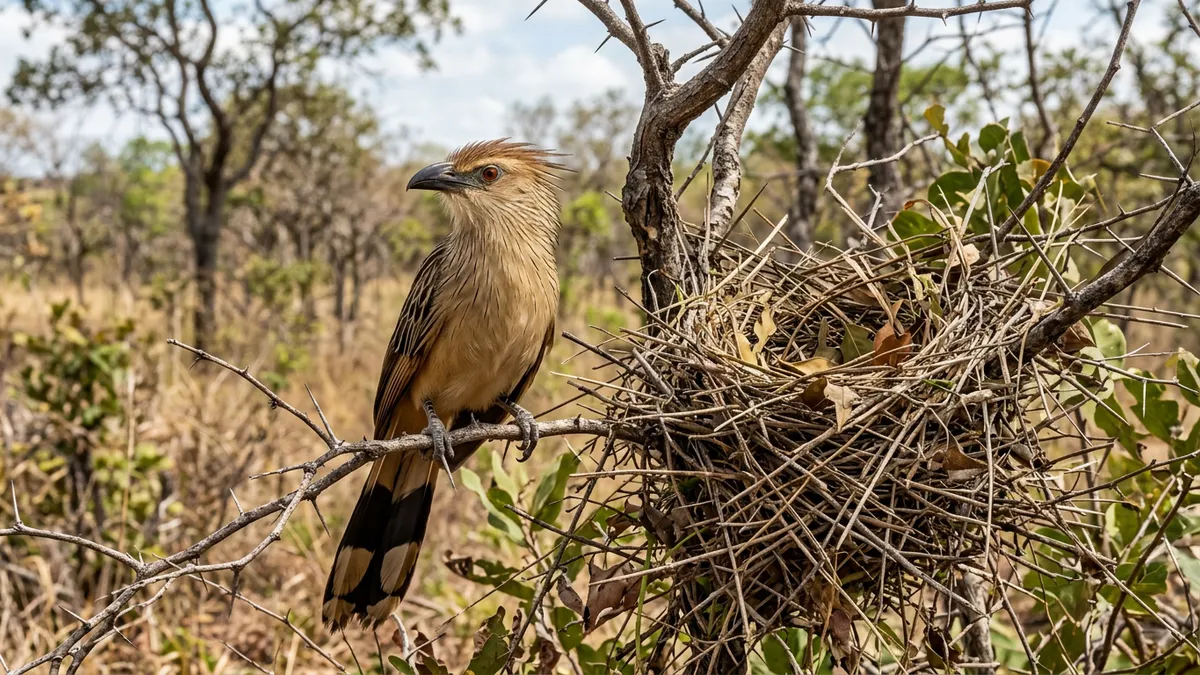
In a tree or a shrub, the nest of the guira cuckoo (known in Brazil as anu-branco) may receive more than one clutch. Several females use the same structure to lay their eggs, instead of each keeping an isolated nest of her own. The scene sums up one of the most striking features of the species’ reproduction, whose scientific name is Guira guira. The shelter looks collective, but living together does not end the rivalry among the birds. Each new clutch changes the position of the eggs that were already in the nest and can lower the chances of survival for some of them.
The result is a structure shared by a group of females, with different consequences for eggs laid at different moments. In the same space, cooperation and competition appear side by side. The species not only shares a breeding site, but also reorganizes the care of the brood once the chicks hatch.
A communal clutch that displaces eggs
The mechanism begins during communal laying. When a female deposits her eggs, they are added to those of other members of the group, and the most recent layer can displace the earlier ones. Some are pushed out of the nest. Others end up covered or buried under the accumulation of new clutches.
The effect does not depend on a conscious decision by every individual to eliminate a particular clutch, but on physical competition for space inside a limited structure. The eggs that end up at the bottom face the greatest disadvantage, because they may remain beneath other eggs and receive fewer of the conditions needed to complete development. In this way, the same practice that concentrates reproduction in a single nest also creates a hierarchy of opportunity among the clutches.
Competition decides which eggs stay
Position inside the nest becomes decisive. An older clutch can lose space when another female arrives later and lays new eggs on top of it, or when the birds’ movements push part of the contents toward the edges. Eggs pushed out stop taking part in the incubation protected by the structure. Those that are buried also face a direct obstacle, since they do not stay on the surface, where they could receive the care needed to reach hatching.
The communal nest, then, does not work as a simple sum of successful clutches. It is an arena of dispute in which the order of arrival, the position reached and the staying power of the egg determine part of the reproductive outcome.
This dynamic helps explain why the guira cuckoo gathers many females at the same spot despite the losses inside the nest. Communal breeding does not require every egg to have the same chance of hatching. The group can concentrate reproductive activity and then share the protection and feeding of the chicks that manage to hatch.
For each female, laying takes place in a nest already used by others, and the new layer may change the fate of the earlier ones. The competition is not an episode separate from collective care but part of the same social organization. Before birth, the structure favors disputes over space. Afterward, the adults present take part in raising the chicks. The system combines egg loss, unequal survival and cooperation in the care of the individuals that remain.
From conflict in the egg to care of the chicks
When the chicks hatch, the logic of the group changes scale. The guira cuckoo practices collective care, and chicks can receive attention from more than one adult in the flock. This shared participation helps separate two stages that are often confused. Laying is communal, but that does not mean the females stop competing. On the contrary, the eggs face a practical selection inside the nest, through displacement, ejection and burial.
The chicks that get through that stage become part of a wider social unit. Care is not restricted to the female that laid a particular egg. Protection and assistance are spread among the adults associated with the group, creating a relationship among several females, their chicks and the other members of the flock.
Territorial flocks and a distinctive bill
The guira cuckoo also lives in territorial flocks, and this organization ties reproduction to the everyday life of the species. The territory is not only the space where individuals look for food. It also holds the communal nest and the chicks cared for by the group. Collective defense reduces the separation between one family and another, because the adults act within a social unit that shares the space.
The tall, laterally compressed bill is a visible mark of the guira cuckoo, but it does not explain its reproduction on its own. The most important thing in this story is the combination of a communal structure, competition for space and cooperation afterward. The same flock that lives together in the territory holds internal reproductive disputes and later helps keep alive the chicks that reached the hatching stage.
A strategy with gains and losses
The reproduction of the guira cuckoo shows that cooperation does not eliminate conflict among individuals using the same resource. The communal nest concentrates females and clutches, but the available space remains limited. That is why some eggs are pushed outward and others are buried, and those at the bottom have the worst chances of hatching. There is no guarantee of uniform success for all females in this process. The most recent clutch may occupy a better position, and an egg that stays exposed and protected has an advantage over one covered by later layers.
After hatching, however, survival depends on the support of the adults in the flock, not only on the chick’s individual origin. The system produces a trade-off between losses inside the nest and care distributed after birth, without turning the species into a simple example of either cooperation or competition.
This story belongs to the reproductive cycle of the guira cuckoo and not to an isolated event with a specific date. In Brazil, where the anu-branco is known in several regions, a nest should be watched from a distance and without any interference with the eggs or chicks. The look of a nest does not reveal which clutches are older, which eggs were displaced or which adults took part in each stage.
What can be observed is the organization of a group that agrees to share one shelter, competes for space during laying and takes on the care of the chicks afterward. In the guira cuckoo, collective life begins with a shared choice of place, but continues through physical decisions that divide the chance of being born unevenly.
Reporting: Natália Santos / Amazonia Mag

Editor · Amazonia Mag
Anne Silva is the editor of Amazonia Mag, the English-language edition of Revista Amazônia. She curates, translates and adapts the outlet's science and environment coverage for an international audience, reporting on Amazon wildlife, flora, rivers, climate and research. Every story she edits is grounded in peer-reviewed studies, official data and on-the-ground reporting from the Revista Amazônia newsroom in Belém, Pará, Brazil. More by Anne Silva →