
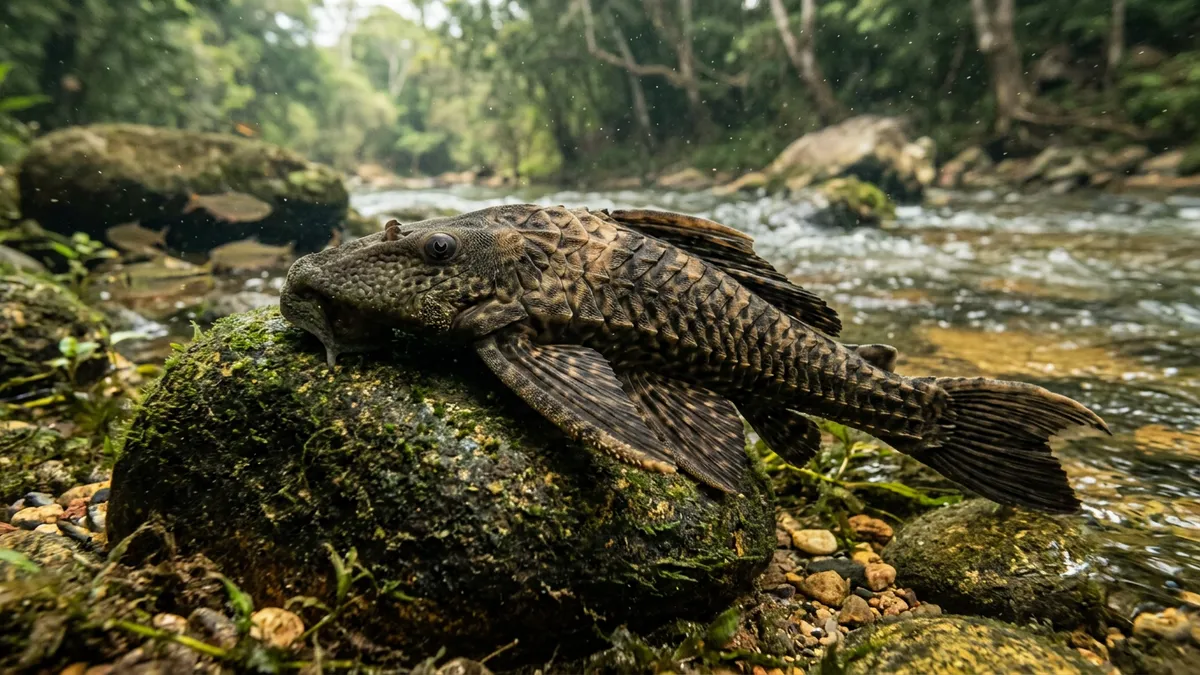
The mouth of the acari works as a suction cup and as a scraper. Facing downward, it clings to rocks, logs and other submerged surfaces, while teeth arranged like a scraper remove the algae and organic material that has built up. The fish turns feeding into a way of staying in place when the water moves with force.
This adaptation brings three functions together in one anatomical package. The sucker mouth lowers the risk of being swept away by the current, the scraper-shaped teeth let the fish work the surface it is attached to, and accessory breathing through the stomach helps the animal in environments with little oxygen. On the body, bony plates replace scales and add protection.
The mouth combines suction and scraping on the same surface
The acari’s ventral mouth sits on the underside of the head, a layout suited to a fish that looks for food on submerged surfaces. By pressing its lips against a rock or a log, the animal creates an area of adhesion that limits the entry of water between the mouth and the substrate. The pressure difference helps keep the fish pressed against the surface, without relying only on the effort of its fins. This hold is especially useful in stretches where the flow could easily move it.
Once attached, the acari moves its mouth and uses its scraper-shaped teeth to remove attached algae, as well as particles and organic matter available on the surface. The movement is not a bite meant to cut into prey. It is a repeated scraping, done close to the substrate, that turns a rock or a log into a feeding ground. The suction cup, then, is not only a safety device. It provides the stability the mouthparts need to work with precision.
The scraper tooth turns rocks into feeding grounds
Algae growing on rocks and logs form an uneven layer, exposed to light and to the flow of water. To use it, the acari has to remove the attached material without losing contact with the surface. The scraper tooth meets that demand because it works by direct contact, in successive movements. The mouth stays turned downward, close to the substrate, and the scraping reaches the surface layer that gathers algae, microorganisms and detritus.
This way of feeding also reduces the need to chase moving organisms. Instead of spending energy hunting prey in the water column, the fish exploits resources that stay fixed on surfaces. The sucker mouth supports the body, while the scraper does the collecting. The arrangement lets the acari alternate between small movements and periods of staying at the same spot. Its effectiveness depends on contact between mouth and substrate, so the ventral shape and the ability to adhere are as important as the teeth.
Bony plates protect the body against contact with the bottom
The acari’s body is covered with bony plates that take the place of the scales found in many other fish. These plates form a rigid covering and give mechanical protection to an animal that spends much of its time near rocks, logs and sediment. When scraping surfaces, the fish is exposed to friction and to possible impacts caused by moving water. Skin protected by plates helps reduce the effects of this repeated contact.
The body armor does not replace the function of the mouth but complements it in a lifestyle tied to the current. The suction cup keeps the front of the body attached, while the protected body can stay aligned with the substrate during feeding. The plates are also part of the characteristic silhouette of acaris, which look more rigid than fish covered only with scales. Here, protection is tied to the physical environment the animal occupies and to the need to work surfaces without depending on still water.
Breathing through the stomach helps when oxygen is scarce
Besides its gills, the acari can breathe through its stomach as an accessory route. The organ takes part in gas exchange when the fish swallows air and the available oxygen reaches regions adapted for absorption. This ability does not remove the role of the gills, which remain important for aquatic breathing, but it offers a physiological alternative under less favorable conditions. Water poor in oxygen places an extra demand on fish living in freshwater environments.
Staying close to the bottom and breathing through an accessory route act on different fronts. The mouth solves the mechanical problem of the current, while the stomach helps the body cope with reduced dissolved oxygen. In certain waters, this combination lets the acari explore places where other fish would struggle to stay active. The adaptation relies on a specific physiological process, not on a supposed ability to breathe indefinitely out of water. The fish remains tied to the aquatic environment, but it has an additional way of getting oxygen.
Anchoring in the current lowers the cost of feeding
A fish trying to hold still in flowing water must spend energy constantly with its fins and body muscles. The acari lowers that cost by using its mouth as an anchor point. Once it has attached to the rock or log, it can direct part of its effort toward scraping and holding its position. The current stops being only a force that pushes the animal around and begins to organize the space where food and shelter can be found.
This solution favors working stable surfaces, but it does not make the acari immune to the flow. Adhesion depends on correct contact between the lips and the substrate, and the animal can still be moved when the speed of the water changes or when it leaves its anchor point. The advantage lies in combining attachment, feeding and protection in the same setting. Natural selection tends to favor arrangements that solve more than one need without requiring separate structures for each function, and the acari’s mouth is an observable example of that principle.
The acari turns the riverbed into part of the ecosystem
By scraping algae and organic matter from rocks and logs, the acari acts directly on the layer that forms on the bottom of freshwater environments. Feeding removes part of that material and brings its components into the animal’s energy flow. The fish also stirs up particles while searching and scraping, although the strength of this effect depends on the substrate and the force of the current. Its activity links submerged surfaces, microscopic organisms and consumers that use the acari as a food resource.
In Brazilian rivers, this strategy appears in environments where flowing water creates productive surfaces and demands the ability to hold on. The presence of bony plates, a ventral sucker mouth, scraper teeth and accessory breathing forms a set consistent with life near the bottom. Seeing the acari merely as a fish that stays stuck to rocks hides the process that sustains that position.
The mouth that scrapes algae also works as an anchor, the plates that protect the body allow frequent contact with the bottom, and the stomach widens the breathing options when oxygen drops. In a river, survival does not depend only on swimming against the water, but on finding ways to work with it. The small suction cup reveals a larger ecological logic: the animal does not master the current, it arranges its own body to stay where life is available.
Reporting: Natália Santos / Amazonia Mag

Editor · Amazonia Mag
Anne Silva is the editor of Amazonia Mag, the English-language edition of Revista Amazônia. She curates, translates and adapts the outlet's science and environment coverage for an international audience, reporting on Amazon wildlife, flora, rivers, climate and research. Every story she edits is grounded in peer-reviewed studies, official data and on-the-ground reporting from the Revista Amazônia newsroom in Belém, Pará, Brazil. More by Anne Silva →