
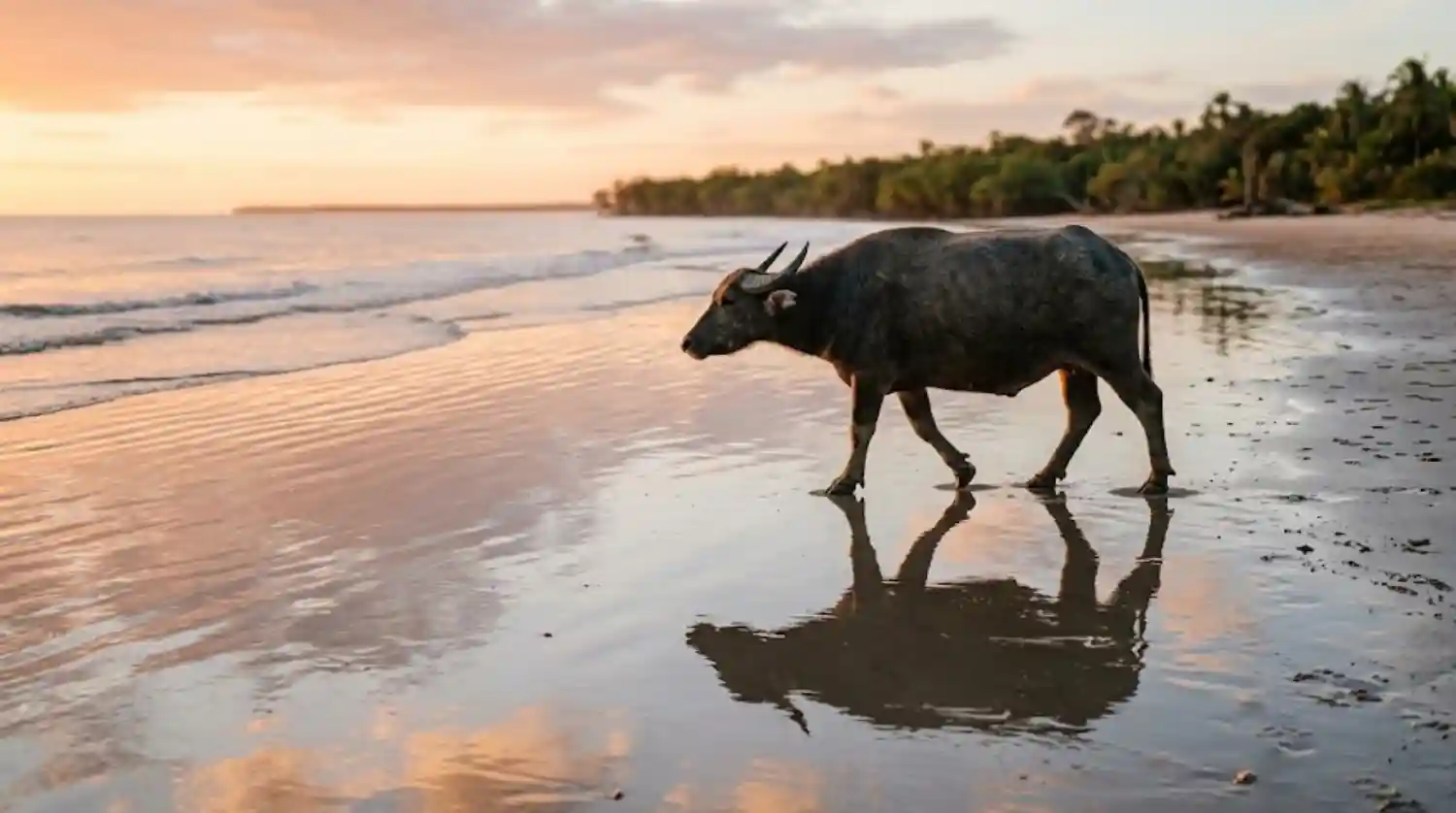
The Marajó archipelago sits at the mouth of the Amazon River, in the northern Brazilian state of Pará, and its main island is the largest fluvio-marine island in the world. This is the point where the muddy waters of the Amazon meet the salt of the Atlantic Ocean in a meeting of proportions found nowhere else on the planet. Only a few hours by boat from Belém, the island offers white sand beaches that could pass for a Caribbean postcard, yet the soul of the place is unmistakably Amazonian. Marajó is far more than scenery: it is a biodiversity sanctuary and one of the most important archaeological sites in the Americas, holding the legacy of a civilisation that flourished long before Europeans reached the continent.
Buffalo on the streets of Soure
Visitors who step off the boat in Soure, the main town on the island, are greeted almost immediately by the scene that became the region’s defining image: water buffalo grazing calmly along the streets, or carrying officers of the local Military Police. The animals arrived in the archipelago in the nineteenth century and, according to oral tradition, the first of them reached land after a French ship bound for Guiana was wrecked nearby. Whatever the origin, they adapted perfectly to the flooded grasslands of Marajó. The island now holds the largest buffalo herd in Brazil, and that herd underpins a good part of the local sustainable economy, from the famous Marajó cheese, creamy in texture and delicate in flavour, to the leather that feeds local craftwork.
The relationship between residents and buffalo works as a lesson in coexistence. On the ranches of Soure and Salvaterra, herd management follows the cycles of the water, so that livestock does not degrade the fragile ecosystems of open grassland and mangrove. Community based tourism lets travellers experience daily life on those ranches and understand how the presence of the buffalo shaped local architecture, cuisine and even the pace of life, turning an exotic animal into a pillar of cultural identity and economic resilience for the archipelago.
Ocean beaches and the mangroves of Soure
The beaches of Marajó, among them Praia do Pesqueiro and Praia da Barra Velha, deliver a sensory experience unlike any other stretch of the Brazilian coast. Because the Amazon River exerts such a massive influence here, the salinity of the water shifts with the season, producing the phenomenon of fresh water in the open ocean during the Amazonian rainy season. At Praia do Pesqueiro, wide bands of sand emerge at low tide, dotted with soft dunes and mangrove trees whose aerial roots stand like natural sculpture. It is a transitional environment, where marine and forest wildlife share a delicate and vibrant balance.
Walking those beaches doubles as an exercise in observing biodiversity. Intensely red ibises, known locally as guarás, cross the sky at dusk, and artisanal fishers can be seen drawing a living from the sea using ancestral techniques. Conserving these areas matters not only for tourism but for the survival of the nurseries of marine life that mangroves provide. Marajó teaches a simple lesson: the beauty of a beach is inseparable from the health of the ecosystem around it, which argues for a model of leisure that puts natural integrity ahead of predatory urbanisation.
Marajoara ceramics and an ancestral sophistication
One of the island’s greatest treasures lies not in its landscapes but in the clay shaped by the hands of its earliest inhabitants. Marajoara ceramics, produced during the most brilliant phase of the Marajó culture, roughly between the years 400 and 1350 of the common era, are recognised worldwide for their geometric complexity and aesthetic sophistication. The vessels, funerary urns and clay body coverings recovered in archaeological excavations reveal an organised society that mastered incision techniques and polychrome painting, using natural pigments drawn from the forest itself, such as annatto and kaolin.
Contemporary artisans in Soure and Salvaterra keep that tradition alive, reproducing ancestral graphic patterns in pieces that stand among the finest expressions of Brazilian culture. Visiting a ceramics workshop is an education in itself: every geometric line, often representing animals such as the snake or the caiman, carries symbolic and spiritual meaning for Indigenous peoples. This cultural recovery strengthens the self esteem of the local community and ensures that the story of the Marajoara civilisation continues to be told, turning craftwork into a tool for heritage education and sustainable development.
Food and hospitality as pillars of ethical tourism
Cooking on Marajó is an extension of its privileged geography. Beyond the buffalo milk cheese, visitors should not leave without trying filé marajoara, a dish served under a generous slice of melted local cheese, or turu broth, made from a mollusc harvested from rotting mangrove trunks and prized for its nutritional properties. The local table is an invitation to sustainability, favouring seasonal ingredients and preparation techniques that respect the timing of nature, and reinforcing the link between the plate and the regional biodiversity that produced it.
Marajoara hospitality, in turn, is marked by a welcoming simplicity that wins over almost everyone who arrives. Guesthouses built into the landscape and local guides who share their knowledge of flora and fauna turn a trip into a period of learning. Ethical tourism on the island focuses on minimising the environmental footprint and maximising the positive impact on communities, encouraging the consumption of local products and respect for tradition. That approach keeps the archipelago an authentic destination, where progress does not mean erasing roots but valuing the wealth the island already holds.
Pressures on a fragile system
For all its richness, Marajó Island faces significant challenges tied to environmental protection and socioeconomic development. Guarding the grasslands against fire and managing waste in beach areas are constant items on the agenda of the municipal governments of Soure and Salvaterra and of local residents’ associations. The future of the island depends on a collective commitment among public authorities, private business and visitors, so that tourism infrastructure can grow without compromising the fragility of fluvio-marine ecosystems.
Encouraging archaeological research and supporting heritage education in island schools are fundamental steps toward a future in which the next generations of Marajoara people become the principal guardians of their own territory. The Amazon, in all its complexity, finds in Marajó a synthesis of its greatest virtues: the force of wild life, the depth of human history and the indescribable beauty of a meeting of waters. To value Marajó is to celebrate the plurality of Brazil and to invest in preserving one of the most fascinating and singular settings on the planet.
Getting there
Reaching Marajó begins in Belém, at the Terminal Hidroviário, where boats take between two and three hours to reach the port of Camará, in Salvaterra. From there a short overland stretch links the port to the towns of Salvaterra and Soure, including a ferry crossing over the Paracauari River. The journey itself is part of the destination, offering a gradual transition from the urban life of the state capital to the lush calm of the island.
To visit Marajó is to allow oneself to be touched by a different kind of time, one in which the rhythm of the tides and the slow step of the buffalo set the pace of the day. An island that keeps the clay of past civilisations in its soil and the future of biodiversity in its waters invites a rethinking of the human relationship with land: not as owners, but as part of a continuous cycle of respect, beauty and history.
Reporting: Anne Silva / Amazonia Mag. Source: Revista Amazônia.

Editor · Amazonia Mag
Anne Silva is the editor of Amazonia Mag, the English-language edition of Revista Amazônia. She curates, translates and adapts the outlet's science and environment coverage for an international audience, reporting on Amazon wildlife, flora, rivers, climate and research. Every story she edits is grounded in peer-reviewed studies, official data and on-the-ground reporting from the Revista Amazônia newsroom in Belém, Pará, Brazil. More by Anne Silva →