
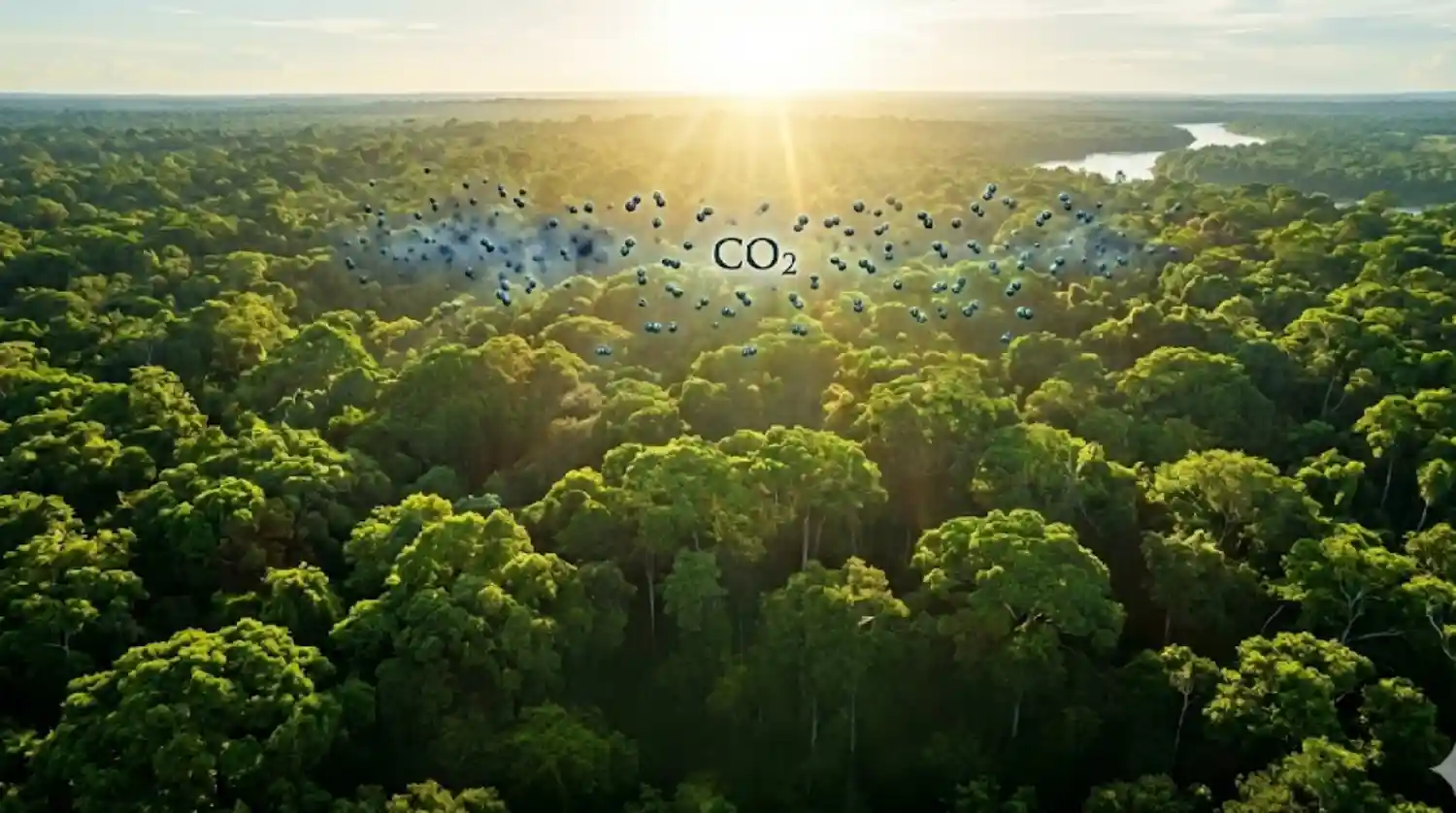
Every second, the living biomass of the Amazon processes so much carbon that, added up across a full year, the biome captures the equivalent of what a fleet of more than one billion cars would emit while running without interruption. That single ecosystem service turns the rainforest into one of the most critical pieces of natural engineering behind the stability of the Earth’s climate. It behaves as a giant sink, pulling greenhouse gases out of the atmosphere and locking them into trunks, roots and soil. Putting a number on it helps explain why protecting the Amazon is not merely a question of sovereignty or environmental aesthetics, but a thermodynamic requirement for the survival of cities and agriculture across the planet.
Photosynthesis as climate technology
The mechanism behind that cleanup is photosynthesis at continental scale. Trillions of leaves capture carbon dioxide molecules and, powered by sunlight, break them apart to build cellulose and release oxygen. Scientific data consolidated by institutions such as INPE, Brazil’s National Institute for Space Research, estimate that the Amazon rainforest stores between 150 and 200 billion tonnes of carbon in its living structure and in the soil. That reserve is what keeps global warming from reaching catastrophic levels straight away. It works as a thermal buffer that moderates the average temperature of the globe.
The comparison with cars is what makes the scale legible. An average car emits roughly 4.6 tonnes of carbon dioxide per year, while the Amazon holds the equivalent of hundreds of years of humanity’s global emissions. If the forest were replaced by pasture, the volume of gases released would be enough to raise the global temperature irreversibly within a few years. Preserving the biome remains the cheapest and most effective climate mitigation policy available anywhere in the world today.
Standing forest is the storage
Keeping the forest standing is what keeps that carbon locked away. When deforestation or wildfires occur, the process reverses in tragic fashion: carbon accumulated over centuries is released all at once into the atmosphere, and what was a climate ally becomes a source of pollution. That is why restoring degraded land ranks among the most effective and least expensive strategies for meeting the targets of the Paris Agreement. Nature already owns the most efficient carbon capture technology on the planet, and the human role reduces to making sure the ecosystem can operate without destructive interference.
Flying rivers and the tipping point
The role of the Amazon reaches far beyond carbon. The forest is also the water pump that irrigates Brazilian agribusiness and feeds the hydroelectric plants of the country’s centre and south. Through evapotranspiration, a single large tree can release up to a thousand litres of water into the atmosphere per day. That vapour forms the so called flying rivers, moisture laden air masses that cross the continent and sustain rainfall patterns thousands of kilometres away. Without the forest, the rainfall regime of much of South America would shift drastically, hitting the food and energy security of millions of people.
Preservation is therefore a direct investment in the Brazilian economy, because farming in the Cerrado and in the south depends on the Amazonian water cycle staying intact. Science shows there is a tipping point at which degradation could leave the forest unable to generate its own rain, starting an irreversible savannisation process. Avoiding that scenario is the top priority for researchers and public managers trying to reconcile food production with the integrity of the ecosystem services nature provides for free.
Biodiversity as biological insurance
An intact forest also works as a natural barrier against the spread of new diseases. In balanced ecosystems, the sheer diversity of host species dilutes viral load and keeps populations of transmitting insects in check. Deforestation breaks that balance and forces contact between wild animals and human settlements, which raises the risk of zoonoses and epidemics exponentially. The Amazon additionally holds the largest genetic bank on the planet, with thousands of plants whose medicinal and industrial properties remain unknown to modern science. Ethical bioprospecting, carried out with respect for the traditional knowledge of Indigenous peoples and riverside communities, is the key to turning that biodiversity into lasting wealth.
Satellites, enforcement and protected land
Brazil operates state of the art satellite monitoring systems, among them DETER and PRODES, which flag deforestation alerts almost in real time and steer enforcement operations on the ground. Technology alone is not enough. Environmental agencies need strengthening, and so does support for the communities who live in the forest and act as its real guardians. Citizen science and the use of artificial intelligence to predict fire risk areas sit at the frontier of that protection effort. The creation of conservation units and the demarcation of Indigenous lands have already proven to be the most effective methods for holding back the advance of the predatory agricultural frontier.
Restoration and the value of standing trees
The future of the biome does not rest solely on halting deforestation. It also depends on an ambitious forest restoration effort. Thousands of degraded hectares can be recovered through agroforestry systems that combine food production with the planting of native trees. Those systems sequester carbon, return nutrients to the soil and rebuild habitat for local fauna, serving as a model of regenerative agriculture for the rest of the world. Payment for environmental services and a stronger carbon credit market are essential tools for compensating those who protect legal reserves and Indigenous territories.
Consumer decisions matter too. By choosing products carrying sustainable origin certification, sourced outside illegally deforested areas, ordinary citizens exert market pressure in favour of the Amazon. Traceability for beef and timber isolates offenders and rewards producers who follow environmental law. Backing cooperatives built on socio biodiversity products such as açaí, native cacao and essential oils creates a consumption network that directly benefits the people keeping the forest alive.
Every leaf that captures carbon and every drop of rain falling on fertile soil restate the quiet commitment of the forest to life. The Amazon is not an obstacle to progress. It is the greatest strategic asset Brazil holds for the twenty first century, and every tree left standing is one step further from the edge and one step closer to a breathable future.
Reporting: Anne Silva / Amazonia Mag. Source: Revista Amazônia, with data consolidated by INPE.

Editor · Amazonia Mag
Anne Silva is the editor of Amazonia Mag, the English-language edition of Revista Amazônia. She curates, translates and adapts the outlet's science and environment coverage for an international audience, reporting on Amazon wildlife, flora, rivers, climate and research. Every story she edits is grounded in peer-reviewed studies, official data and on-the-ground reporting from the Revista Amazônia newsroom in Belém, Pará, Brazil. More by Anne Silva →