
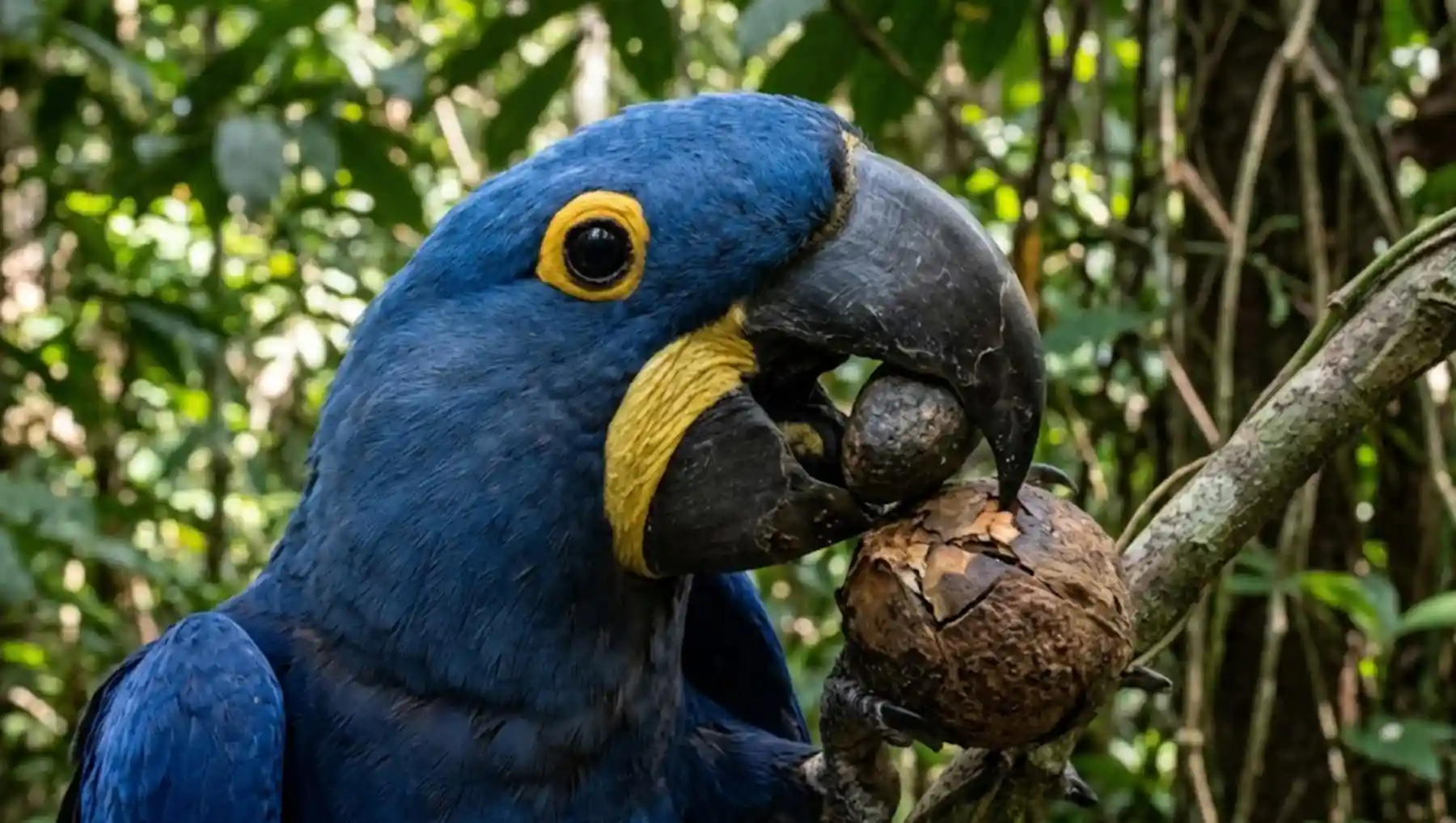
In the lowlands of the Amazon biome and along its transition zones, evolution shaped more than bright colours. It also shaped complex minds. The hyacinth macaw (Anodorhynchus hyacinthinus), the largest parrot species on the planet, is responsible for one of the rarest and most fascinating behaviours ever recorded by ornithology and, surprisingly, by primatology as well. The bird uses stones as tools. It picks up fragments of rock to increase leverage and crack open the extremely hard nuts of the bocaiuva palm (Acrocomia aculeata), its main food source. The phenomenon is scientifically established, and it dismantles the old assumption that tool use was a human privilege, or something restricted to a handful of higher mammals.
A sequence of decisions, not a lucky strike
The behaviour has been robustly documented by researchers and nature documentary makers in the Pantanal region and in parts of the Amazon, where bocaiuva palms grow in abundance. What impresses specialists is not simply the act of holding a stone with the foot. It is the chain of actions the task demands. The bird has to locate a suitable stone, carry it to the nut, settle the fruit into the right position and then apply the necessary force with almost surgical precision. Every step depends on the one before it, and none of them works in isolation.
That sequence is what animal behaviour researchers call practical intelligence. It points to planning ability and to an advanced grasp of mechanics, meaning the notion that an external object can change the outcome of an effort. And it points to something even more delicate: cultural learning. The technique is not born ready inside the bird. It is passed between generations, watched, copied and refined. A young macaw that has never seen an adult work with stones is unlikely to reach the same result on its own.
The secret of the bocaiuva and a monumental beak
The bocaiuva nut is known for an extremely rigid shell, designed by nature to protect a kernel rich in fats and proteins. For most animals in the forest that food simply does not exist. It is right there, visible, and still out of reach. The hyacinth macaw developed a monumental beak that works like a natural hydraulic shear, able to apply immense pressure to the fruit. It is one of the most powerful jaws in the bird world.
Even with that strength, the toughest nuts defeat the animal. And this is exactly where behavioural engineering comes in. By using the stone as a hammer or as a wedge, the macaw optimises its effort and reaches the food with less energy spent. The tool does not replace the beak. It complements it. An exhausting job becomes an efficient operation, which matters enormously for a large bird with high energy demands and a highly specialised diet.
Studies in functional morphology indicate that the skull and beak of Anodorhynchus hyacinthinus carry unique biomechanical adaptations that let the bird handle those forces without injuring itself. Yet tool use shows that biology is not the only road to survival. Cognition plays a decisive part. The body opens the door, and the brain decides how to walk through it.
Why primatology keeps watching a blue bird
The fascination this behaviour holds for primatologists is no accident. Tool use is one of the pillars in the study of human cognitive evolution and of the great apes. Watching a bird, a lineage phylogenetically very distant from mammals, perform a task of such complexity forces scientists to rethink the definitions of intelligence and learning. If the skill shows up on branches of the tree of life this far apart, then it is not a rare inheritance. It is a solution evolution arrives at more than once.
Even herpetology, devoted to reptiles and amphibians, gains from the discussion, because it highlights how different evolutionary lineages can converge on similar behavioural solutions. The question stops being who is intelligent and becomes which environmental pressures make intelligence appear in the first place.
A behaviour that can also go extinct
Keeping this technique alive depends on a healthy ecosystem where three things coexist at the same time: the macaws, the palms and the sources of suitable stones. Remove one of those elements and the chain breaks. Habitat loss, deforestation and wildlife trafficking threaten not only the species itself, but also this unique cultural tradition handed down between generations of birds. A macaw captured and taken into captivity does not merely vanish from the forest. It takes with it a piece of knowledge it will now never teach to anyone.
Conservation organisations such as Instituto Arara Azul and WWF Brazil carry out continuous monitoring and protection work for these birds and their habitats. The hyacinth macaw is treated as an umbrella species, meaning a species whose protection benefits countless others sharing the same ecosystem. Safeguarding the area it needs also safeguards, almost as a side effect, everything else living inside that area. Birdwatching tourism, when properly managed, can generate income for local communities and give them a direct reason to keep the forest standing.
There is a practical lesson in that arrangement for anyone designing conservation policy. Protecting a charismatic bird is easier to explain, easier to fund and easier to sustain politically than protecting an abstract stretch of vegetation. The macaw becomes the visible face of an invisible system of palms, nesting trees, soils and rivers. Its intelligence, so easy to admire, ends up serving as an argument for everything that surrounds it and never makes the headlines.
Environmental education and continuous science
Spreading accurate scientific information about the hyacinth macaw is a powerful tool against misinformation and trafficking. Knowing that these birds can learn complex behaviours increases respect for their existence and exposes the cruelty of captivity, where such natural behaviours simply cannot be expressed. Environmental education projects in Amazonian schools and communities are essential to raise the next generation of biodiversity guardians. Continuous scientific research, supported by institutions such as INPA, the National Institute for Amazonian Research, supplies the data needed to underpin effective public policy.
The hyacinth macaw is not merely a symbol of beauty. It is a reminder that intelligence takes many forms and that the barriers we draw between species are often artificial. Culture, creativity and problem solving are not human exclusives. By protecting this bird we preserve a unique chapter in the history of behavioural evolution, and we make sure future generations can still watch, with their own eyes, a monumental blue bird lifting a stone to open a feast in the crown of a palm tree.
Reporting: Anne Silva / Amazonia Mag. Source: Revista Amazônia, Instituto Arara Azul, WWF Brazil, INPA.

Editor · Amazonia Mag
Anne Silva is the editor of Amazonia Mag, the English-language edition of Revista Amazônia. She curates, translates and adapts the outlet's science and environment coverage for an international audience, reporting on Amazon wildlife, flora, rivers, climate and research. Every story she edits is grounded in peer-reviewed studies, official data and on-the-ground reporting from the Revista Amazônia newsroom in Belém, Pará, Brazil. More by Anne Silva →