
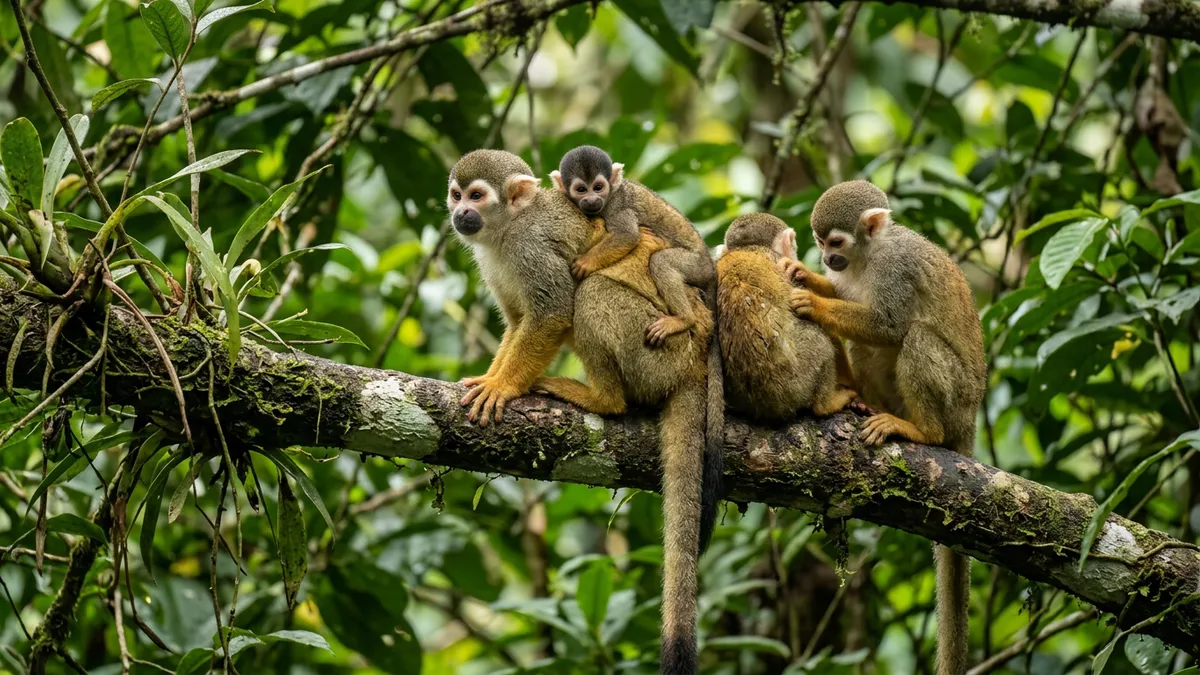
When night falls over the forest, squirrel monkeys (known in Brazil as macaco-de-cheiro) may stay pressed against one another on the same branch. The huddle is not only about taking up a resting place. It brings together the members of a large, tightly knit group, in which the infant also receives care from adults that are not its mother. During the first weeks of life, the youngster spends a good part of its time clinging to the backs of different group members, instead of being carried exclusively by the female that gave birth to it.
This behavior is called allomaternal care: a form of parental care shared by individuals other than the mother. In the squirrel monkey it includes carrying the infant, and it fits into a social routine defined by physical closeness. The mother remains a central reference for feeding and early protection, but other adults may carry the youngster while the group moves. The scene combines two traits that help define the animal: social cohesion and collective participation in raising the young.
A group that stays together to rest and to travel
The squirrel monkey is a diurnal primate, yet its social behavior also shows when the activity of the day ends. When choosing a branch for the night, the animals stay close, bodies touching and the distance between them reduced. Physical contact joins the group into a living structure in which each individual keeps its position and reacts to the movements of the others. This is not a single animal occupying a shelter, but several members sharing the same resting spot.
Cohesion is also useful by day, when the group searches for food among leaves, twigs and other parts of the vegetation. One individual may shift position, and the others follow the movement without losing proximity altogether. This arrangement makes it easier for infants to stay near adults and keeps companions available for watchfulness and interaction.
In social primates, living together does not depend only on calls or occasional meetings. It is built through contact, shared travel and tolerance among individuals who spend long periods very close to one another.
The infant changes carriers without leaving the group
In the first weeks, the infant stays clinging to an adult’s back during part of the group’s travel. The posture reduces the effort needed to keep up, because the youngster does not yet have the locomotion ability of the larger animals. Its body rests against the carrier’s back, while its hands and feet help it hold on to the fur. The mother may carry her infant, but what stands out in this species is that other adults take part in the task as well.
The handover does not mean the bond between mother and infant is abandoned. Allomaternal care adds other participants to the infant’s routine and widens the network of contact available inside the group. An adult that carries the youngster can make it easier for the mother to feed, let her move more freely, or simply keep the infant included in the group’s travel.
The passing from one carrier to another also shows that the infant is not treated as an isolated presence. It belongs to the social unit from the very beginning of its life.
The tail balances, but it is not a fifth hand
The squirrel monkey has a long tail, but it is not prehensile. This means it is not built to wrap around a branch and hold up the body, as happens in other Amazonian primates with grasping tails. The animal relies mainly on its hands and feet to hold on to branches. The tail contributes to balance, helping stabilize the body when the monkey moves along narrow, uneven supports in the canopy.
This anatomical difference changes how a photograph of the animal in the forest should be read. The tail can follow the line of the body, offset quick changes of direction and help control posture, but it should not appear coiled around the branch like a claw. The infant, for its part, uses the adult’s body as its means of transport, not the carrier’s tail. This distinction sets the squirrel monkey apart from other Amazonian primates and links anatomy, locomotion and social behavior.
Insects and fruit sustain the forest routine
The diet combines insects and fruit, two resources that lead the group to explore different parts of the vegetation. Insects supply animal matter, while fruit offers energy and other nutrients associated with plants. The search does not happen at a fixed point. The monkeys move through their surroundings, inspect branches and foliage, and take advantage of opportunities as availability changes. The primate’s small size favors exploring twigs and spaces that would be harder for larger animals to reach.
By eating fruit, the squirrel monkey also takes part in the ecological relationships that tie primates to forest plants. Eating turns fruit into food and may contribute to the movement of seeds, although the effect depends on the plant species consumed and on what happens to the seeds after they pass through the digestive system. Catching insects, meanwhile, places the animal as a consumer of small invertebrates.
The diet, then, is not a detail apart from behavior: it guides movement and helps explain why group life has to combine travel, contact and the carrying of infants.
What the scene reveals about the species
Seeing several squirrel monkeys resting on the same branch may look like a simple choice of shelter, but the scene records the social organization of a species that keeps large, cohesive groups. Seeing an infant on the back of an adult that is not its mother adds another layer. The carrying shows that responsibility for the youngster can be shared, and that staying with the group lessens the need for the infant to follow the canopy journeys alone.
The image is also a reminder that a primate’s life is not found only in the individual leaping between branches. It lies in the network of adults around it, in the body that serves as transport, and in the group that turns the forest into a shared space.
Reporting: Natália Santos / Amazonia Mag

Editor · Amazonia Mag
Anne Silva is the editor of Amazonia Mag, the English-language edition of Revista Amazônia. She curates, translates and adapts the outlet's science and environment coverage for an international audience, reporting on Amazon wildlife, flora, rivers, climate and research. Every story she edits is grounded in peer-reviewed studies, official data and on-the-ground reporting from the Revista Amazônia newsroom in Belém, Pará, Brazil. More by Anne Silva →