
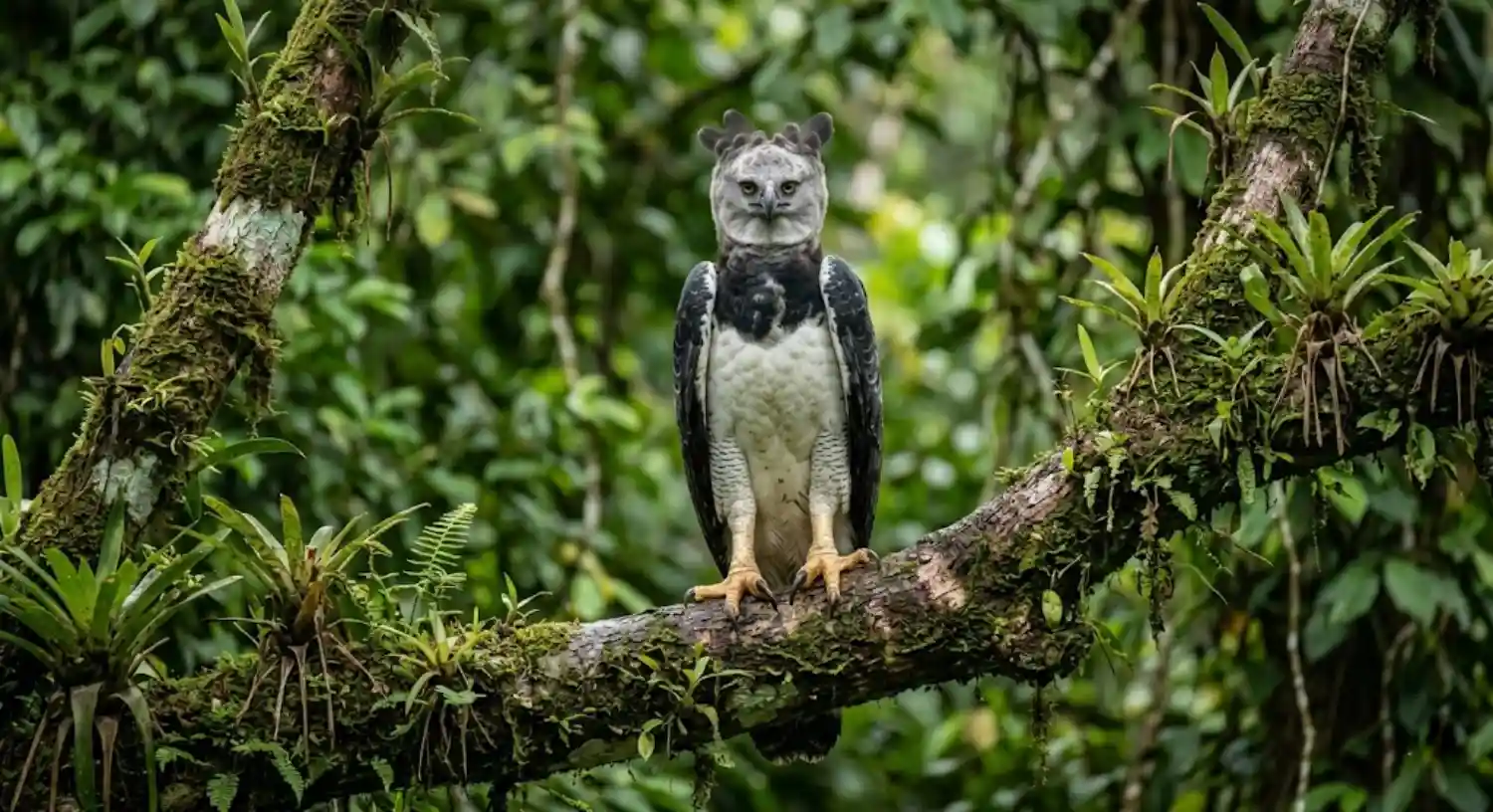
The harpy eagle has talons so large and powerful that they exceed those of a grizzly bear in size and strength. Science recognizes that the bird can apply overwhelming crushing force almost instantly. This evolutionary adaptation is not merely an intimidating accessory, but the primary tool of a highly specialized hunter.
Across the Neotropical region, the harpy eagle commands the low skies and the treetops. According to established biological knowledge, it is the heaviest and most powerful eagle in the Americas, a flying colossus that patrols the vast green ocean of the Amazon rainforest.
A body built for power
The Amazonian harpy eagle’s biological design is optimized for attack. Its rear talons, known as hallux claws, can measure more than four inches (10 centimeters), exceeding the size of human fingers. They work like piercing daggers, backed by the muscles of thick, powerful legs.
That structure allows the eagle to crush bones and puncture vital tissue within seconds. Such strength is essential for holding large, moving prey, including monkeys and sloths that live high in the canopy.
Its wingspan can reach nearly 6.6 feet (2 meters). Although impressive, the wings are short in relation to the bird’s weight, a feature that gives it the agility needed to maneuver skillfully through dense tree vegetation.
The harpy eagle’s imposing figure, as seen perched on a moss-covered branch in image_8.png, reveals gray-and-white plumage, a striking black collar and a forked crest. Yet its thick legs and yellow talons are what sustain its extraordinary power.
An ambush hunter in the canopy
The hunting strategy of Harpia harpyja depends on patience and surgical precision. Unlike other eagles that soar high on rising warm air, the harpy eagle prefers an ambush.
It settles on concealed, strategic branches and watches and listens carefully to the canopy for hours. When it detects prey, such as a distracted monkey, it launches a fast, silent and direct attack.
The eagle uses air currents moving through vegetation corridors to surprise its victim. It seizes the animal with lethal talons before the prey can recognize the threat, and the hunt is so efficient that the victim may be killed instantly by impact or crushing force.
Established biological knowledge indicates that harpy eagles also hunt other large canopy animals, including sloths and macaws. They adjust their techniques as necessary, depending on the prey and the surrounding vegetation.
A vast territory is essential
Supporting a predator of this size requires an enormous home range. A single harpy eagle or a breeding pair needs a territory that may cover dozens or even hundreds of square kilometers of intact primary forest, a vast area measured in square miles as well.
This territorial requirement is one of the main reasons the harpy eagle is rarely seen, even by experienced researchers or local communities. The species is naturally scattered across the forest, reflecting its biological need for abundant prey and enough space to forage without competition.
Harpy eagles patrol their domains with quiet authority and help control herbivore populations. The existence of active harpy territories is a strong indication that the surrounding forest remains in excellent conservation condition.
For that reason, the presence of this eagle reveals more than the survival of one predator. It points to a habitat capable of supporting large prey, emergent trees and a complex web of life throughout the canopy.
A slow and demanding breeding cycle
The harpy eagle’s reproductive cycle is long and demanding. Pairs build colossal nests at the tops of the tallest emergent trees, such as the samaúma, using thick branches and fresh foliage.
A pair generally raises only one chick every two or three years. It devotes considerable time to feeding the young bird and teaching it the complex hunting techniques required to survive in the canopy.
This low reproductive rate makes the species inherently vulnerable to environmental disturbances. Population recovery is slow, making the preservation of large blocks of continuous forest crucial to the reproductive success of this powerful-clawed Amazonian eagle.
The chick remains dependent on its parents for a long period. During that time, it learns to navigate and hunt within the forest’s dense green maze, an environment that demands coordination, patience and precision.
Silence as a form of protection
The rarity of harpy eagle sightings should not be viewed negatively. It is also evidence of the bird’s remarkable adaptation to a complex environment in which discretion and patience are essential.
Harpy eagles spend much of their time motionless and hidden among canopy foliage, often more than 98 feet (30 meters) above the ground. Their gray-and-white coloring, although striking in photographs, works as surprisingly effective camouflage against the bright sky and leaf shadows, breaking up the bird’s outline for predators and prey.
Established biological knowledge suggests that the forked crest, visible in image_8.png, may serve social signaling functions or even contribute to camouflage. When the bird is seen, however, the encounter can be transformative, reaffirming the grandeur and vitality of the Amazon rainforest.
The harpy eagle’s eyesight is another established biological wonder. Studies indicate that its eyes are extraordinarily sharp, capable of detecting small movements at great distances even under the diffuse light of the canopy.
That visual acuity, combined with sophisticated hearing, allows the eagle to locate and identify prey in a maze of leaves and branches. Its continued presence at the top of the food chain is a positive indicator of the health and integrity of the ecosystem that supports it.
The harpy eagle’s continued existence, patrolling the skies of the world’s largest tropical rainforest, testifies to nature’s resilience and to the importance of protecting the last strongholds of primary forest.
The species acts as an umbrella for biodiversity conservation. Protecting the vast territory required by a single harpy pair automatically protects thousands of other plant, animal and insect species that coexist in the same intact habitat.
Reporting: Anne Silva / Amazonia Mag

Editor, English Edition — Amazonia Mag
Anne Silva is the editor of Amazonia Mag, the English-language edition of Revista Amazônia. She curates, translates and adapts the outlet's science and environment coverage for an international audience, reporting on Amazon wildlife, flora, rivers, climate and research. Every story she edits is grounded in peer-reviewed studies, official data and on-the-ground reporting from the Revista Amazônia newsroom in Belém, Pará, Brazil. More by Anne Silva →