
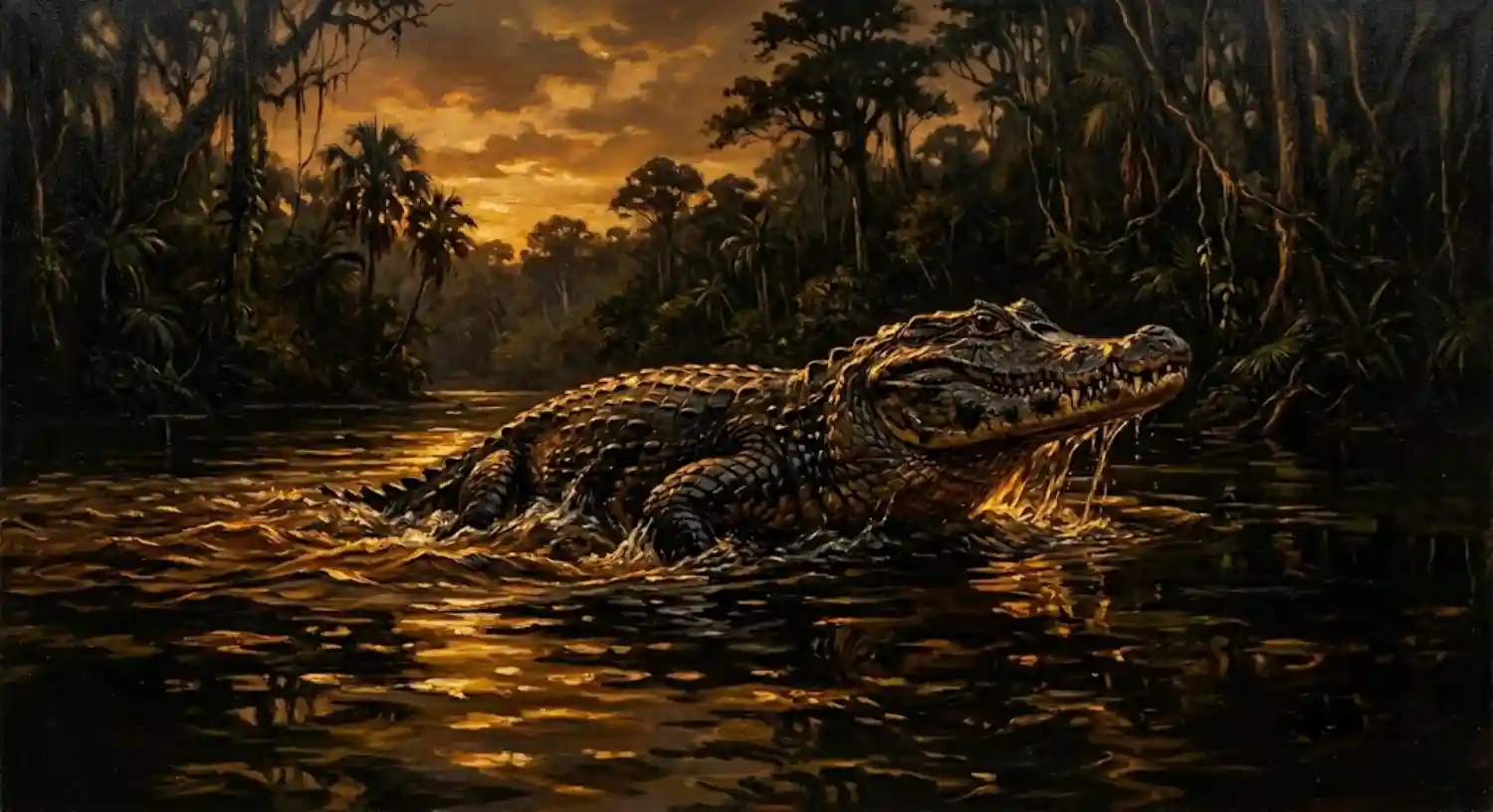
The black caiman is the largest predator in Amazonian waters, yet its relationship with fish is not simply that of a consumer that depletes resources. This enormous reptile needs proportionally less food than a mammal of equivalent weight to survive and thrive.
According to scientific understanding, its efficient ectothermic metabolism allows it to go for long periods without feeding after a large meal. That biological trait makes its effect on fish stocks surprisingly strategic and regulatory rather than simply destructive.
A predator with a regulatory role
This biology helps explain the indispensable role the black caiman plays in the health of the river and lake ecosystems of the planet’s largest drainage basin. In those waters, its presence is an important part of the balance among many forms of life.
Adult males can exceed 16.4 feet in length, or five meters, making the species Melanosuchus niger a powerful presence in rivers and floodplain lakes. Its importance, however, goes beyond its size and its position as a consumer.
The species’ ecology and behavior show that it also structures the environment. At the top of the food web, it acts as a silent sentinel in rivers and floodplain lakes, where its hunting patterns affect several levels of the ecosystem.
Its hunting habits are often crepuscular or nocturnal. The black caiman targets a broad range of prey, including fish, turtles, aquatic birds and even small land mammals that approach the shoreline.
Its continuing interaction with fish communities, however, reveals its most important contribution to the biome’s sustainability. The food web in which it participates does not depend on eliminating species, but on subtle and continuous regulation.
How it helps keep fish populations healthy
Studies indicate that apex predators tend to select slower, sick, older or genetically less fit individuals within prey populations. In fish communities, the selective pressure exerted by the black caiman can help keep schools healthy and vigorous.
By removing certain individuals, that pressure also helps prevent the spread of disease and encourages the reproduction of stronger animals. The predator’s impact, therefore, cannot be measured only by the number of fish it eats, but also by the effect it has on the quality and structure of fish populations.
Without this regulatory influence, dominant carnivorous or omnivorous fish could multiply unchecked. Examples include certain piranhas and large catfish, which could consume resources excessively and push smaller species into decline.
In this way, the black caiman acts as a key part of the food web. Its presence helps prevent one species from becoming excessively dominant and supports a more balanced distribution of aquatic life.
An ecosystem engineer during the dry season
The reptile’s positive influence extends beyond direct predation. During the dry season, when river levels fall sharply, adult black caimans often dig or deepen channels and holes in the beds of lakes and igapó areas.
These deep, permanent pools become vital refuges for many species of fish, turtles and aquatic invertebrates. Without them, animals could be trapped in shallow pools that would eventually dry out.
By helping those populations survive the difficult months, the black caiman acts as an ecosystem engineer. It also supports the rapid recolonization of flooded environments when the rains return.
The territorial behavior of large males adds another organizing function. By defending extensive areas against rivals and other medium-sized predators, such as spectacled caimans or smaller smooth-fronted caimans, they create zones of relative stability.
Within those territories, the density of smaller predators can be kept under control. Indirectly, some fish species may find safer places there for feeding and reproduction.
What happens when the giant disappears
The consequences of the black caiman’s absence are visible and troubling in areas where historical hunting or habitat degradation has sharply reduced its populations. Without the control exerted by this predator, the balance of the aquatic food web can be disrupted.
One possible result is a phenomenon known as a trophic cascade. Intermediate predators that were once controlled may increase rapidly, devastate herbivore populations and alter the composition of aquatic vegetation and the clarity of the water.
As the ecosystem loses complexity, it becomes more vulnerable to outside disturbances. Restoring black caiman populations is therefore not only a conservation goal for the species itself, but also an essential strategy for recovering the overall health of Amazonian rivers and lakes.
Black caiman reproduction further strengthens the species’ connection to its surroundings. Females build large nests from decomposing vegetation and mud along flooded shores, where they lay their eggs.
The heat produced by decomposition is vital for incubation. During this period, females fiercely protect their nests from predators such as coatis, tegu lizards and certain birds.
After hatching, the young remain vulnerable, but they represent a seasonal pulse of biomass entering the food web. Other birds, larger fish and carnivorous mammals can feed on that pulse, closing a vital cycle that nourishes both forest and water.
Watching an adult black caiman glide silently through the dark waters of the Amazon is to witness millions of years of evolutionary adaptation and coexistence. Its presence should not be viewed through simplistic fear, but with the respect due to a vital component of a complex and interdependent system.
Valuing wildlife and understanding its ecological roles are essential if future generations are also to marvel at the grandeur and efficiency with which nature organizes life across the world’s largest tropical rainforest. Protecting the black caiman ultimately means protecting the integrity and resilience of the entire Amazon Basin.
Recognizing the crucial importance of this regulatory predator is an invitation to understand that every creature, no matter how imposing or frightening it may seem, performs an irreplaceable role in the web of life. The absence of a single piece can destabilize the whole system.
Territorial guardian
Adult black caimans are extremely territorial. Studies indicate that a large male can patrol and defend a vast area of river or lake for years.
This behavior not only secures access to resources, but also regulates the species’ population density in the region. By helping structure the ecosystem, the territory defended by these large males indirectly affects the distribution of other aquatic species.
Reporting: Anne Silva / Amazonia Mag

Editor, English Edition — Amazonia Mag
Anne Silva is the editor of Amazonia Mag, the English-language edition of Revista Amazônia. She curates, translates and adapts the outlet's science and environment coverage for an international audience, reporting on Amazon wildlife, flora, rivers, climate and research. Every story she edits is grounded in peer-reviewed studies, official data and on-the-ground reporting from the Revista Amazônia newsroom in Belém, Pará, Brazil. More by Anne Silva →