
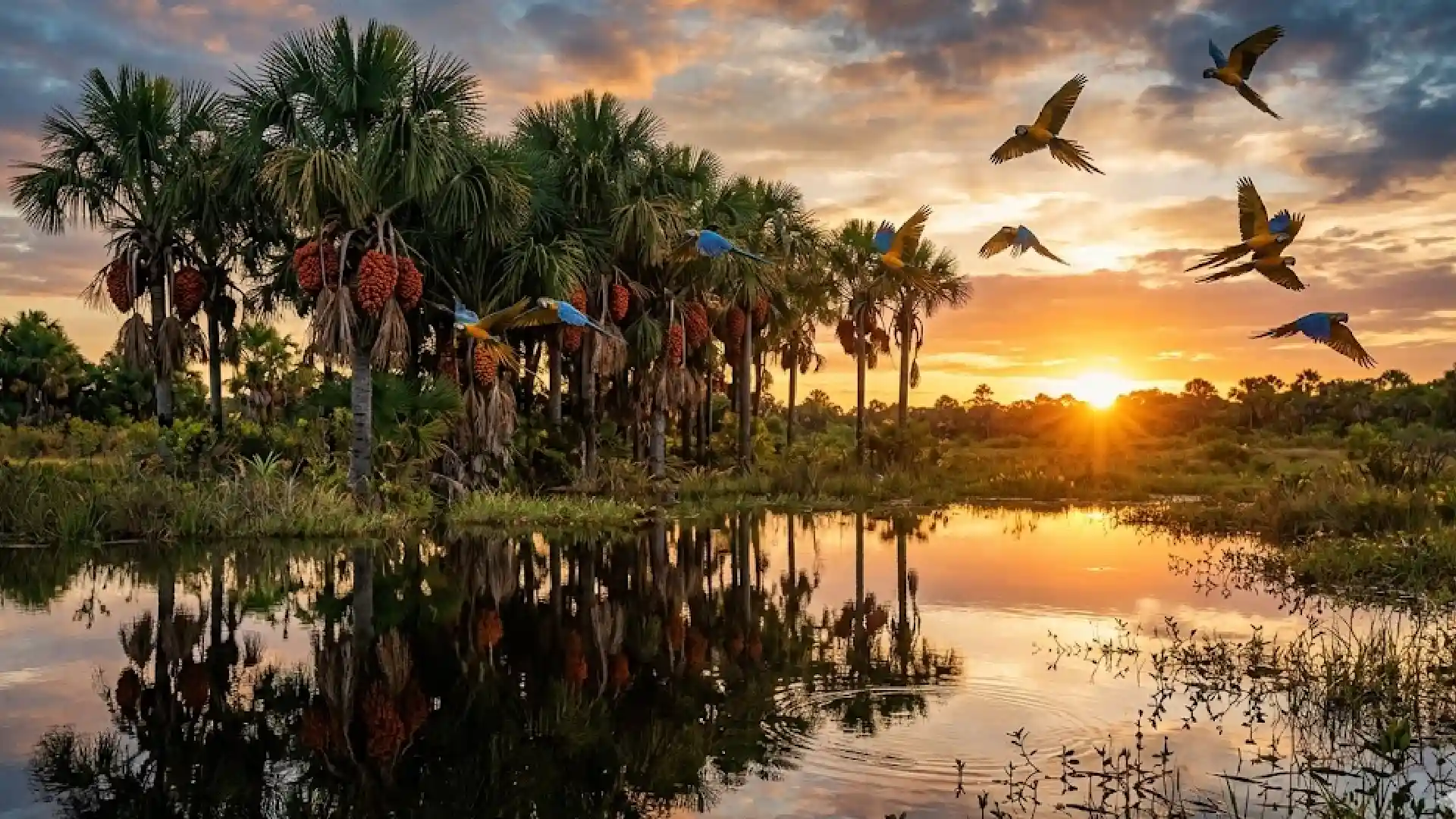
In the heart of the Cerrado, where the water table breaks the surface and creates oases of biodiversity known as veredas, stands the buriti palm (Mauritia flexuosa). For Indigenous peoples and traditional communities it is, without exaggeration, the “palm of life.” It is not merely a feature of the landscape. It is an ecological and economic pillar that manages to feed blue-and-yellow macaws, the threatened maned wolf and entire families of riverside dwellers and extractivists all at once.
The synchrony between the buriti’s fruiting and the needs of wildlife and people is one of the most beautiful and efficient examples of interdependence in any Brazilian biome.
The pillar of the veredas and natural water engineering
The buriti is a dioecious palm, meaning there are separate male and female plants. It can grow up to 115 feet (35 meters) tall and lives only in waterlogged soils or where the water table lies very close to the surface. That requirement makes it both an indicator and a protector of the veredas, fundamental ecosystems that work as the water tanks of the Cerrado, keeping rivers flowing even in the dry season.
Its deep, dense roots form a network that stabilizes the banks of watercourses and prevents erosion, while its giant leaves capture moisture from the air and help recharge the water table.
Beyond its role in water, the architecture of the palm creates essential habitat. Its dense, tall crowns offer safe nesting sites and shelter for a multitude of birds, insects and small mammals. The presence of buritis is a sign of clean water and abundant life, so protecting the palm is closely tied to protecting the water resources of the whole Cerrado, a biome that supplies major river basins on the continent, among them the Tocantins-Araguaia.
A banquet for wildlife
The fruiting of the buriti is an event of seismic proportions in Cerrado ecology. The bunches can weigh more than 220 pounds (100 kilograms) and carry hundreds of oval fruits covered in shiny brown scales. They ripen over several months, so the supply of food is constant. The orange, oily pulp is highly energetic and rich in vitamin A.
Macaws, especially the blue-and-yellow macaw (Ara ararauna), are regular visitors. They use their powerful beaks to break the hard shell and reach the pulp, and by carrying the fruits away they act as important long-distance seed dispersers.
On the ground, when ripe fruits fall, another group of “customers” is waiting. The maned wolf (Chrysocyon brachyurus), the largest canid in South America, finds in the buriti a crucial food source, especially in the dry season, when animal prey becomes scarcer. Its omnivorous diet makes it dependent on the “lobeira” and on the buriti as well.
Other animals, such as tapirs, white-lipped peccaries, capuchin monkeys and agoutis, also feast on fallen fruit, ensuring local dispersal and the renewal of the palm. Even the death of an old buriti gives something back to wildlife: the trunk stays upright for years and provides perfect cavities where macaws and smaller parakeets known as maracanãs can nest.
Sustainability and a livelihood for communities
For the people who live in the Cerrado and in the transition zones toward the Amazon, the buriti means food security and income. Sustainable harvesting of the fruit is a centuries-old tradition. From the orange pulp, rich in vegetable oils and beta-carotene, people make the famous buriti sweet, ice cream, popsicles, cooking oils and high-quality cosmetics.
Buriti oil is one of the richest in provitamin A known to science and has recognized medicinal properties, such as healing and acting as a natural sunscreen. It is the subject of advanced research at the University of Brasília (UnB).
The uses of the buriti go well beyond food. The trunk, or stipe, yields timber for rustic construction. The giant leaves are used to thatch roofs, the traditional palhoças, and to make refined crafts such as bags, hats and mats. Even the calcareous formations that build up around the roots are used to correct soil.
This multiple-use approach, based on traditional knowledge and on harvesting that does not kill the plant, makes the buriti a model of sustainable development for the Cerrado. It shows that a biome can be kept standing while still generating wealth.
Threats, and why scientific accuracy matters
Despite its enormous importance and its resilience, the buriti and the veredas face serious threats. The advance of the agricultural frontier, with wetlands drained to plant monocultures and the water table pumped without restraint for irrigation, is drying out the veredas and killing the palms. Uncontrolled fire is another pressure: although the Cerrado is a fire-adapted biome, fire that burns too intensely or too often destroys nests in the palms and undermines natural regeneration.
In the face of misinformation, journalism has to rest on established facts. Claims of miracle cures based on the buriti, or unfounded assertions that it can purify polluted water regardless of where it grows, pull attention away from the real threats and weaken conservation efforts built on the full protection of the vereda ecosystem.
Science, through institutions such as Embrapa Cerrados, has validated traditional knowledge and provided technical data on the palm’s productivity and ecology, which are essential for sustainable management plans.
The buriti is more than a palm. It is an organism that weaves the web of life in the Cerrado. Its existence guarantees water for rivers, energy-rich food for emblematic wildlife and a dignified living for traditional communities. By protecting the buriti and its habitat, the veredas, we preserve not just one species but a living, complex and irreplaceable system that defines the identity and survival of much of central Brazil.
The “palm of life” offers a forceful lesson about what real sustainability means. Nature does not work in watertight compartments: the same fruit that feeds the macaw in the sky and the wolf on the ground also sustains the riverside family, while its unseen roots secure the water that all of us drink, including people in big cities.
Buriti oil and health
The oil extracted from buriti pulp is regarded as a superfood and an outstanding cosmetic ingredient. It is the richest natural source of beta-carotene (provitamin A) known to science, surpassing the carrot. That substance is a powerful antioxidant that protects skin from the damage of UV rays and from premature aging.
In food, the oil is rich in monounsaturated fatty acids (omega-9), which benefit cardiovascular health. The traditional medicinal use of the oil for healing wounds and treating burns also has scientific backing.
Reporting: Anne Silva / Amazonia Mag

Editor · Amazonia Mag
Anne Silva is the editor of Amazonia Mag, the English-language edition of Revista Amazônia. She curates, translates and adapts the outlet's science and environment coverage for an international audience, reporting on Amazon wildlife, flora, rivers, climate and research. Every story she edits is grounded in peer-reviewed studies, official data and on-the-ground reporting from the Revista Amazônia newsroom in Belém, Pará, Brazil. More by Anne Silva →