
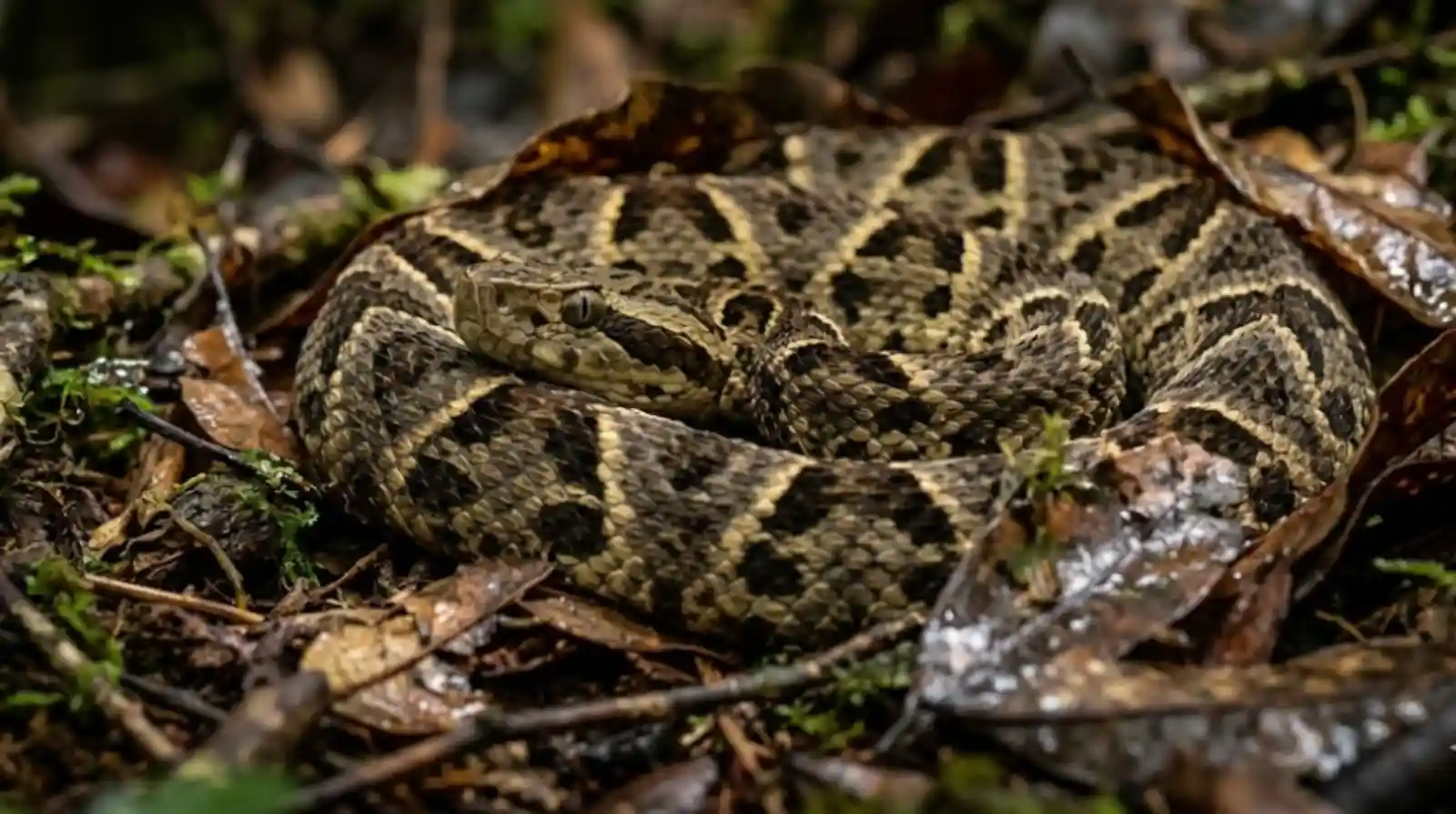
Bothrops jararacussu, known in Brazil as the jararacuçu, has a striking biological capacity that sets it apart from every snake in South America: it can inject up to 800 milligrams (about 0.03 ounces) of venom in a single bite. That is far more than any other Brazilian snake, which makes an encounter with this animal a matter of major medical and scientific importance.
Although its reputation often inspires fear, the jararacuçu plays a fundamental role in the balance of Atlantic Forest ecosystems and transition areas, where it acts as a natural control on populations of small mammals and amphibians. Understanding of the species has changed dramatically in recent decades, moving from the stigma of danger to the status of an ally of modern medicine in cutting-edge research in Brazil.
The biological power of Bothrops jararacussu
The jararacuçu is feared not only for the volume of its toxins but also for its physical robustness: it can reach up to 7.2 feet (2.2 meters) in length. Its scale pattern, alternating shades of yellow and black (or dark gray), provides perfect camouflage on the floor of tropical forests.
According to studies by the Butantan Institute, the venom of this snake is a complex mixture of proteins and enzymes that cause proteolytic, hemorrhagic and nephrotoxic effects. Unlike other species in the genus Bothrops, the adult jararacuçu tends to be more lethargic, but its strike is surgically precise.
The biology behind this mass production of venom is an example of evolutionary adaptation: it allows the animal to subdue large prey with maximum efficiency and to secure its survival in competitive environments.
The science behind cures and innovation
Although its venom is potent, it also represents one of the largest natural pharmacies on the planet. Brazilian researchers have isolated peptides in its secretion that show antibacterial properties and even potential as treatments for chronic diseases.
A notable example is research aimed at understanding how certain venom molecules may inhibit the replication of viruses, a field of study that drew global attention in recent years.
Brazil’s biodiversity, protected by institutions such as the Ministry of the Environment and Climate Change, is the foundation of these discoveries. Without preserving this snake’s natural habitat, we would lose not only a top predator but entire genetic libraries that national science has not yet finished cataloging.
A vital role in the balance of biodiversity
The presence of the jararacuçu in a forest area is an indicator of environmental health. As a top predator, it controls the population of rodents that, in excess, could upset the regeneration of seeds and young plants.
Conserving the species depends on environmental education and on dispelling the idea that snakes should be killed. Conservation initiatives in Brazil show that coexistence is possible when people have information. By respecting the territory of these animals and avoiding deforestation, we ensure that the food chain keeps working in harmony.
The jararacuçu is, in the end, a silent guardian of the forests, keeping alive the cycle of renewal of Brazilian fauna and flora.
Medical care and the antivenom network
In the event of an accident, Brazil’s health network is a world reference in treating snakebites. Antibothropic serum is the effective treatment and must be given as quickly as possible at specialized health facilities. Success depends on speed and on the availability of the immunobiological product that the country manufactures on a large scale.
It is essential to stress that self-medication and home techniques, such as cutting the skin at the bite site, are dangerous and are advised against by specialists at the Oswaldo Cruz Foundation (Fiocruz). Popular knowledge must be joined with scientific knowledge so that rural communities and nature enthusiasts know how to act, turning fear into respect and responsible caution around wildlife.
The production of snake antivenom in Brazil is a rigorous process that involves the ethical extraction of venom, followed by the immunization of horses in controlled environments. The plasma of these animals, rich in antibodies, goes through purification and quality control until it becomes the medicine that saves thousands of lives every year.
This work of excellence places Brazil at the forefront of world herpetology and shows that investing in national science is the best path for public health and environmental conservation.
Sustainability and the future of the Atlantic Forest
Protecting the remaining fragments of Atlantic Forest is the most important step toward making sure the jararacuçu and thousands of other species continue to exist. Sustainable ecotourism and the creation of Private Natural Heritage Reserves (RPPNs) have proved to be viable paths for combining human development with preservation.
When we value the standing forest, we value every being that lives in it. The jararacuçu, with all its imposing presence and biochemical complexity, is a symbol of Brazil’s natural wealth. Promoting sustainability is not only about saving trees. It means understanding that every component of an ecosystem, from the smallest insect to the largest snake, has an irreplaceable function in sustaining life on Earth.
Over 25 years of coverage by Revista Amazônia, we have watched a shift in how Brazilians see their wildlife. Where there was once only the instinct to defend oneself, scientific curiosity and pride in biodiversity now flourish. The jararacuçu should not be seen as a villain but as a masterpiece of biological evolution. Understanding its biology and the importance of its venom for medicine is the first step toward peaceful coexistence.
Protecting nature is, above all, an act of collective intelligence, in which every preserved species is a guarantee of a future for the generations who will live on this land. The existence of the jararacuçu reminds us that the strength of nature lies in the balance between danger and cure. By protecting the forests where it glides, we protect our own future and the medical solutions still to come from its scales.
Reporting: Anne Silva / Amazonia Mag

Editor · Amazonia Mag
Anne Silva is the editor of Amazonia Mag, the English-language edition of Revista Amazônia. She curates, translates and adapts the outlet's science and environment coverage for an international audience, reporting on Amazon wildlife, flora, rivers, climate and research. Every story she edits is grounded in peer-reviewed studies, official data and on-the-ground reporting from the Revista Amazônia newsroom in Belém, Pará, Brazil. More by Anne Silva →