
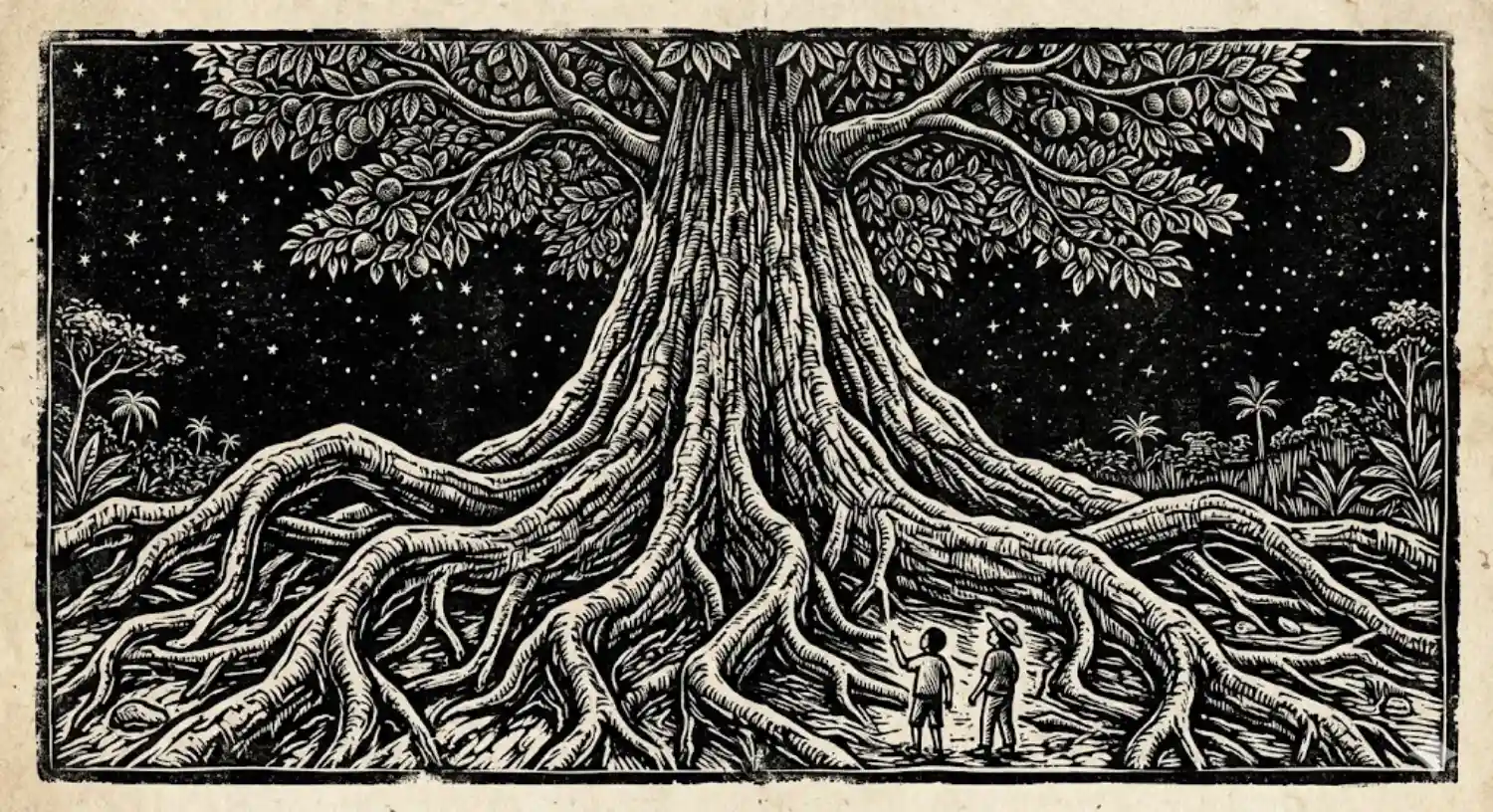
The Brazil nut tree, Bertholletia excelsa, is one of the Amazon rainforest’s giants. Its reproductive system is so complex that the species cannot multiply without the simultaneous action of two animals and the integrity of its natural habitat.
The Eulaema bee, the agouti and a continuous forest form an ecological alliance that allows a new Brazil nut tree to exist. If any one of these elements disappears, the entire cycle is placed at risk, from pollination to seed germination.
This three-part dependence is one of the clearest lessons in how life is woven through tropical ecosystems. A Brazil nut tree can live for centuries, making it a living record of a biological connection that links plants, animals and the environmental conditions of the forest.
A flower that only certain bees can open
The first crucial obstacle in the tree’s reproduction is pollination. Brazil nut flowers have a complex structure, with overlapping petals that hide the nectar and pollen. That arrangement prevents most insects from reaching the parts required for fertilization.
Science recognizes that only bees in the genus Eulaema have the size, strength and behavior needed to open these flowers. When the bees enter, they become covered in pollen from other trees and can carry it to a different flower, making cross-pollination possible.
The flowers release specific fragrances at the right time to attract these bees. The relationship is therefore more than a casual insect visit. It is a precise meeting between the flower’s structure, the bee’s ability and the timing of the fragrance.
No other insect can replace Eulaema bees in this task. Their presence also depends directly on forest integrity, because they need a continuous forest environment in which to nest and find food throughout the year.
The fruit’s long journey to the forest floor
Once the flower has been fertilized, the fruit begins to develop. It is a woody, extremely tough pod that protects the seeds, commonly called Brazil nuts, for more than a year. The hard covering keeps the seeds protected while the fruit matures on the tree.
Studies indicate that the pod can take more than a year to mature and fall. When it reaches maturity, it drops to the forest floor, where the second stage of the species’ reproductive alliance begins.
The pod’s hardness prevents most animals from eating the nuts. This is when the agouti becomes the second irreplaceable actor in the process. This rodent is the only creature capable of breaking the tough shell with its sharp incisors.
The agouti does not eat every nut immediately. It buries the surplus to consume during times of scarcity and, in doing so, acts as a seed disperser. The seeds are moved away from the tree that produced them and may reach other parts of the forest floor.
Studies indicate that many of the buried seeds are forgotten by the agouti or never recovered. In those places, they can find the soil and moisture conditions needed to germinate and produce a new Brazil nut tree.
Why a new tree needs the forest’s shade
The third part of the system is an intact forest. The Brazil nut tree is a climax species, meaning that it needs a mature, continuous forest environment in order to germinate and develop.
Its seeds cannot withstand direct exposure to the intense sun of deforested or fragmented areas. They need the shade and stable microclimate provided by the tropical forest canopy. Without that protection, a seed buried by an agouti may rot, or the seedling may die before becoming a mature tree.
For this reason, forest fragmentation affects more than germination. It also threatens populations of Eulaema bees and agoutis, disrupting every stage of the reproductive system.
A Brazil nut tree isolated in a deforested area may remain alive for some time, but its ability to produce offspring is severely reduced. The survival of a mature tree in an isolated pasture is only an echo of a forest that is gone. It becomes a living dead tree, unable to generate descendants.
Fragmentation, pollination and the loss of dispersers
Environmental degradation and the fragmentation of the Amazon represent a direct threat to this delicate balance. When Brazil nut trees become isolated, Eulaema bees, which are long-range pollinators, are prevented from moving between trees to carry out cross-pollination.
The result can be fruit containing infertile seeds or a smaller number of seeds. It is not enough for an adult tree to remain standing. Reproduction depends on animals being able to move and on the forest conditions remaining connected.
Habitat loss for agoutis and excessive hunting also reduce the populations of these dispersers. With fewer agoutis, seed dispersal declines, limiting the formation of new Brazil nut stands.
The problem, therefore, is not simply the disappearance of one plant or the loss of one animal. Altering one part of the network affects the others, because the flower needs the bee, the fruit depends on the rodent and the seed needs the forest to complete its development.
Protecting Brazil nuts means protecting the network
Community-based, sustainable management of Brazil nuts, carried out by traditional and Indigenous peoples, is one of the most effective strategies for conserving the species and the forest. The traditional knowledge of these communities recognizes the importance of protecting the habitat of the trees, their pollinators and their seed dispersers.
By giving Brazil nuts economic value, communities create an incentive to keep the forest standing and preserve the integrity of its ecosystems. The product that reaches people depends on a relationship that begins long before collection, with a bee visiting a flower and an agouti burying a seed.
Brazil nuts are not merely a product. They are the result of a millennia-old biological alliance that supports human and nonhuman lives in the Amazon.
Every nut we eat carries the story of that deep connection. It also reminds us that the rainforest is not simply a collection of trees, but a complex and fragile network of relationships in which every life, however small it may seem, has a fundamental role.
Protecting the Brazil nut tree means keeping all the elements of this system together: Eulaema bees capable of pollinating its flowers, agoutis that open the pod and disperse the seeds, and a mature, continuous and protected forest. Only then can a tree that may live for centuries continue to produce descendants.
Reporting: Anne Silva / Amazonia Mag

Editor, English Edition — Amazonia Mag
Anne Silva is the editor of Amazonia Mag, the English-language edition of Revista Amazônia. She curates, translates and adapts the outlet's science and environment coverage for an international audience, reporting on Amazon wildlife, flora, rivers, climate and research. Every story she edits is grounded in peer-reviewed studies, official data and on-the-ground reporting from the Revista Amazônia newsroom in Belém, Pará, Brazil. More by Anne Silva →