
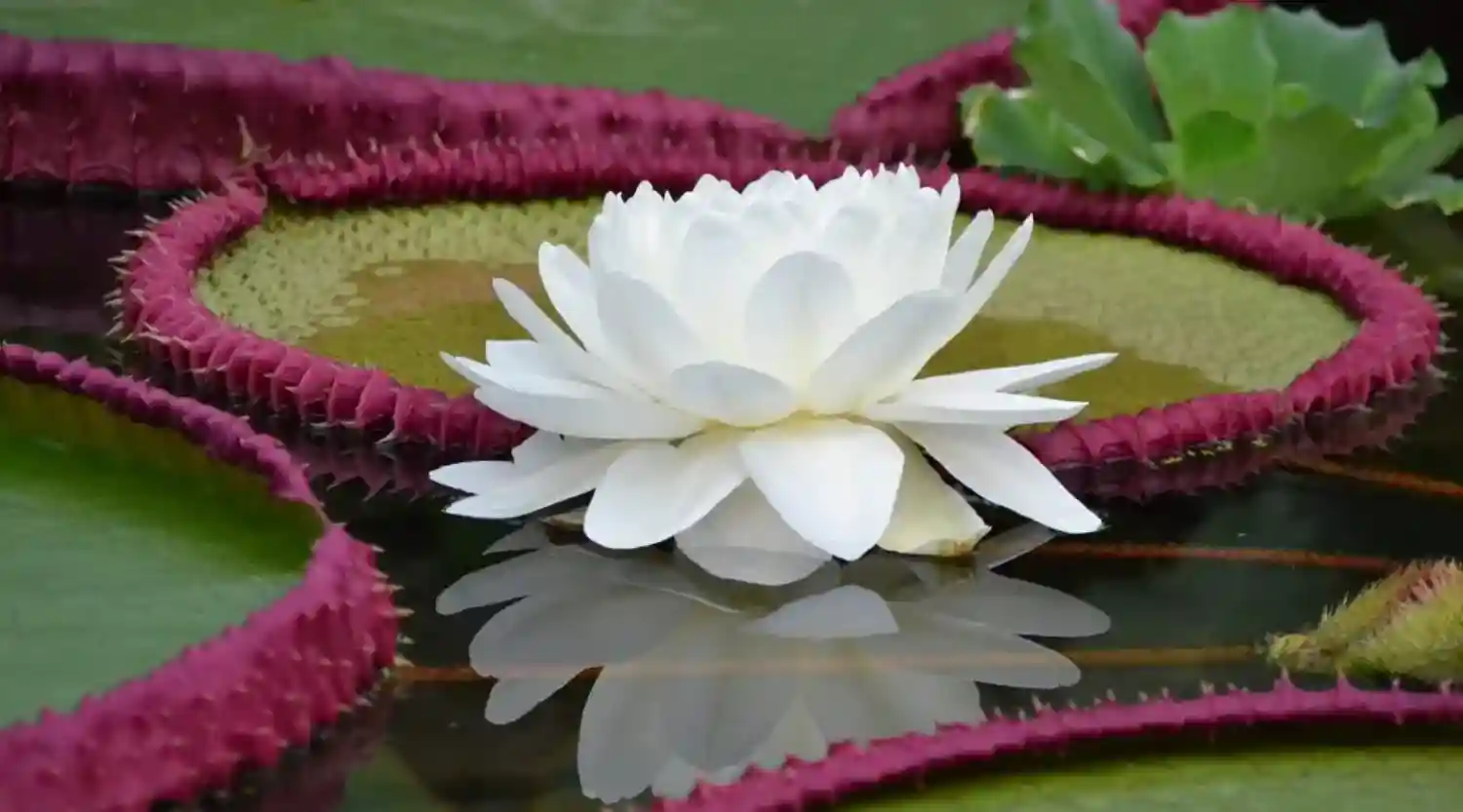
Victoria amazonica, one of the largest aquatic plants on the planet, turns its only two nights of flowering into a finely timed strategy for reproduction. During that brief period, the flower does more than change color. It also changes sex and coordinates a carefully structured relationship with pollinating beetles.
The scene resembles a hidden courtship dance unfolding after dark in the Amazon. First, a white, fragrant and warm flower opens to attract the insects and receive them inside. Then the same flower opens again in pink or purple, releases pollen and allows the beetles to leave for another flower.
According to studies of this phenomenon, the heat produced by the flower has a decisive role. Floral thermoregulation raises the temperature at the center above the surrounding temperature, creates a welcoming refuge for nighttime visitors and helps disperse the aromatic substances that make up the flower’s invitation.
A flower arranged in two acts
The reproductive life of Victoria amazonica unfolds in two distinct acts. In the first, the flower opens at dusk in white, like a star reflecting moonlight across the river. That first appearance accompanies a stage in which the female reproductive parts are ready for the pollinators’ visit.
For the beetles, the invitation does not rely on a single signal. An irresistible fragrance combines with heat generated inside the flower, a process known as floral thermoregulation. The temperature at the center can rise significantly above the surrounding temperature, a notable contrast during a cold Amazonian night.
Studies indicate that the warming also helps disperse the aromatic substances. By extending the reach of the fragrance, the flower strengthens its call at the moment when it needs to find its visitors. Heat, therefore, is not merely a source of shelter. It is part of the communication between plant and animal.
Attracted by the promise of food and protection, the beetles enter the flower. When morning arrives, it closes and holds them inside for the day. The structure becomes a kind of treasure chamber, where the insects find the resources they need to remain active until night returns.
Shelter that keeps the pollinators active
Inside the flower, the beetles feed on nectar and on the female reproductive parts. This meal supplies the energy required for the task still ahead. Their daytime confinement is part of the sequence because it prepares the visitors for the next stage of pollination.
Science also recognizes that the flower’s heat speeds up the metabolism of the pollinating beetles. With greater activity, they can feed and mate inside the flower, remaining vigorous until the second evening. In this way, the higher temperature participates in several parts of the partnership, from the first attraction to the insects’ preparation.
This stay inside the flower is not an incidental part of the cycle. Victoria amazonica keeps the beetles within its structure throughout the day and coordinates their release with the maturation of the male parts. While the insects remain fed and sheltered, they are carried through the biological sequence that will make pollen transport possible.
The flower turns a period of confinement into a preparation phase. Shelter receives the visitors, food sustains their energy and heat supports their activity. When the next opening occurs, the beetle is ready to leave carrying the reproductive material needed for its next visit.
On the second night, color and sex change
At dusk on the second day, the flower opens again, but it is no longer white. Its new color may be pink or purple, a visible change that signals the transition to another stage of the cycle. For the beetles, the shift in color acts as a visual invitation to continue the relationship.
During this second opening, the male parts of the flower have matured. They release pollen, which covers the insects completely while they are still inside. The visitor that entered in search of food and shelter now carries the flower’s reproductive contribution.
The beetles leave Victoria amazonica with renewed energy and their bodies covered in pollen. Their next step is to visit another flower during its first night of flowering. By carrying pollen between these different stages, they ensure fertilization and contribute to genetic diversity.
The sequence is brief, but its organization is precise. On the first night, the white flower attracts and receives the insects. During the day, it holds them inside. On the second night, it reopens in color, reaches the male stage of its cycle and sends the beetles onward in the next movement of the nighttime ballet.
A partnership that supports the ecosystem
The relationship between the plant and the beetles shows how flora and fauna can cooperate in reproduction. The insect receives nectar, female reproductive parts, shelter and warmth. The flower, in turn, gains a pollen-transport service when the beetle leaves to visit another flower on its first night.
This cooperation is fundamental to ecosystem health. Pollination allows the reproductive cycle to continue and supports the ongoing life of the species. In Victoria amazonica, floral thermoregulation and nighttime flowering reveal an especially elaborate biological solution for survival and the continuation of life.
The phenomenon also shows that a flower does not need to remain open for many days to perform a decisive function. Its only two nights concentrate changes in color, shifts in sexual function, heat production, fragrance release, feeding by visitors and the transport of pollen.
According to studies of the species, each stage connects to the next. Heat attracts the beetles and helps spread the scents. Closure keeps them inside. Food and warmth support their activity. The color change accompanies the next opening, and the maturation of the male parts covers the insects with pollen.
This nocturnal cycle is a reminder of the complexity of Amazonian relationships. The flower and the beetle do not act in isolation. Their actions fit together in a sequence that depends on signals, timing and opportunity, producing a brief but essential partnership for fertilization and genetic diversity.
Every breath of the forest invites us to understand that life finds ways to continue when it has the space and respect needed to flourish. In Victoria amazonica, that path passes through two nights, a change in color, self-generated warmth and the quiet work of beetles carrying pollen onward.
Reporting: Anne Silva / Amazonia Mag

Editor, English Edition — Amazonia Mag
Anne Silva is the editor of Amazonia Mag, the English-language edition of Revista Amazônia. She curates, translates and adapts the outlet's science and environment coverage for an international audience, reporting on Amazon wildlife, flora, rivers, climate and research. Every story she edits is grounded in peer-reviewed studies, official data and on-the-ground reporting from the Revista Amazônia newsroom in Belém, Pará, Brazil. More by Anne Silva →