
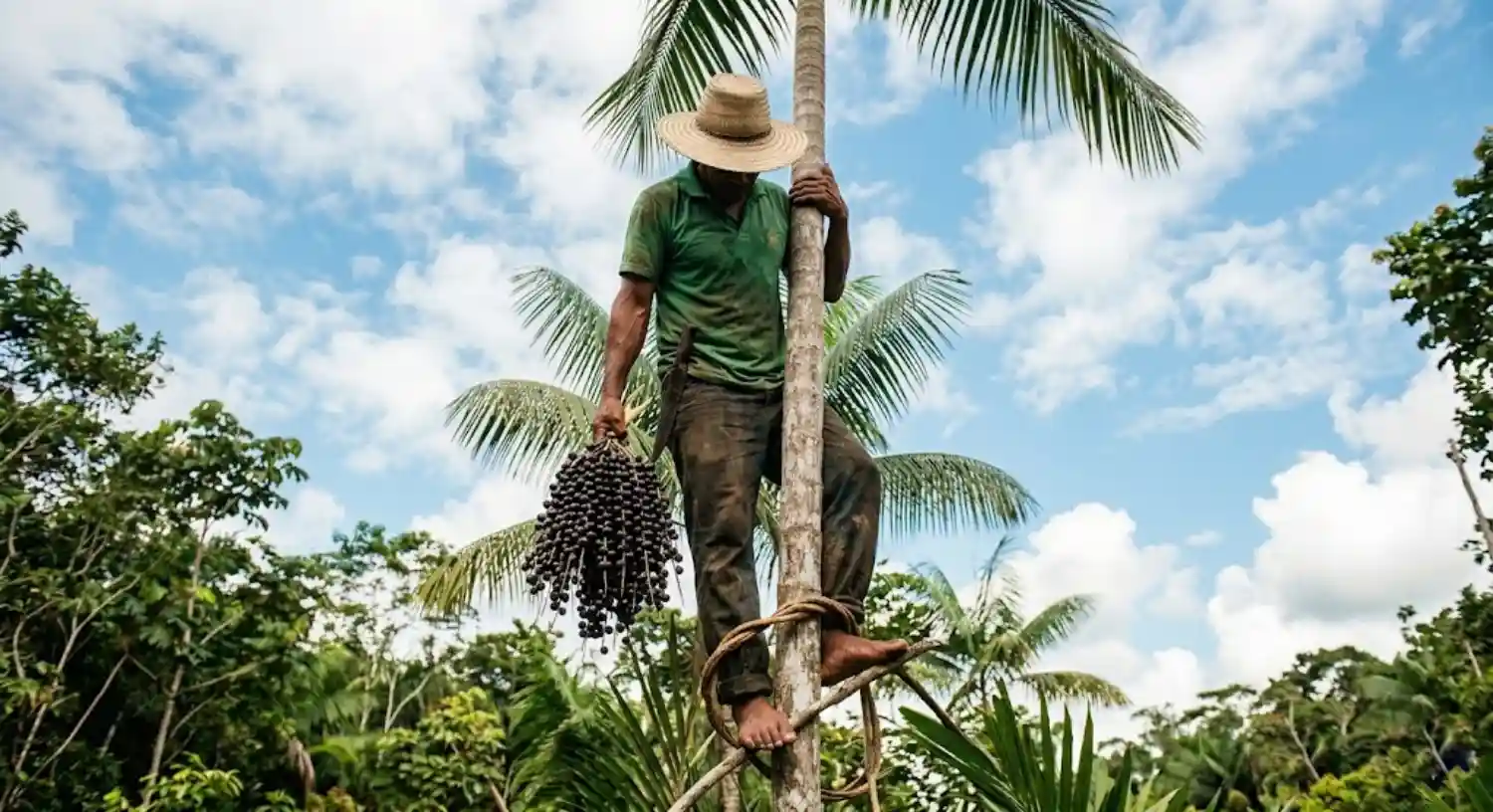
A palm adapted to flooded forests
The açaí palm, Euterpe oleracea, thrives in várzea floodplains and igapó forests, where its adapted roots can breathe in soils periodically flooded by the movement of the tides. In these environments, water is not an exception but part of the natural rhythm of the forest.
These ecosystems cover broad areas of the Amazon, especially around the estuary. They form dense native açaí groves that play an important role in soil stability and in maintaining local biodiversity.
The complex interaction among the palm, the flow of water and the management carried out by riverside communities is a classic example of ecological balance. The natural regeneration of the palm groves helps ensure the continuity of a resource that is vital to both the forest and the people who depend on it.
It is in this challenging environment that the açaí harvester carries out one of the region’s most distinctive activities. To gather the fruit that feeds communities and consumers around the world, the harvester performs a vertical choreography on the palm trunk.
Climbing with a peconha
The açaí palm is a slender species that can reach impressive heights of 20 meters, or about 66 feet, or more. Clusters filled with small, dark fruits grow at the top of the crown, protected by long, leafy fronds.
The climb begins with preparing the peconha, also known as a vine bow. This simple but highly effective tool is made from a braid of natural fibers gathered from the forest itself.
The harvester fastens the peconha to the feet, creating a loop that grips the rough palm trunk. The climbing technique requires considerable physical strength, as well as a refined sense of balance and coordination.
The harvester drives the body upward while embracing the trunk with both hands. At every movement, the peconha gives the feet traction, allowing a rapid ascent that demonstrates agility and ancestral knowledge while appearing to defy gravity.
The absence of modern safety equipment is a notable feature of the practice. The climb relies on confidence in the technique, control of the body and a close connection with the natural environment where the work takes place.
Once at the top, the harvester uses a machete to cut the ripe cluster. The cluster is held firmly before the descent begins, and although the way down may be faster, it requires equal care to avoid damaging the fruit or the harvester’s own body.
Harvesting without cutting down the palm
Manual açaí harvesting is a tradition passed from one generation to the next. It has been shaped by necessity, by detailed knowledge of the palm groves and by respect for the forest that supplies the fruit.
The importance of this work extends far beyond obtaining food. Unlike monoculture or cutting down the palm to extract heart of palm, a practice that historically decimated many açaí groves, fruit extraction is inherently sustainable.
The harvester removes only ripe clusters and leaves the palm standing so it can continue to grow and produce in later harvests. This approach preserves the structure of the várzea forest rather than replacing it with a single crop.
It also allows sunlight to enter the canopy in a balanced way. Other plant and animal species can continue to coexist in the native açaí groves while riverside families maintain an income connected to their territory.
According to studies cited on the management of native açaí groves, controlled thinning of competing species and proper cleaning around the clumps allow the palms to receive more light and nutrients. The result is larger clusters and better-quality fruit, without agrochemicals or the conversion of the forest into a monoculture.
Extractive harvesting keeps the forest standing while giving value to the knowledge and culture of traditional communities. Protecting local biodiversity is therefore connected to securing income for riverside families.
Seasonality shapes the riverside economy
Seasonality sets the pace of harvesting in the estuary. Although the açaí palm can produce fruit during much of the year, there are specific peak harvest periods that vary according to the region’s rainfall pattern.
During those months, activity in the groves intensifies and changes daily life in riverside communities. Harvesting and processing become the center of economic and social life, bringing entire families into the work.
The perishable fruit must be transported quickly to processing units or local markets. There it is turned into açaí wine, a preparation that is part of Amazonian food culture and a product facing growing global demand.
That demand transformed açaí from a subsistence food into a global commodity. The shift created new opportunities, but it also brought challenges for the communities that depend on the fruit and on the continued health of the groves.
Science recognizes that appropriate management of native açaí groves, based on established biological knowledge, can increase productivity without compromising the integrity of the ecosystem. The challenge is to balance economic growth with environmental preservation.
That balance also requires ensuring that the benefits created by the fruit’s rising value are shared fairly and that traditional ways of life are respected. The açaí economy depends on both the quality of the product and the continued existence of the forest where it grows.
Strength, resilience and ancestral knowledge
The image of a harvester balanced at the top of a 66-foot palm symbolizes human strength and resilience in the face of nature that is both exuberant and fragile. Every climb combines physical effort, practiced technique and a precise reading of the trunk, the clusters and the surrounding environment.
The harvest shows that ancestral knowledge is more than a cultural inheritance. It is also a practical way of working with the movement of water, the regeneration of palms and the diversity of the várzea without destroying the resource.
When people eat a bowl of açaí, they consume more than a rich and energizing food. They receive the result of a millennia-old interaction between human beings and the forest, based on knowledge that demonstrates every day that it is possible to prosper alongside nature without destroying it.
In the Amazon estuary, that possibility depends on preserving the balance among the palm, the rivers, the tides and the families who carry out the harvest. Sustainable management of native açaí groves offers a way to protect the environment while preserving a local economy built around the fruit.
Reporting: Anne Silva / Amazonia Mag

Editor, English Edition — Amazonia Mag
Anne Silva is the editor of Amazonia Mag, the English-language edition of Revista Amazônia. She curates, translates and adapts the outlet's science and environment coverage for an international audience, reporting on Amazon wildlife, flora, rivers, climate and research. Every story she edits is grounded in peer-reviewed studies, official data and on-the-ground reporting from the Revista Amazônia newsroom in Belém, Pará, Brazil. More by Anne Silva →