
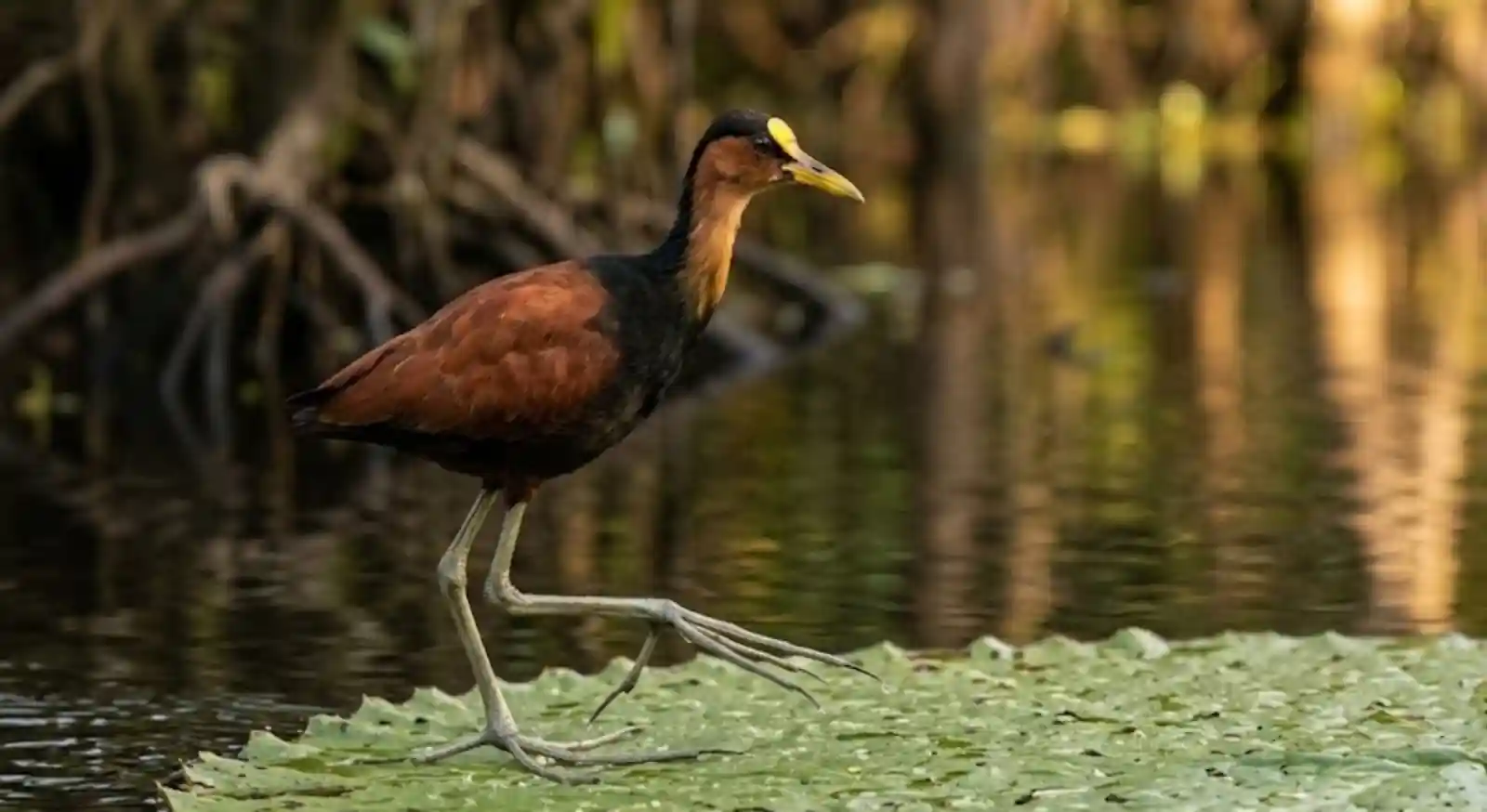
In the flooded lowlands of the Amazon there is a biological fact so counterintuitive that it looks, at first glance, like a trick of the light. The jacana (Jacana jacana), a slender waterbird with chocolate plumage and bright yellow wings, walks with complete ease across the floating vegetation of floodplain lakes, appearing to stride over the surface of the water itself. The behaviour earned the bird its popular nickname of jesus bird, and it owes nothing to any exemption from the laws of gravity. It is the direct result of an extreme anatomical adaptation: among all wading birds, the jacana has the longest toes and claws in the world relative to body size.
Those outsized feet spread the bird’s modest weight, between ninety and one hundred and fifty grams, across an enormously wide surface. By stretching its giant toes over the floating leaves of plants such as water hyacinth and giant water lily, the jacana works like a pair of natural snowshoes. The pressure it applies to the vegetation is minimal, so the leaves neither sink nor tear beneath its steps. That refined biomechanics opens feeding niches that remain out of reach for most other birds: the jacana hunts small insects, picks up molluscs and gathers seeds straight from the heart of the floating herbaceous mats.
A reversal of roles on the floating nest
If the anatomy that lets the jacana walk on water is remarkable, its breeding system breaks some of the most familiar rules of animal behaviour. In the vast majority of bird species the female takes the leading role in incubating the eggs and raising the chicks, or at least shares that work intensively. Among jacanas the dynamic is completely inverted through an uncommon mating system known as classical polyandry. The female is dominant, noticeably larger and more aggressive than the male, and she defends a territory that can take in the smaller territories of up to four different males.
Polyandry here is not an occasional exception but the organising principle of the whole society. One female, several partners, and a territory held by force: the arrangement turns the usual arithmetic of bird reproduction upside down, and it places the entire cost of parental care on the smaller sex. Every male inside her boundaries is a potential nest, and the dominant female spends much of the breeding season moving between them, checking borders and answering challenges from rival females that would take the same males for themselves.
After courting and mating with the males of her harem, the female lays a clutch of usually four eggs in a floating nest of extreme simplicity, often no more than a few thin stems arranged on a giant water lily leaf. As soon as laying is finished she leaves, either to patrol the borders of her territory or to mate with another male, handing every remaining duty to her partner. According to research in behavioural ecology, the male alone incubates the eggs for the following twenty eight days and cares for the chicks exclusively once they hatch.
The vigilant father of the floodplain
The male’s commitment to the survival of the brood is a display of dedication and protective instinct. Because the floating nest is exposed to sudden rises in water level, to storms and to predators such as piranhas, caimans and snakes, the father has to stay permanently alert. To shield the eggs from excess moisture and extreme heat he developed an ingenious behaviour: rather than simply sitting on them, he tucks them under his wings, holding them directly against the warmth of his body, dry and suspended above the water line.
The chicks hatch precocial, which means they arrive with their eyes open and are able to walk and feed themselves within hours. Even so they remain extremely fragile and cannot regulate their own body temperature efficiently. At any sign of danger, or when the temperature drops, the male gives a specific alarm call. The chicks run towards him and hide beneath his wings. The father then presses the small birds against his body and, astonishingly, manages to walk across the floating leaves carrying them under his arms, with only their tiny legs showing below his flight feathers.
Wing spurs, the weapons of a territorial bird
Beyond its outsized toes, the jacana carries another striking anatomical feature that is less obvious at first sight: sharp spurs set at the joint of its wings. These pointed bony structures, sheathed in keratin, play no part in locomotion. They serve territorial defence and the protection of the young. During the fierce disputes between females for control of a harem of males, or when a male defends his nest against predators such as snakes and herons, the spurs work as efficient weapons in short bouts of close combat. The adaptation underlines how competitive and territorial life is for this species on the floodplain lakes.
The flood pulse sets the calendar
The life of the jacana is inseparable from the Amazon flood pulse, the annual rise and fall of river levels that sets the rhythm for the whole of local biodiversity. During the high water season, when large stretches of forest are submerged and the várzea floodplains form, the abundance of aquatic macrophyte mats reaches its peak and creates ideal breeding habitat. That is when the territorial and reproductive dynamics of jacanas become most intense, depending directly on the stability and the biological health of those calm water lakes.
Studies indicate that the conservation of jacanas is an important indicator of environmental quality in wetlands. Changes driven by the clearing of riverside vegetation, pollution by agricultural chemicals or the introduction of exotic aquatic plants can unbalance the structure of those floating mats, harming both food availability and safe nesting sites. Monitoring and preservation projects on floodplain lakes, such as those run by the Mamirauá Institute in sustainable development reserves of the Central Amazon, are crucial to keeping these complex ecological dynamics free from destructive human interference.
Birdwatching as a conservation tool
Its behavioural and physical singularity makes the jacana one of the most sought after species by nature photographers and birdwatchers visiting the Amazon. Birdwatching tourism is a powerful conservation tool in Brazil, because it attaches direct economic value to keeping the forest standing and its aquatic ecosystems intact. By turning a jacana sighting into an educational and sustainable experience, riverside communities gain concrete incentives to protect lakes and riverbanks against predatory fishing and the advance of cattle ranching.
Securing a future for the jacana and other floodplain birds means keeping the dynamic balance of Amazonian rivers. Integrated conservation actions are essential, combining responsible tourism with support for public policies that protect river basins from hydroelectric dams that drastically alter the natural cycle of flood and drought. Official tourism portals such as Visit Brasil promote these natural sanctuaries, where the harmony between species and communities can be experienced in a conscious way.
Watching a jacana step across giant water lily leaves is to witness the ingenuity and the sheer variety of paths that biological evolution has taken in the Amazon. Its enormous toes and the moving dedication of the male raising his chicks are a reminder that the rules of nature are rich, plural and full of surprises. Protecting these aquatic habitats is an ethical and scientific commitment, so that coming generations can go on marvelling at this small miracle of balance and fatherhood walking over Amazonian waters.
Reporting: Anne Silva / Amazonia Mag. Source: Revista Amazônia, Mamirauá Institute, Visit Brasil.

Editor, English Edition — Amazonia Mag
Anne Silva is the editor of Amazonia Mag, the English-language edition of Revista Amazônia. She curates, translates and adapts the outlet's science and environment coverage for an international audience, reporting on Amazon wildlife, flora, rivers, climate and research. Every story she edits is grounded in peer-reviewed studies, official data and on-the-ground reporting from the Revista Amazônia newsroom in Belém, Pará, Brazil. More by Anne Silva →