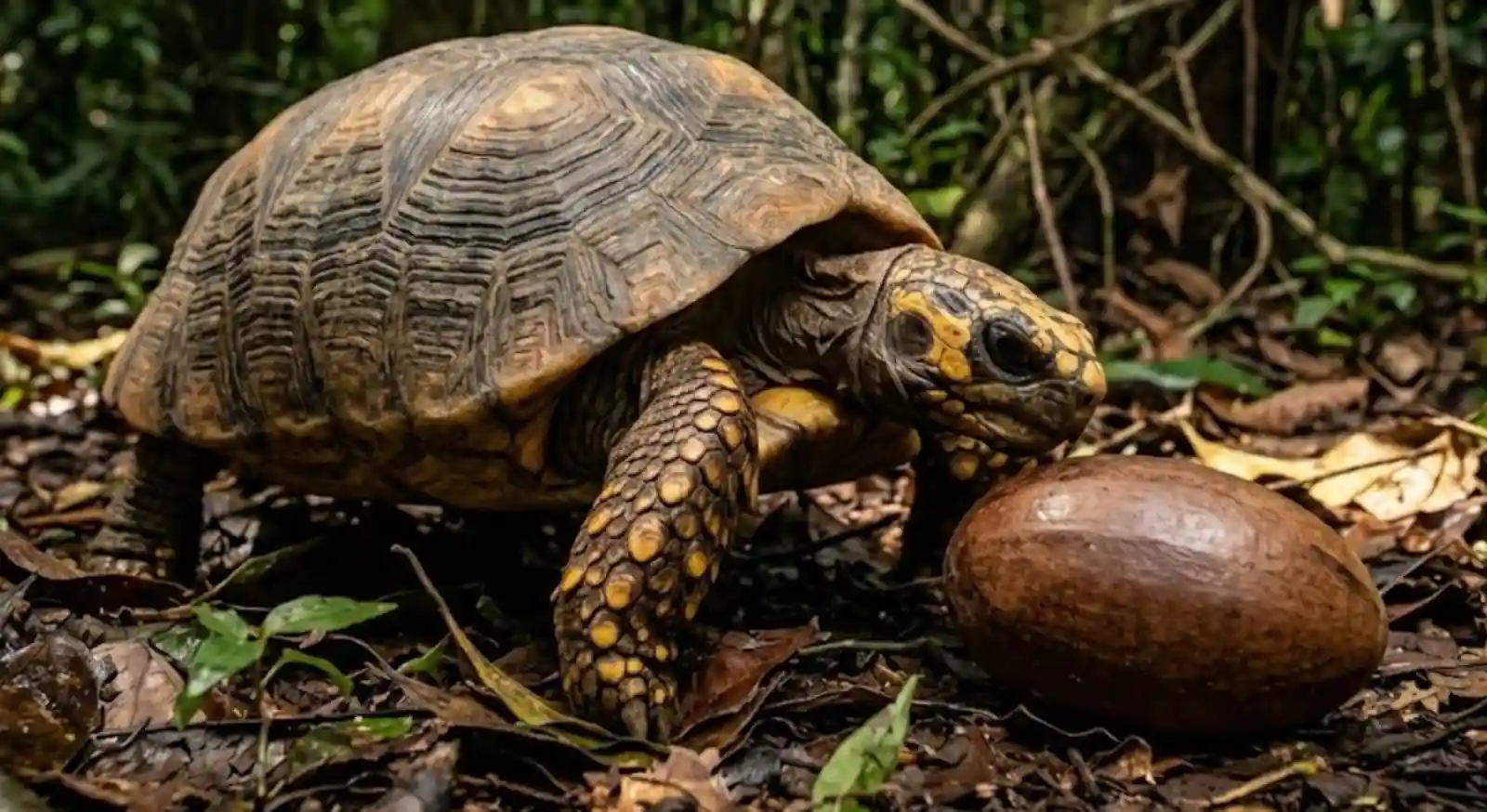
On the floor of the Amazon rainforest there are fruits almost no animal can swallow whole: woody capsules, seeds the size of an egg, fibrous husks that resist beaks, teeth and hands. Most known seed dispersers ignore them, crack them open to eat only the pulp, or leave them lying a few steps from the tree that produced them. One of the very few animals that carries them away inside its body is slow, armoured and in no hurry at all: the yellow-footed tortoise, known in Brazil as jabuti tinga (Chelonoidis denticulatus), the largest land turtle in South America.
Its size is impressive, but the real ecological weight of this reptile is not in the shell. It is in the stomach. By eating fallen fruit and swallowing the seeds whole, the tortoise performs a job the forest struggles to replace. It is an ecosystem engineer in the most literal sense of the phrase, because it decides which trees get to sprout far from where their fruit landed, and in doing so it shapes the composition and the structure of the forest across decades.
What the tortoise does that other dispersers do not
Seed dispersal in the Amazon works as a division of labour. Fruit-eating birds, toucans among them, mostly move small and medium fruit, and they do it from the canopy. Understory rodents tend to handle, gnaw and bury seeds close to where they found them. Large ground mammals such as the tapir do swallow bulky fruit, but they are big-bodied animals, increasingly scarce and heavily pressured by hunting across much of the basin.
The yellow-footed tortoise fills a gap none of those groups covers completely. It works on the forest floor, exactly where the heaviest fruits end up once they drop from the canopy and fall out of reach of aerial dispersers. It does not crush the seed to eat it: it swallows the seed whole, pulp and all, and returns it intact to the ground. That single detail changes everything. An animal that cracks a seed destroys it; an animal that swallows a seed transports it. Trees with large, heavy seeds, such as the Brazil nut, the piquia and several palm species, depend precisely on that second behaviour to escape the shade of the parent plant.
A digestive system built for hard seeds
The physiology of the yellow-footed tortoise is adapted to this role. Its digestive system is robust and processes tough, hard-shelled fruit and seeds without grinding them down. The seeds travel through the gut undigested and come out viable. More than that, research indicates that the passage through the reptile can break the dormancy of some seeds, meaning it deactivates the mechanism keeping them inactive, and therefore raises germination rates. The seed does not merely travel: it emerges from the journey better prepared to sprout.
Where it lands matters too. Seeds are deposited together with the animal’s droppings, inside a package loaded with organic matter that works as a starter substrate for the seedling. Ecologists call this the post-dispersal fertilisation effect. The new plant begins life in a nutrient-rich micro-environment, in a spot where it is not competing head to head with the roots and the shade of the tree that produced it.
Slowness as a method of transport
This is where the tortoise separates itself from every other disperser in the forest: time. It is a long-lived animal with a slow metabolism, and seeds can stay inside its body for days or even weeks before being released. Throughout that whole period the reptile keeps walking, unhurried but persistent, searching for food. The digestive delay stops being a limitation and becomes the mechanism itself. The longer a seed takes to come out, the farther from the parent tree it is finally dropped.
It is the opposite strategy to that of fast dispersers, which release seeds soon after feeding and usually leave them nearby. The tortoise does not compensate with speed. It compensates with duration. And because its diet is omnivorous and varied, built mainly on fruit, seeds and leaves, with occasional small animals and carrion, it consumes a wide range of plant species. In practice each individual works as a mobile planter handling many different tree species at once.
That combination is hard to substitute. A bird can carry a seed far, but only if the seed is small enough to swallow. A rodent can handle a heavy seed, yet tends to bury it close by and often eats it later. The tortoise is the animal that pairs a wide gape and a tolerant gut with a body that keeps moving for weeks on end. Remove it and there is no obvious replacement waiting in the understory.
When the disperser vanishes, the tree stops moving
The flip side of that dependence is stark. Studies on defaunation, the quiet emptying of wildlife from forests that are still standing, show that the disappearance of large ground dispersers drives what researchers call recruitment degradation among heavy-seeded trees. Seeds fall, germinate under the parent canopy, compete with one another, are found by their specialised predators and rarely reach adulthood. The forest still looks green from the air, but it loses diversity, structural complexity and carbon storage capacity.
The threats facing the yellow-footed tortoise are concrete. Hunting for its meat remains one of the main drivers of population decline. On top of that comes habitat loss and fragmentation caused by deforestation for agriculture, cattle ranching and mining, which isolates populations and cuts off exactly what makes this tortoise unique: its ability to cover considerable distances on foot. A tortoise trapped inside a forest fragment keeps its physiology but loses its ecological function.
Protecting the animal to protect the tree
Many of the tree species that depend on this reptile carry direct economic value for Amazonian communities. Giant-seeded trees produce nuts, oils, fruit and other resources that sustain local supply chains and reach international markets. Protecting the tortoise is not only a gesture in favour of a charismatic reptile. It is a way of preserving the biological process that guarantees the next generation of those trees and, with them, the continuity of the regional bioeconomy.
The measures required are well known and demand coordination: effective action against illegal hunting, the creation and genuine enforcement of protected areas, support for sustainable forest use, and long-term backing for research and population monitoring. Individual choices count as well, from consumers who refuse to buy turtle meat to companies and public managers who decide where and how the agricultural frontier expands.
Watching a yellow-footed tortoise cross the forest floor does not look like a remarkable event. Yet that discreet, silent walk is one of the few routes by which the heaviest seeds of the Amazon ever reach somewhere new. Conserving the rainforest does not depend only on the trees left standing, but on the animals still able to move them from place to place.
Reporting: Anne Silva / Amazonia Mag. Source: Revista Amazônia, Portuguese edition.

Editor · Amazonia Mag
Anne Silva is the editor of Amazonia Mag, the English-language edition of Revista Amazônia. She curates, translates and adapts the outlet's science and environment coverage for an international audience, reporting on Amazon wildlife, flora, rivers, climate and research. Every story she edits is grounded in peer-reviewed studies, official data and on-the-ground reporting from the Revista Amazônia newsroom in Belém, Pará, Brazil. More by Anne Silva →