
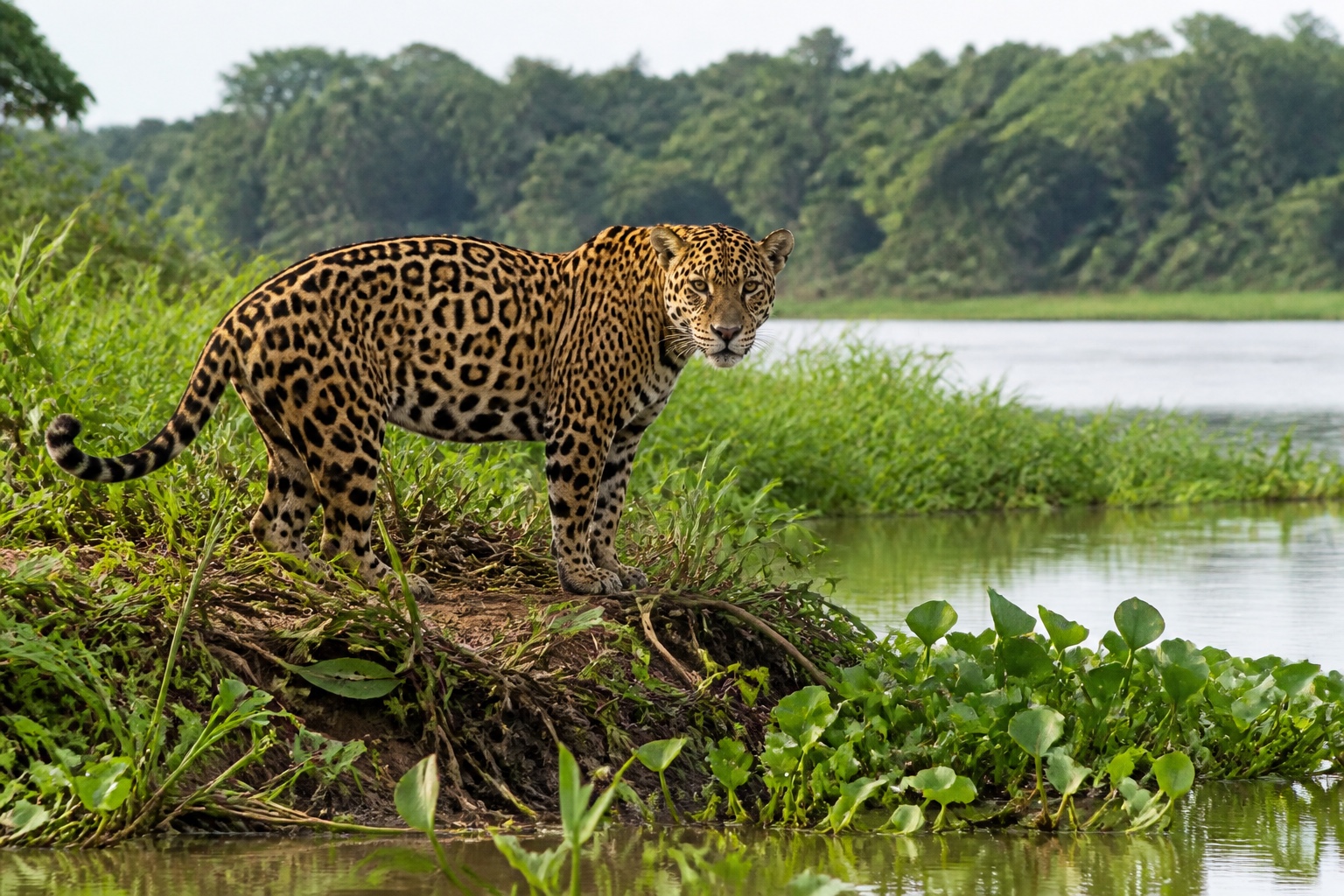
When a large predator stops patrolling a stretch of forest, the first thing that changes is not the list of species living there. It is the invisible map of risk. In the Amazon, the absence of the jaguar (Panthera onca) from a given area does not leave a clean, isolated hole. It leaves a silent reorganisation of animal behaviour that can end up far from the spot where the cat stopped appearing, right on the banks of the rivers, where water, vegetation and human communities all share the same narrow edge.
A study on defaunation in the Amazon showed that removing large vertebrates can alter behaviour and entire ecological functions. That observation works as a key to understanding what ecologists call a trophic cascade: the effect that travels downward, step by step, from the predator at the top all the way to the young plants trying to grow at the water line. It is not a simple chain in which one species automatically increases because another one vanished. The forest is built from overlapping relationships, and a single cat can control prey, compete for resources with other carnivores and define which areas different animals choose to avoid.
Fear organises the landscape too
Animals decide where to walk, where to feed and where to rest by calculating risk. The presence of a predator keeps certain prey away from open ground and from exposed banks, places with nowhere to hide. When that predator declines or disappears, those same animals begin to occupy the spots they used to avoid, and they do so more often and for longer stretches of time.
At first glance this looks like good news for anyone watching wildlife: more visible animals, more movement along the shore. The problem shows up later. More herbivores concentrated in one stretch can consume the seedlings that sustain forest regeneration. More mesopredators, meaning mid sized carnivores that once moved cautiously, can increase the pressure on birds and small mammals. The absence of the jaguar reorganises behaviour long before it reorganises species lists, which is exactly why the process goes unnoticed for years.
The riverbank is a meeting zone
Rivers concentrate water, fish, prey and pathways. The jaguar uses the margins to move and to hunt, while other animals use the very same strip to drink or to find fruit. The result is that the predator turns the bank into a place of permanent caution, somewhere nobody lingers and nobody lowers their guard.
When human pressure drives the cat out, that strip changes character. The bank can become busier with prey and, at the same time, more contested by people. The shift reaches fishing, livestock, tourism and even the sense of safety of those who live along the shore. The animal that vanished from the territory leaves a lasting mark on the behaviour of everyone who stayed.
What travels downstream afterwards
This is the heart of the trophic cascade. If bank vegetation is consumed faster because herbivores no longer fear standing there, the shoreline loses part of its ability to hold soil in place. Fewer roots mean more fragile edges when the flood arrives. And whatever happens at the water line eventually ends up inside the water itself.
The same logic applies to the small animals almost nobody associates with a big cat. Ground nesting birds, rodents, reptiles and the seed dispersers that guarantee the renewal of riverside forest all respond to a change that started several steps higher up. Nobody sees them collapse or surge overnight. The composition of the place simply shifts, and the landscape that results is no longer the same, even though from a canoe it still looks untouched.
That slowness is exactly what makes the phenomenon so hard to communicate. There is no single dramatic moment to point at, no photograph of the precise instant when the bank began to change. There is only a sequence of small adjustments in where each animal feels safe, and every adjustment makes the next one more likely. By the time the difference becomes obvious to the people who use the river every day, the chain has already been running for a long while.
River islands and a territory that breathes with the flood
In flooded forests of the Amazon, prey availability helped explain the occupation of river islands by the species. That finding changes the way the animal’s territory should be understood: the river is not merely a boundary. It can be a route, a refuge and part of the home range. The jaguar crosses, swims, hunts and stays wherever the bank still holds vegetation and food.
For that reason the predator’s territory cannot be drawn as a solid block of continuous forest. Rivers and channels reorganise where prey can be found, while the flood turns trails into water for months at a time. An effective reserve has to follow that rhythm and protect precisely the margins that connect different environments, because those margins are what allow the animal to keep moving.
Conserving the predator means conserving the relationship
Protecting the jaguar demands far more than stopping direct hunting. It requires conserving prey, water, plant cover and the connections between areas. An isolated population may survive for a while, but it becomes vulnerable to food loss and to breeding among too few individuals, a problem that compounds with every generation.
Riparian corridors, enforcement and the management of conflicts with ranchers all help keep the species in the landscape. Community participation is essential, because encounters with jaguars happen in working territories and not only in distant parks. Where the bank keeps its vegetation and its prey, the cat can cross, hunt and remain. Where the bank is degraded, the crossing becomes riskier and the animal moves closer to livestock areas. Protecting the predator begins long before anyone meets one face to face.
An absence that cannot be seen
The jaguar does not have to be seen every day to perform its function. Tracks, marks and avoided areas are all signs of its presence. When those signs disappear, the ecosystem can change its behaviour even while it still looks intact from the outside. The best way to explain the importance of this cat is to drop the idea that it exists merely to control other animals: it takes part in a network that includes rivers, plants, prey, people and the very design of the forest.
When the predator disappears, it is not just a photogenic animal that leaves. A whole way of organising space disappears with it. Conserving the jaguar means conserving the relationships that make the Amazon function as a forest rather than as a collection of trees, and those relationships are easier to read on a riverbank than anywhere else.
Reporting: Anne Silva / Amazonia Mag. Source: Revista Amazônia.

Editor · Amazonia Mag
Anne Silva is the editor of Amazonia Mag, the English-language edition of Revista Amazônia. She curates, translates and adapts the outlet's science and environment coverage for an international audience, reporting on Amazon wildlife, flora, rivers, climate and research. Every story she edits is grounded in peer-reviewed studies, official data and on-the-ground reporting from the Revista Amazônia newsroom in Belém, Pará, Brazil. More by Anne Silva →