
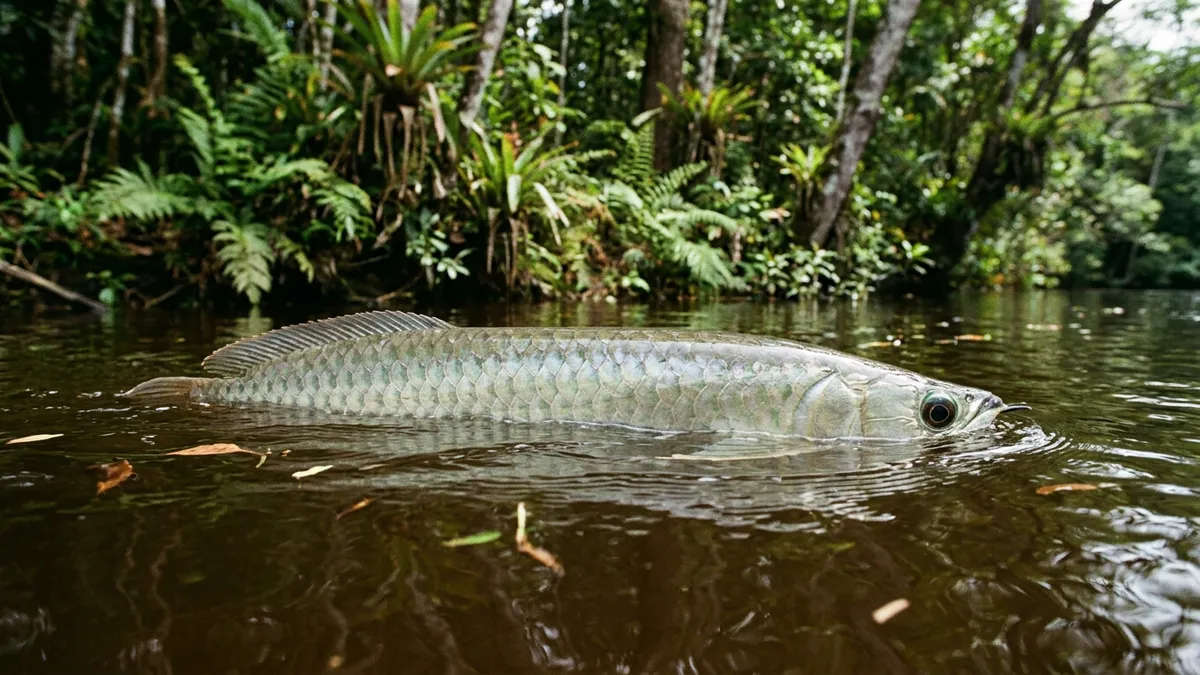
The silver arowana can leave the water in a leap of more than 3 feet (1 meter) to catch insects and spiders sitting on low branches. The fish aims its mouth upward during the movement and reaches prey above the surface, in a quick action that links the aquatic environment to the vegetation along the banks.
The same animal also has a reproductive strategy that is unusual among fish: the male incubates the eggs inside his mouth. The arowana thus brings together two functions of the oral cavity, which takes part both in catching food outside the water and in protecting the future young. Its large, shiny scales complete the look of a fish adapted to the rivers and creeks of the Amazon.
The leap begins with the mouth turned upward
To reach an insect or a spider on a low branch, the arowana has to point its body toward the bank and lift its head before it leaves the water. An upturned mouth favors approaching prey that sits above the surface, instead of forcing the fish to attack only animals located in front of it or below.
The movement combines the thrust of the body with a rapid opening of the mouth. On leaving the water, the fish briefly loses the support of the current and depends on the force generated by its body muscles to complete the jump. The prey may be on a branch or on a low part of the vegetation, where insects and spiders sit within reach of a vertical strike. After the capture, the arowana returns to the water, the environment where it carries out its main vital activities. The leap is therefore not a long trip outside the river but a short, directed lunge to get food that is available above the water line.
Anatomy that favors catching prey above the water
The upper mouth is one of the most important features for understanding this behavior. When the mouth opening faces upward, the fish can place its jaw directly under the prey. This shape reduces the need to tilt the whole body to reach something on a low branch and lets the capture happen the instant the fish breaks the surface.
The large, shiny scales are also a visible mark of the arowana, although they are not the mechanism behind the leap. They cover the body and reflect light as the fish moves through the water. For the capture, the decisive element is the combination of the shape of the mouth, the orientation of the head and the body force used to leave the water. The arowana does not have to climb slowly toward the bank. It turns its own body into a structure of thrust, pointing its head at the prey and using the opening of the mouth at the moment of contact. The behavior depends on coordination among sight, positioning and movement.
Insects and spiders widen the menu
The leap lets the arowana take advantage of resources that are not in the water. Insects and spiders on low branches may be out of reach for many fish, but they become accessible when the arowana leaves the surface for a few moments. The strategy widens the area where it searches for food and leads the fish to work the strip of vegetation just above the banks.
This link between water and forest is especially important in Amazon rivers, where trees and branches can reach out over the surface. The fish does not depend only on what passes through the water column. It also watches for opportunities at the edge of the aquatic environment, taking advantage of animals that live in nearby vegetation. The behavior shows how a small prey animal, even one located outside the river, can enter the feeding dynamics of a large fish. For the arowana, the low branch works as a temporary extension of its feeding territory. For the insects and spiders, being near the water creates a risk that does not exist higher up or farther from the bank.
The water surface normally marks the boundary between the place where the arowana lives and the space occupied by vegetation. During the leap, that boundary stops being a rigid barrier. The fish starts to work a small strip above the water, enough to reach low branches and take prey from them. The ecological gain lies in getting food without leaving the river. The arowana does not need to move along the bank or stay out of the water. It makes a brief strike, catches the animal and returns to the aquatic environment. The leap also sets the arowana apart from fish that find food only below the surface, since it lets the animal use resources spread across two neighboring environments.
The mouth is also a shelter for the eggs
In reproduction, the male’s oral cavity takes on another function. After spawning, the male incubates the eggs inside his mouth, keeping the future young in a protected space. This strategy is known as mouthbrooding and requires the animal to keep the eggs inside the oral cavity during the early stage of development.
Incubation temporarily changes the male’s relationship with feeding. While he carries the eggs, the mouth stops being only a structure for capturing prey and becomes a shelter for the young. This creates a behavioral demand: protecting what is inside the mouth and avoiding movements that could put the eggs at risk. The same anatomy that helps the arowana reach an insect above the water also offers room for incubation. The contrast between these functions shows that one structure can take part in different stages of an animal’s life. At one moment the mouth is used to strike at prey, and at another it becomes a place of protection for the offspring.
The behavior of the arowana reveals a direct connection between the vegetation of the banks and the inside of Amazon rivers. Low branches are not merely part of the landscape. They can provide spots where insects and spiders are available to an aquatic predator able to leap. By catching these animals, the arowana brings part of the energy found in streamside vegetation into the river’s food chain. A fish with large, shiny scales, an upturned mouth and the ability to jump more than 3 feet (1 meter) holds a particular place in the Amazon environment. It is not only a resident of the water, nor only a predator below the surface: its behavior includes a step beyond the surface, and its reproduction involves protecting eggs inside the mouth.
Reporting: Natália Santos / Amazonia Mag

Editor · Amazonia Mag
Anne Silva is the editor of Amazonia Mag, the English-language edition of Revista Amazônia. She curates, translates and adapts the outlet's science and environment coverage for an international audience, reporting on Amazon wildlife, flora, rivers, climate and research. Every story she edits is grounded in peer-reviewed studies, official data and on-the-ground reporting from the Revista Amazônia newsroom in Belém, Pará, Brazil. More by Anne Silva →