
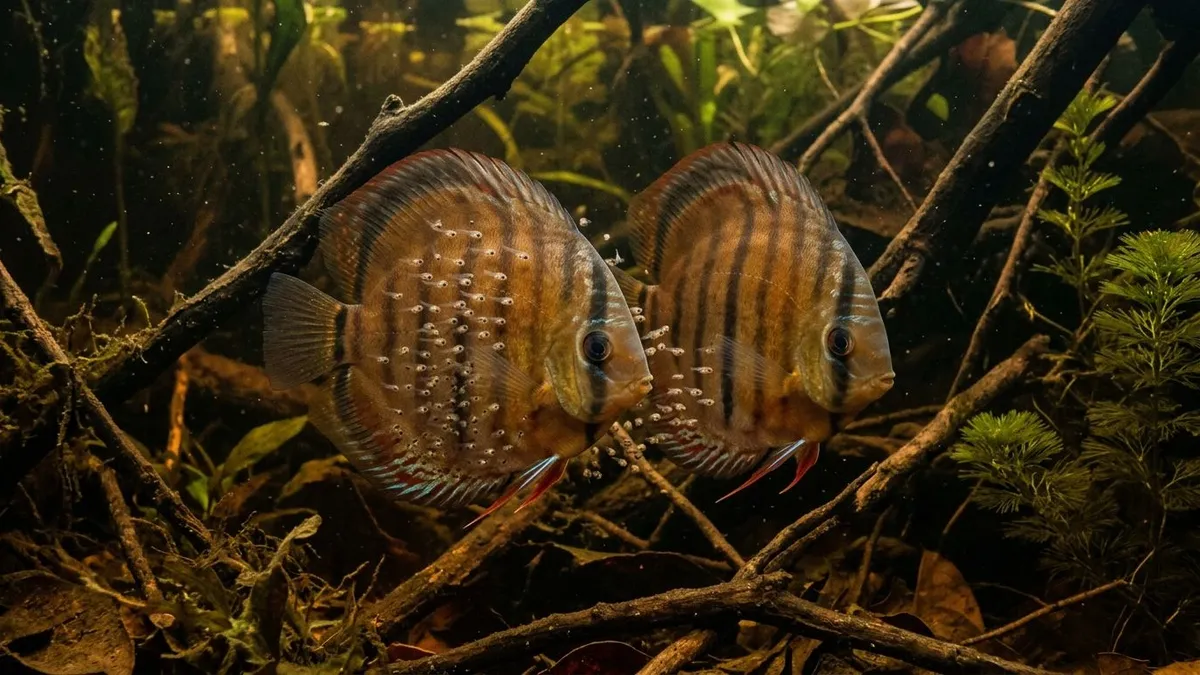
In the dark water of an Amazonian stream, newly hatched discus fish do not scatter in search of food. They stay close to the bodies of their parents and feed on a nutrient-rich secretion produced by the adults’ skin. In the first days of life this mucus is the fry’s first food, and the contact that delivers it is essential to the survival of the brood.
The care is not left to a single individual. Both parents take part, offering the young a food source that is available in the very territory where they live: the black-water streams that Brazilians call igarapés. The strategy combines protection, closeness and nutrition during a phase when young fish still depend heavily on parental care.
How skin mucus becomes food
The skin of discus fish produces mucus, a layer that covers the body and takes part in protecting the fish. In this species the secretion also contains nutrients that the young can use. Instead of relying only on particles drifting in the water, the brood can feed by touching and gently scraping the body surface of its parents.
The behavior ties parental care directly to feeding. The fry follows an adult, positions itself against the body and eats the secretion available on the skin. This is not nursing, because fish do not produce milk. It is a feeding system built on nutritious skin mucus, and the distinction matters if the mechanism is to be understood without comparing it, wrongly, to mammals.
The parents’ skin helps raise the brood
The mucus is not a separate element of the animal. It forms on the surface of the fish and stays attached to the skin while the young approach to eat. In this way the outer anatomy of the adults takes on an extra job during the early development of the brood: the same surface that protects the fish also feeds its offspring.
The contact also requires the parents to tolerate the constant presence of the young around their bodies. The skin works as an access point to food while the adults keep moving through their surroundings. The discus fish, in other words, does not simply guard its young in a fixed spot. It sustains a repeated physical interaction between adults and offspring, one that lasts through the days when the fry cannot yet fend for themselves.
Why both parents take part
The participation of the pair increases the supply of secretion available to the brood. The fry can approach one adult and later the other, keeping access to the food the parents produce during the first days. Having two individuals involved also spreads the effort of rearing the young, so the work is not left to just one of them.
This intense parental behavior keeps the young close to the adults in a stage of great dependence. By following the pair, the brood stays in contact with its source of food and receives protection in the same space. With both parents present, care becomes a continuous activity in which feeding and vigilance happen together rather than as separate tasks.
An advantage for fry that still depend on their parents
Newly developed fry have limitations that make it important to find food without leaving the group. The mucus produced by the parents solves part of that problem by offering a concentrated source close at hand. Rather than searching for food scattered across the stream, the young can stay with the adults and eat the secretion directly from their bodies.
The strategy also shortens the distance between the fry and the pair early in life. That closeness helps keep the brood grouped and lets the adults stay involved in its care. The evolutionary benefit lies in the combination of accessible food and parental protection, two needs that show up at the same time in the first days.
It also shows that parental care among fish can go beyond defending eggs or holding a territory. Here the adults produce a food resource on their own bodies and let the young use it directly. The behavior sets up a close relationship between the condition of the parents and the development of the brood, since what the young eat depends on what the adults’ skin provides.
The fry must respond to the adults’ behavior to make use of the secretion. They stay close, find the body surface and eat the mucus available there. This coordination between parents and young turns contact into a rearing routine. The brood does not receive food left somewhere in the environment, but an offering tied to the body and to the presence of both parents.
That is why the first days matter so much. Young fish that stay near their parents have access to food and protection at once, and drifting away would mean losing both. Remaining close to the pair keeps everything the brood needs within reach.
A mechanism of the black-water streams
The discus fish lives in black-water streams, Amazonian waterways whose dark color is linked to dissolved organic matter. In this setting, parental care keeps the fry near the adults in a habitat where early feeding may depend on local conditions. The skin secretion supplies a resource that travels with the pair inside the stream itself.
The relationship between fish and environment shows how an individual behavior can have an ecological function without changing the nature of the ecosystem. The adults sustain the brood through their own mucus while the young grow within the family group. When the early dependence fades, the rearing will have completed a decisive stage in the life of the fish, leaving in the stream a new generation able to occupy its surroundings.
In the discus fish, the boundary between body, care and food becomes blurred. The skin of the parents does not only cover the fish, and the presence of the pair is not limited to protection. During the first days the adults become a direct part of their young’s diet. In a black-water stream, this bond turns rearing into continuous physical contact, in which surviving means staying close. Watching the behavior is a reminder that parenthood among fish can involve mechanisms as specific as producing food on one’s own body.
Reporting: Natália Santos / Amazonia Mag

Editor · Amazonia Mag
Anne Silva is the editor of Amazonia Mag, the English-language edition of Revista Amazônia. She curates, translates and adapts the outlet's science and environment coverage for an international audience, reporting on Amazon wildlife, flora, rivers, climate and research. Every story she edits is grounded in peer-reviewed studies, official data and on-the-ground reporting from the Revista Amazônia newsroom in Belém, Pará, Brazil. More by Anne Silva →