
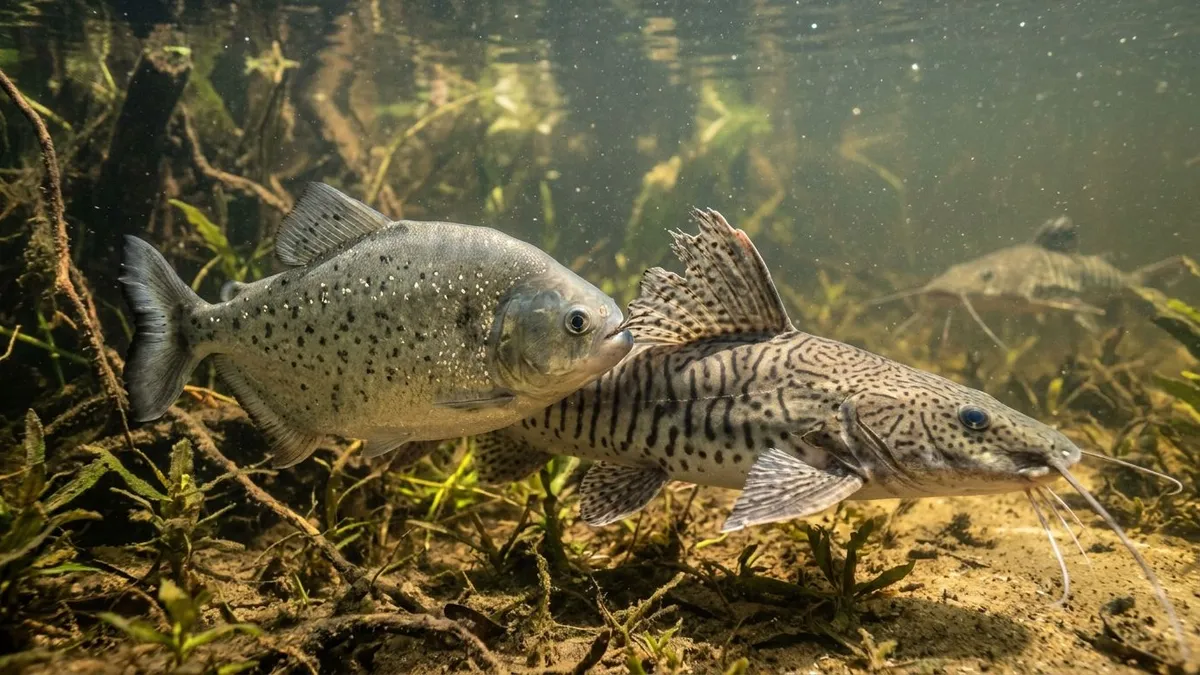
One fish approaches another, bites the edge of a fin, tears off a fragment and swims away. The victim does not have to die for the predator to get a meal. This behavior is linked to the pirambeba, a common name used for fish related to piranhas but known for a different feeding strategy. Instead of concentrating the attack on the whole body of its prey, it makes use of small parts, such as scales and pieces of fin.
The scene is quick because the pirambeba’s teeth work as a cutting tool. The fish does not need to overpower the other animal completely, or to eat it whole, to obtain a nutritious portion. The result is a partial mutilation, with a localized loss of tissue and a chance of survival for the fish that was bitten. The strategy shows that a predator and prey relationship can end in severe damage but without the immediate death of the animal attacked.
The attack ends before death
The habit is called lepidophagy when it involves eating scales. The word also appears in connection with fish that remove external parts of other animals, including fragments of fins. In the case described for the pirambeba, both resources follow the same logic: the mouth reaches an exposed surface, the teeth cut a small portion, and the predator leaves with its food.
The prey keeps swimming after the attack, although it may lose some maneuvering ability depending on the area affected. The difference from the best-known image of piranhas lies in the kind of feeding opportunity that is used. This relative does not necessarily depend on a carcass or on a complete capture. It can obtain food in a short encounter, reducing the time of contact with a fish that is still moving. The bite works as the collection of a fragment, not as a step in an obligatory killing.
A mouth adapted to cut
The dentition is the central mechanism of this conduct. Sharp teeth, arranged so as to produce a cutting bite, make it possible to remove a strip of fin or to separate scales from the surface of the body. There is no need to attribute to the pirambeba a human intention of sparing its victim. The behavior can be understood as a form of feeding in which the predator takes only the portion it can reach at that moment.
The sequence has three observable stages: approach, bite and withdrawal. The attacked fish remains a living animal, while the predator carries away a fragment. This pattern also explains why the injury can be localized, instead of immediately compromising the whole body of the prey. Fins are external, visible structures, and scales sit in the surface layer of the skin.
Even so, the cut is not harmless. Losing part of a fin can affect stability and propulsion, while an open wound may require the regeneration of tissue.
Kinship with piranhas, and its limits
The relationship with piranhas helps to place the pirambeba in context, but it does not allow all these fish to be treated as if they had exactly the same behavior. The common name can cover different species depending on the region, and feeding traits vary among them. It is not correct to turn an observation of this kind into a rule for all individuals, all environments or all encounters between fish.
The conduct is better understood as a strategy of partial feeding. It draws attention because the predator manages to turn a brief approach into food, while the victim stays alive and can begin to recover the part that was lost.
What happens to the bitten fish
The survival of the victim does not mean there are no consequences. A damaged fin can change the way the fish accelerates, brakes, turns or holds its position in the water. The impact depends on the size of the fragment removed, on the place of the bite and on the condition of the animal. Scales can also be regenerated, but the wounded surface remains an area of recovery.
The description of partial lepidophagy allows us to say that an attack does not have to be fatal, not that every bitten fish will be free of lasting effects. The animal can stay alive and rebuild part of the tissue, as long as it manages to keep up feeding, movement and protection against other risks.
The pirambeba, for its part, obtains a resource without investing in a prolonged capture. This ecological exchange is important: the predator feeds, the prey suffers an injury, and the interaction does not necessarily end with the disappearance of one of the participants. The episode reveals a form of predation based on the occasional or repeated removal of small parts.
Recovery also depends on factors that do not appear in the short description of the behavior. A fish with a wound may have difficulty swimming, spend more energy or become more vulnerable to new bites. At the same time, it should not be claimed that the injury always produces infection, disability or later death. Those outcomes would require specific observation, because they vary with the extent of the cut and with the environment.
What is known and what still has to be defined
The pirambeba is a relative of the piranha, has cutting teeth, practices a form of feeding based on scales, and can remove part of the fin of another fish without killing it. It cannot be said that the pirambeba always prefers fins, that it never kills its prey, or that all the species called pirambeba behave in the same way.
The safest reading is that removing external parts allows food to be obtained through a short interaction. Other variables, such as the availability of prey, the age of the fish and the conditions of the environment, can change how often the behavior occurs. This precision is needed to tell a feeding strategy apart from a lethal attack. The pirambeba does not need to consume the whole animal to fulfill its role as a predator. The fragment of fin and the scales already represent the immediate reward of the bite.
In Brazil, the connection is legitimate because pirambeba and piranha belong to the popular vocabulary used for freshwater fish, but the common name does not replace scientific identification. The best reading of the scene lies in the mechanism: a mouth with cutting teeth reaches scales and fins, removes a fragment and leaves the prey alive.
Watching this process changes the idea that all predation ends with a total capture. In many environments, eating can mean taking a small part and moving on. For the bitten fish, life goes on with a mark that has to be repaired. For science, each bite is still an invitation to tell recorded behavior apart from easy generalization.
Reporting: Natália Santos / Amazonia Mag

Editor · Amazonia Mag
Anne Silva is the editor of Amazonia Mag, the English-language edition of Revista Amazônia. She curates, translates and adapts the outlet's science and environment coverage for an international audience, reporting on Amazon wildlife, flora, rivers, climate and research. Every story she edits is grounded in peer-reviewed studies, official data and on-the-ground reporting from the Revista Amazônia newsroom in Belém, Pará, Brazil. More by Anne Silva →