
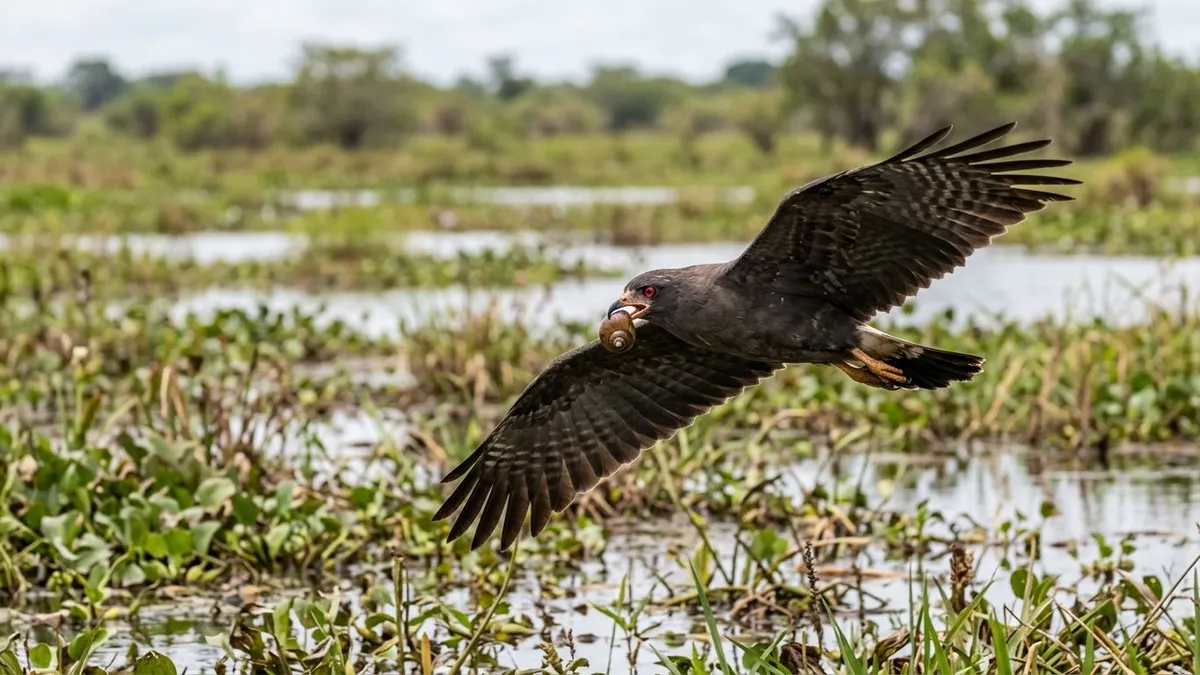
A bird that eats almost nothing but water snails has to solve a specific problem: how to pull a soft body out of a hard shell without breaking it. The snail kite (Rostrhamus sociabilis), called gavião-caramujeiro in Brazil, solves it with a long, thin, curved bill and a low flight over the marshes.
The cut starts before the shell breaks
The snail kite does not need to crack the aquatic snail’s shell to feed. According to the scientific literature on the species, including work by the ornithologist Steven Beissinger, the bill is long, thin and sharply hooked at the tip of the upper mandible. That shape lets the bird slip the tip into the shell opening and cut the columellar muscle, the structure that anchors the mollusk’s body to the columella, the spiral axis of the shell. Without that attachment, the body comes loose and can be pulled out whole, and the shell is left empty and intact.
The snail closes the opening with the operculum, a kind of lid. In observations described in the literature, the bird inserts its bill, presumably between the shell and the operculum, shakes its neck to loosen the lid and, with the upper mandible inside the shell and the lower one outside, cuts the muscle in a few strokes. The result is feeding based on a precise cut, not on the force needed to crush the chalky protection.
The empty, intact shell left on the perch or dropped into the water is the visible trace of that method: the mollusk was removed, but its protection was not defeated by force.
Low flight follows the habitat where prey appears
The search comes before the cut. The species flies slowly and low over marshland, head pointed down, looking for snails near the surface. The Audubon Society describes how the bird glides slowly over the wetland and drops to take a snail in one foot, lifting it out of the water or off the vegetation. It can also hunt from a perch, watching the area before launching at its prey.
After the capture, the kite carries the snail to a perch, holds it with one foot and extracts the body with its bill, letting the empty shell fall. The marsh, then, is not just the scenery. According to descriptions of the species in Brazil, it is a paludicolous bird, meaning one that lives in marshes, in groups, in areas with permanent water and aquatic vegetation, and that occurs in every Brazilian region where there are swamps and flooded areas. Its range runs from Florida and Mexico to Argentina and Uruguay.
A specialized tool for a nearly exclusive diet
The snail kite’s diet is made up almost entirely of aquatic snails of the genus Pomacea, known in Brazil as aruás. In dry periods, when those mollusks become scarce, the Audubon Society records that the bird may occasionally eat small turtles, rodents and crabs. Outside those occasions, the bill answers to one specific prey: the long, thin tip reaches the body hidden by the shell, and the curve guides the movement to the muscle that holds it.
The relationship between bill and prey shows up clearly in a case studied in Florida. Around the year 2000, the invasive snail Pomacea maculata, larger than the native Pomacea paludosa, arrived in the region. In a study published in the journal Nature Ecology & Evolution, University of Florida researchers showed that in a little over a decade the bills and bodies of snail kites grew larger, and that birds with larger bills were more likely to survive their first year. According to the team, the change was attributed mainly to phenotypic plasticity, that is, the ability of individuals to respond to their environment.
The Florida case shows that the bill is not a fixed part, independent of the environment: when the available prey changes, the measurements of the birds that depend on it change too. It is an example of how a tool this specialized can adjust within a few years.
How to recognize the bird
The snail kite is about 16 inches (41 centimeters) long, and its wingspan reaches a little over 3.3 feet (1 meter), according to descriptions of the species. The male is slate gray, with a white base to the tail and an orange or reddish cere and feet. The female and young birds are brown, with a whitish stripe above the eyes, a pale throat and underparts barred with cream. In both sexes, the dark, strongly curved bill is the most striking feature.
These traits make it possible to tell male from female at a glance, and the curved bill serves as a clue in both sexes when the bird passes low over the marsh.
A species tied to flooded areas
The International Union for Conservation of Nature (IUCN) classifies the species as Least Concern on a global scale. In some regions, however, the situation is more fragile. In Florida, according to the Audubon Society, the population is considered threatened, and the drainage of wetlands and changes in water levels are among the main conservation challenges.
The most accurate picture of the species is of a bird flying low over the marsh, finding an aruá and using a cut at the exact point where the shell stops being an obstacle. The thin, curved bill does not need to overcome the snail’s protection by force, only to reach the columellar muscle that keeps it attached to the body.
Reporting: Natália Santos / Amazonia Mag

Editor · Amazonia Mag
Anne Silva is the editor of Amazonia Mag, the English-language edition of Revista Amazônia. She curates, translates and adapts the outlet's science and environment coverage for an international audience, reporting on Amazon wildlife, flora, rivers, climate and research. Every story she edits is grounded in peer-reviewed studies, official data and on-the-ground reporting from the Revista Amazônia newsroom in Belém, Pará, Brazil. More by Anne Silva →