
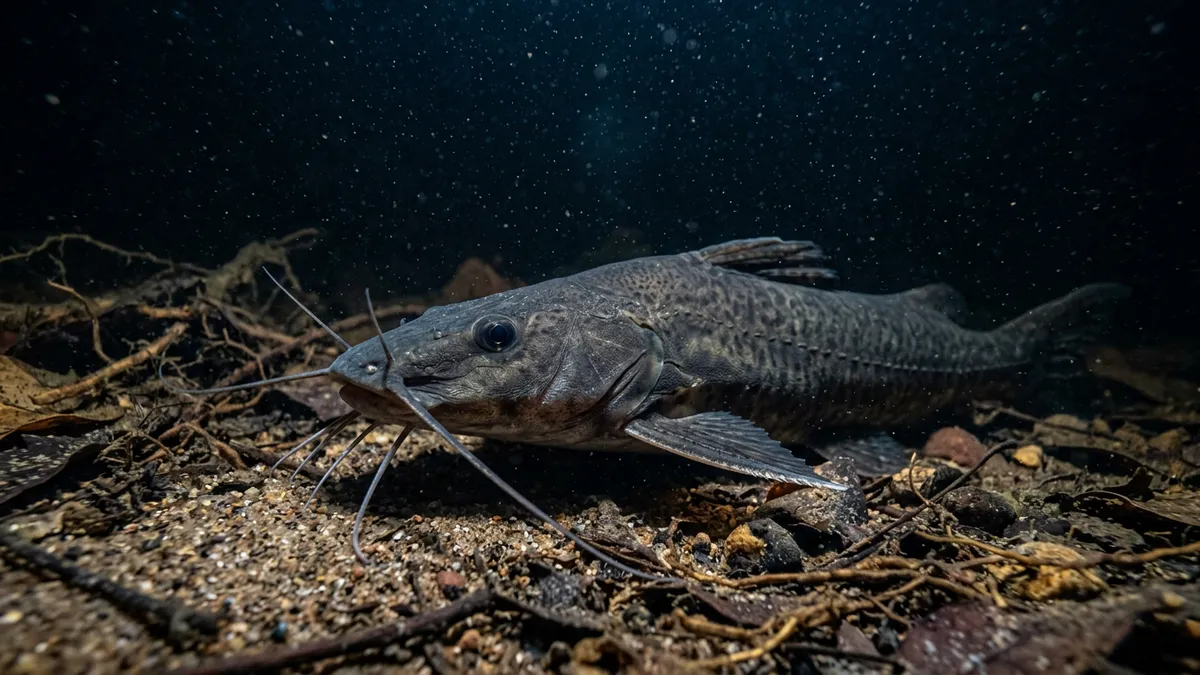
When a predator tries to grab a mandi, the defense does not end the moment the fish gets away. The spine of its pectoral fin can lodge in the body of the attacker through a locking mechanism. The structure works as a rigid piece that, once set in position, is hard to pull out quickly. Contact is also associated with a venom gland, which adds pain to the wound. In this way a bottom-dwelling fish turns a fin into a tool of defense, even when it is smaller than the animal that attacked it or at a disadvantage against it.
The result is a short sequence whose effects can continue after the two animals separate. First comes the attempt at capture, usually in a low-light setting, where the mandi spends much of its active period. Next, the spine catches, and the predator has to deal with the mechanical resistance of the fin. After the fish gets loose, the injury remains tied to the action of the venom. The mechanism does not depend on a chase or a prolonged confrontation. It lets the mandi leave a physical and painful obstacle in the way of whoever tried to catch it.
The spine that does not let go at once
The key detail is timing. Most defenses are judged by what happens while the fish is being held, but here the consequence reaches into the moments afterward. A predator that releases the mandi may still carry the effects of the encounter. That is why the mechanism deserves attention: it is not a simple shield that stops working when the contact ends.
It is also worth being clear about what the mandi is not doing. The fish does not hunt its attackers and does not seek confrontation. The spine is a response to being seized. It acts at the decisive moment, when the body is already in the grip of another animal, and it changes what that grip costs.
A bottom fish guided by barbels
The mandi is a fish associated with the bottom of freshwater environments, and it has nocturnal habits. In that setting its barbels, sensory structures located around the mouth, help the animal explore the space close to the substrate. They are not ornaments, and they are not used for swimming. They work as sensors that widen the fish’s ability to perceive its surroundings when visibility is reduced.
With them the fish can look for food and recognize obstacles while staying in contact with the water and the bottom, instead of depending only on sight. For an animal that is active at night, close to the bottom, touch and chemical perception through these appendages are a practical answer to the darkness.
The same anatomy that favors life close to the substrate has to coexist with the need for protection against attacks. The mandi brings together sensors in the head region and rigid spines in the pectoral fins, two solutions to two different problems. The barbels help with exploration and orientation in nocturnal conditions. The spine acts when the body is grabbed.
How locking turns a fin into a defense
The central point of the mechanism is the ability of the pectoral spine to become locked. On a free fin, a rigid structure could be folded back or shifted during an escape. In the mandi, the locking makes that movement difficult when the predator has already closed its mouth or is using another part of its body to hold the fish.
The fin stops being only a control surface for swimming and starts to offer resistance to the pull. This explains why the attacker may stay injured even after the mandi is no longer attached to it. The spine, once fixed, becomes a hard point that the predator cannot easily ignore.
The venom gland associated with the structure adds a chemical response to the mechanical defense. Together, the lock and the gland make the encounter more costly for whoever bites. Without turning the animal into a hunter of predators, this combination increases the chance that an attempted capture ends with the fish being released.
These limits matter because they do not allow the mechanism to be turned into a precise measure of toxicity. What can be said is that there is an association between a lockable structure, the wound, and a painful action that continues after release. Claims about the exact strength of the venom, or about how long the pain lasts in each predator, would go beyond what is known.
A defense spread across the Amazon basin
The mandi is a common fish throughout the Amazon basin. That places the defense mechanism in an area of great variety, with rivers, lakes, streams and other freshwater environments. The wide presence does not mean that every individual faces exactly the same predators or uses its fin with the same frequency. It means that the set formed by bottom-dwelling habits, nocturnal activity, barbels and a pectoral spine occurs in different parts of the basin.
For this reason, any comparison with other mandis, catfish or armored and leathery bottom fish should be made with caution. The safe point is the function described. The animal explores the bottom at night, uses barbels to sense its surroundings, and carries a pectoral spine that can lock into a predator. The associated venom gland means that the defense is not only a matter of a physical hook.
What the mechanism changes for predators
For a predator, catching a mandi can mean more than swallowing a small prey. The attempt can result in a lodged spine, an injury and prolonged pain. That possibility changes the cost of the attack and may favor the release of the fish. Even so, the defense offers a concrete answer at a decisive moment, when the prey is already being held.
For the Amazonian ecosystem, the safest consequence to point out is the mandi’s part in the relationships between predators and prey. As a common fish tied to the bottom, it takes part in food chains and interactions that vary with the environment. Its barbels help in the routine of searching and perceiving, while the spine limits some ways of being captured.
The phenomenon is not an event with a single date. It is a biological and behavioral trait of the mandi. The defense shows how, in Amazonian rivers, survival can depend on a small structure that combines contact, locking and pain.
Reporting: Natália Santos / Amazonia Mag

Editor · Amazonia Mag
Anne Silva is the editor of Amazonia Mag, the English-language edition of Revista Amazônia. She curates, translates and adapts the outlet's science and environment coverage for an international audience, reporting on Amazon wildlife, flora, rivers, climate and research. Every story she edits is grounded in peer-reviewed studies, official data and on-the-ground reporting from the Revista Amazônia newsroom in Belém, Pará, Brazil. More by Anne Silva →