
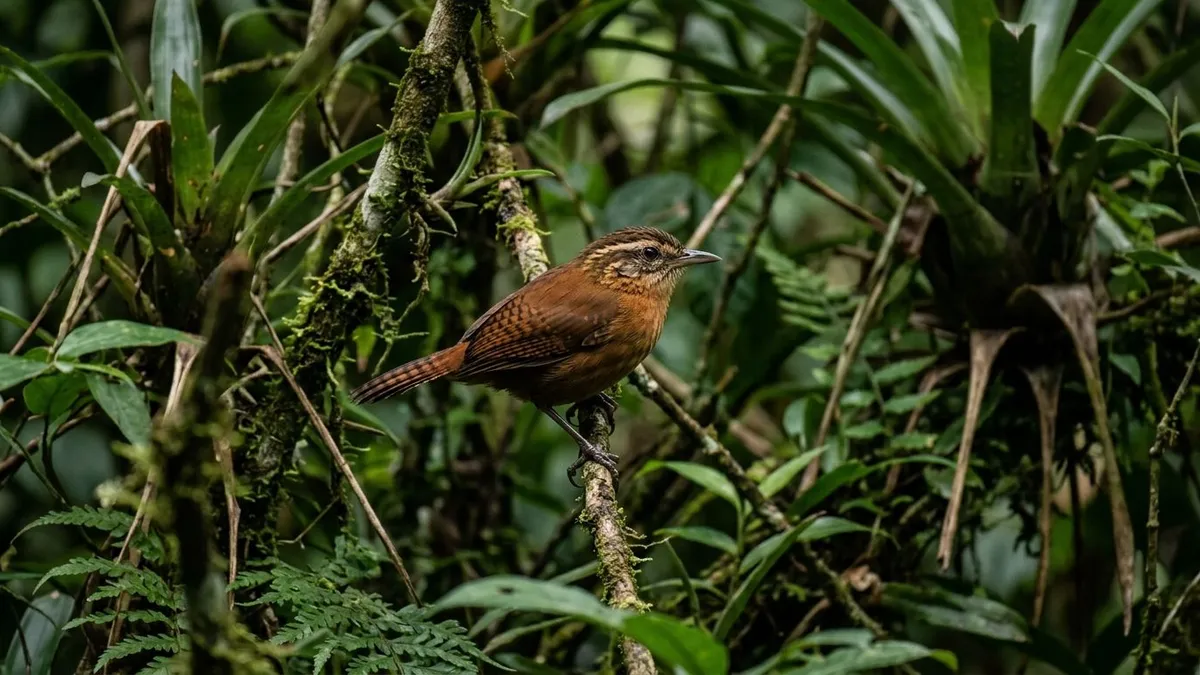
The musician wren, Cyphorhinus arada, is a small bird of the Amazon forest that has inspired legends, field recordings and even concert music. It belongs to the wren family, Troglodytidae, the same family as the house wrens. Descriptions of the species give a length of about 4.9 inches (12.5 centimeters) and a weight of 0.6 to 0.85 ounces (18 to 24 grams). It is hard to see, and its fame comes almost entirely from its voice.
Two ideas circulate about that voice. The first is that both males and females sing. The second is that the bird sings for only 15 days a year and stays silent the rest of the time. The first idea is well supported. The second comes from popular accounts that the technical literature does not confirm in full, and the difference between the two is worth looking at closely.
Who sings, and how
According to Birds of the World, the ornithological database of the Cornell Lab of Ornithology, the musician wren is aptly named for a highly musical song produced by both males and females. Descriptions of the species record pairs singing in alternation, in clear whistled notes that vary widely in pitch. The song is a duet in the plain sense of the word: two birds taking turns.
The same source describes a bird of primary forest that forages mostly on the ground, sometimes follows swarms of army ants, and occurs at low density. Following army ants is a common strategy among forest birds, because the ants flush insects from the leaf litter. A species that lives at low density and keeps to the forest floor is also a species that is heard far more often than it is seen, which helps explain why its song became so central to its reputation.
The International Union for Conservation of Nature, the IUCN, lists the species in the category of least concern. That classification refers to the species as it was understood when the assessment was made, a point that becomes important further down.
The 15-day window: what is known and what is not
WikiAves, the Brazilian bird-records platform, says the species usually sings only during the breeding season, between mid-September and October, and that its song is fully developed on only 15 to 20 days of the year. This is where the popular idea of a bird that sings once a year comes from. The phrase used is “well-developed song”, and that is not the same as absolute silence for the rest of the year.
For a close relative, the song wren of Central America (Cyphorhinus phaeocephalus), Birds of the World records that males and females sing all year round to defend territory, and that groups keep stable territories throughout the year. For the musician wren itself, the publicly available part of Birds of the World describes song by both sexes without setting a short period of activity.
For that reason, the claim that the bird sings for only a few weeks and then falls silent should be treated as information from observers’ reports, not as a pattern measured in long-term studies. A fully developed song concentrated in the breeding season is plausible for many birds. A total absence of song for eleven months is a much stronger statement, and it would need long-term recordings to be established.
Six species under one name
The voice also helps to tell populations apart. In 2016, Bocalini and Silveira published a taxonomic revision in the journal Zootaxa based on 515 museum specimens and 146 sound recordings. The authors concluded that the former musician wren, treated as a single species with several subspecies, actually comprises six valid species, all endemic to the Amazon basin: C. arada, C. transfluvialis, C. modulator, C. salvini, C. interpositus and C. griseolateralis. Vocal analyses were particularly informative in recognizing the differences.
In Brazilian nomenclature, WikiAves calls C. arada the uirapuru-da-guiana. That has a practical consequence: the song described at one point in the Amazon does not necessarily hold for another, and any generalization about the uirapuru has to say which population it refers to. A statement about timing or behavior that was observed in one part of the basin cannot simply be carried over to the others.
Low forest, insects and a covered nest
According to WikiAves, the bird lives in the lower layer of humid forests, mainly on terra firme, the upland forest that is never flooded, but also in várzea, the seasonally flooded forest along rivers. It forages on the ground, hopping among the vegetation and catching insects, also on leaves, and it eats fruit. Occasionally it accompanies army ants.
The nest is covered. The female lays two to four white eggs, which hatch in about 15 days, and both parents feed the chicks. A covered nest tended by two parents fits the picture of a shy bird of the understory that spends its life close to the forest floor.
From legend to recording
Amazonian legend associates the uirapuru with luck and love. The ornithologist Johan Dalgas Frisch, who recorded the species’ song, said that everybody wanted a uirapuru feather because of the legend of prosperity attached to the bird, according to a text by IAS Brasil about the recording. The same source says his record of bird songs spent 18 consecutive weeks among the best sellers in the country.
The composer Heitor Villa-Lobos also wrote, in 1917, the symphonic poem Uirapuru, inspired by Brazilian folklore. Culture attributes meaning to the bird’s voice, while science is still accumulating data on when and how it sings in each population.
Between one and the other, it is worth keeping to what is documented. The musician wren is a small bird of humid forest, with a musical song produced by males and females, and its taxonomy and its repertoire are still being organized by researchers. The legend of the single annual song is a good story. As a statement about the biology of the bird, it should be held with caution until long-term recordings show how much of the year each population sings.
Reporting: Natália Santos / Amazonia Mag

Editor · Amazonia Mag
Anne Silva is the editor of Amazonia Mag, the English-language edition of Revista Amazônia. She curates, translates and adapts the outlet's science and environment coverage for an international audience, reporting on Amazon wildlife, flora, rivers, climate and research. Every story she edits is grounded in peer-reviewed studies, official data and on-the-ground reporting from the Revista Amazônia newsroom in Belém, Pará, Brazil. More by Anne Silva →