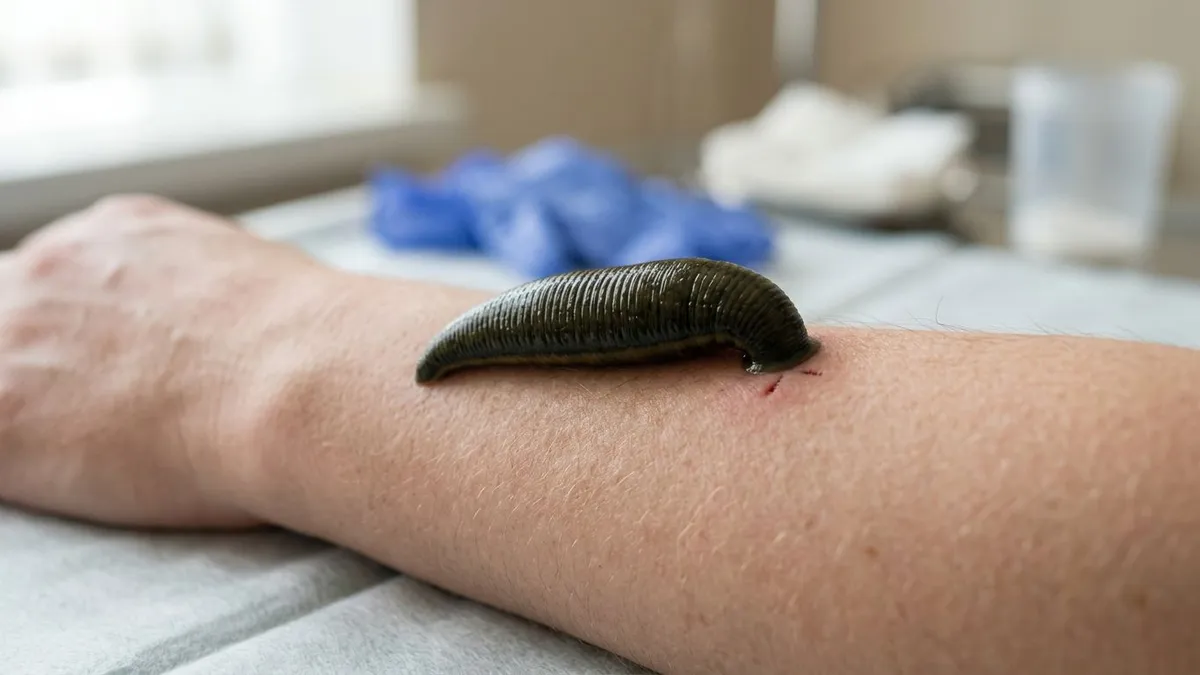
A leech can attach to the skin, open a small wound and begin feeding without causing the immediate reaction that many people would expect from a bite. The mechanism depends on its saliva, released at the point of contact while the animal stays fixed to the host. Among the substances present is hirudin, an anticoagulant that prevents a clot from forming properly. Another part of the saliva has an anesthetic effect, lowering the perception of the bite and making the cut less noticeable at first.
The scene does not involve a single needle-like structure. The leech uses three jaws arranged in a Y shape to make the opening in the skin. While the jaws work, the saliva prepares the site so that blood stays available. The result is a combination of a barely noticed cut and a prolonged flow, a feeding adaptation that also caught the attention of medicine. The animal does not need to make a large wound to obtain blood, because the chemistry of its saliva temporarily changes the normal response of the body.
Three jaws leave the feeding mark
The Y shape is one of the traits that help explain the leech bite. The three jaws meet at the front of the body and produce a mark with three directions, instead of a single isolated puncture. The arrangement lets the animal attach itself and draw blood efficiently. The saliva is released at the same time, reducing coagulation at the site and lessening the pain associated with the injury.
This description holds for the general mechanism of blood-feeding leeches, but it does not mean that all species have exactly the same medical use. Hirudin is linked above all to medicinal leeches, animals selected for clinical applications under control. The strength of the bite, the amount of saliva and the reaction of the host can vary. For this reason, the existence of a local anesthetic does not turn every bite into a completely unnoticeable experience. Pressure, movement of the animal or itching afterward can still be felt.
Hirudin interrupts a central step of clotting
When the skin is injured, the body starts a sequence that reduces blood loss. Platelets adhere to the damaged area, and clotting proteins help build a network that stabilizes the plug. Hirudin interferes with this process by binding to thrombin, an enzyme that is central to the conversion of fibrinogen into fibrin. Without the normal action of thrombin, the formation and stabilization of the clot are impaired for as long as the anticoagulant stays active.
This effect is what keeps the blood flowing after the opening made by the jaws. The leech does not need to keep enlarging the cut to prolong its meal. It combines the injury with a chemical change at the site, a strategy that turns a small bite into a source of blood for a longer time.
The anesthetic serves another function, because it reduces the pain signal that could lead the host to remove the animal quickly. They are two different effects, but they are coordinated in the saliva.
From historical observation to medicine
The medicinal use of leeches has been documented since Antiquity, when drawing blood was employed in different medical systems. The historical practice did not have today’s knowledge about thrombin, fibrin or local anesthesia, but it already took advantage of the fact that bleeding could continue after the animal attached itself.
With the development of physiology and pharmacology, the saliva came to be studied more specifically, and hirudin became the main example of the anticoagulant produced by the leech. In contemporary medicine, interest is concentrated on controlled situations, including certain microsurgery procedures.
When reattached or reconnected tissues have difficulty draining venous blood, the feeding of the leech can relieve local congestion while circulation reorganizes itself. The saliva helps keep blood flowing and the accumulated blood being drawn out. This is not the same as treating any wound with the animal. It is the use of a biological resource under conditions defined by health teams.
The medical benefit depends on strict control
The clinical application has clear limits. The leech does not replace the surgical correction of vessels, does not solve all circulation problems and does not make bleeding predictable in every patient. Local anticoagulation can prolong blood loss, and improper use can increase risks. Infection, the reaction of the body and the origin of the animals also have to be considered. For that reason medical practice requires selection, supervision and proper disposal, instead of home use based only on the look of the bite.
There is also an important difference between the action of the hirudin produced by the animal and anticoagulant drugs developed from the same knowledge. The saliva contains substances that act together, while a drug can be standardized for a specific purpose. In addition, the anesthetic effect does not remove all perception of the interaction. The skin can show redness, itching or prolonged bleeding after the leech detaches. Current research in microsurgery takes advantage of the mechanism, but it does not ignore these limitations.
An old adaptation still useful in research
The history of the medicinal leech is not a single discovery with a single date. Therapeutic use runs through medical records from Antiquity, while the biochemical explanation of hirudin belongs to the modern development of the science of coagulation. The use in microsurgery is a contemporary stage of that path, in which the animal’s ability to keep blood flowing is employed in specific circumstances. The origin of the phenomenon is feeding, but accumulated knowledge turned the saliva into an object of medical research.
For Brazil, the legitimate connection lies in the principle that also guides studies of biomaterials, anticoagulants and techniques for rebuilding small vessels, areas in which understanding physiology can inspire clinical solutions. There is no need to attribute a specific Brazilian species, hospital or study to recognize the relevance of the mechanism.
The leech shows that a simple structure, three jaws in a Y, takes on another meaning when combined with a molecule that interferes with coagulation and an anesthetic that lowers the host’s alert. Medical knowledge often begins when the observation of a meal reveals a tool for caring for delicate tissues.
Reporting: Natália Santos / Amazonia Mag

Editor · Amazonia Mag
Anne Silva is the editor of Amazonia Mag, the English-language edition of Revista Amazônia. She curates, translates and adapts the outlet's science and environment coverage for an international audience, reporting on Amazon wildlife, flora, rivers, climate and research. Every story she edits is grounded in peer-reviewed studies, official data and on-the-ground reporting from the Revista Amazônia newsroom in Belém, Pará, Brazil. More by Anne Silva →