
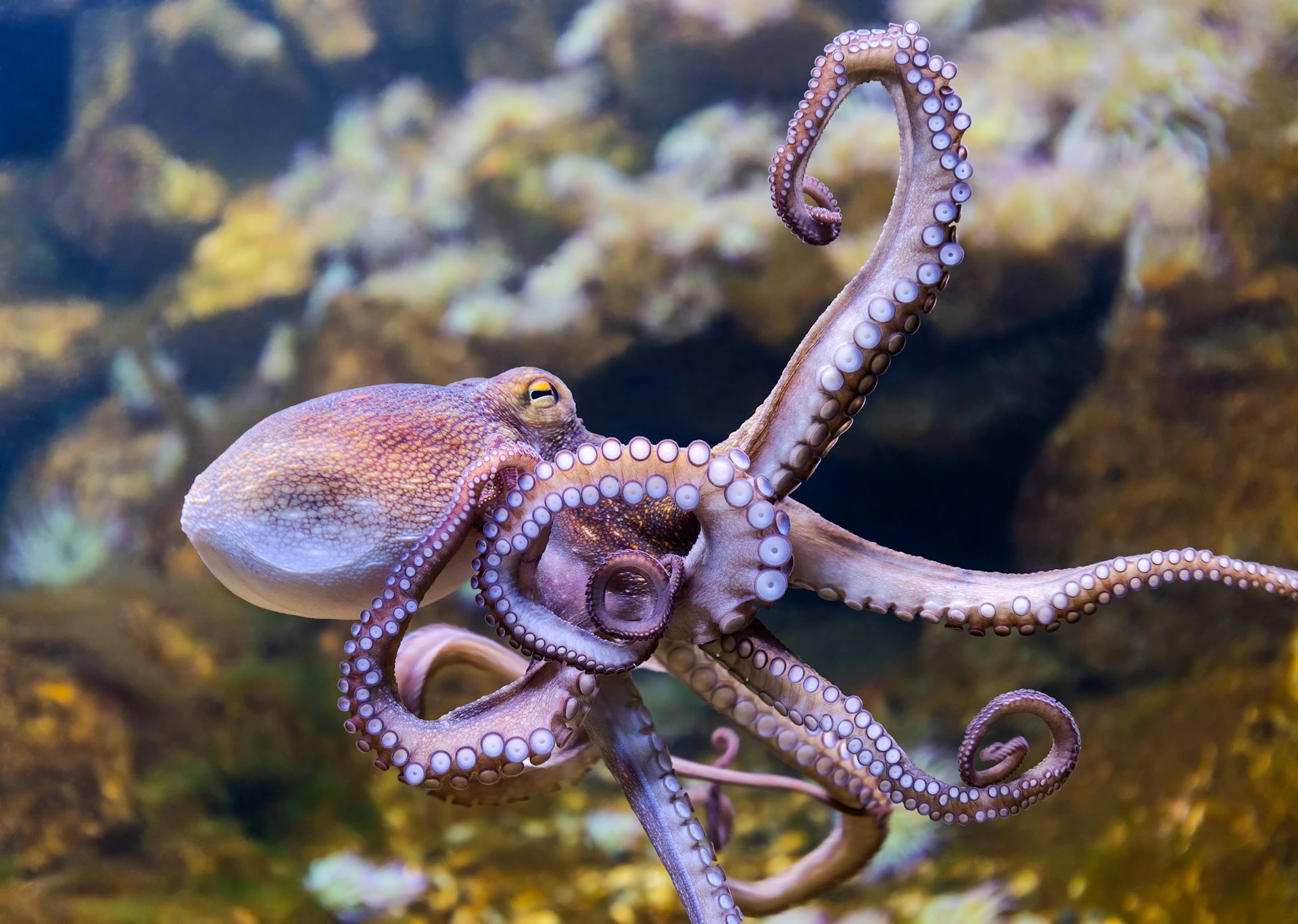
For a few seconds, the skin of a sleeping octopus can change color, its arms can twitch and its eyes can move. The scene looks like an underwater version of a dream, and that possibility is exactly what researchers set out to examine when they followed four wild Brazilian reef octopuses, Octopus insularis, in the laboratory, in a study published in 2021.
The animals were collected in tropical Brazilian waters and observed by a team led by neuroscientist Sylvia Medeiros, of the Federal University of Rio Grande do Norte. The result does not prove that octopuses dream, because they cannot report what happens while they sleep. Still, it revealed an organized pattern, with two phases that alternate in cycles.
When the skin changes, the octopus is not necessarily awake
Most of the resting time was spent in a state called quiet sleep. In this phase the octopuses stayed almost motionless, with pale skin and eyes reduced to closed slits. The body showed little reaction, an image very different from the intense activity for which these mollusks are known.
After periods that were usually longer than six minutes in that state, short episodes of active sleep appeared. The skin changed color and texture, the eyes made rapid movements, the suckers on the arms contracted and small muscles in the body twitched. The two states returned one after the other, at intervals of roughly 30 to 40 minutes.
According to the study published in 2021, Octopus insularis alternates between quiet and active sleep, with color changes and body movements concentrated in the second phase. In other words, a flicker of color across the skin of a resting octopus is not proof that the animal is awake. It can be a sign of a specific stage of sleep.
The tests showed the animals were really asleep
To tell sleep apart from a simple pause or a subtle reaction to the surroundings, the researchers measured how much stimulation it took to rouse the animals. In some tests, a live crab was shown on a screen. In others, the wall of the aquarium was tapped with a rubber hammer, sending vibrations through the water.
When the octopuses were alert, they reacted to the stimuli. During the resting periods, however, they responded little or not at all. That difference supported the interpretation that the animals were truly asleep, and not just sitting still while keeping watch over their surroundings.
The research also helps make sense of a video that went viral a few years ago. In the footage, an octopus named Heidi rapidly shifts from white to yellow, then to a wine-red tone and finally to a mottled pattern. The narration suggested she might be hunting a crab in a dream. The new study does not confirm that story, but it shows that similar transformations can occur during a specific phase of sleep.
A possible dream shorter than a short video
In humans, the most vivid dreams are usually associated with REM sleep, a period marked by rapid eye movements, changes in heart rate and irregular breathing. The active phase in octopuses shares some of these features, although it lasts much less, from a few seconds to about one minute.
For that reason, if octopuses really do dream, the experience would probably not have a long narrative with linked scenes, as human dreams do. It would be closer to a quick image, a flash or a small clip of video. That comparison is a hypothesis based on the behavior observed, not an established conclusion.
The scientific interest lies in the evolutionary distance. Octopuses and vertebrates took separate paths more than 550 million years ago. The common ancestor of the two groups had a simple nervous system, similar to that of a flatworm. Even so, their sleep patterns have features in common.
What octopus sleep says about evolution
For a long time, well-defined sleep states were linked mainly to mammals and birds. Later evidence also appeared in reptiles, fish and cuttlefish, which are relatives of octopuses. An active phase in animals so different from one another may indicate that similar mechanisms evolved independently, in a process known as convergent evolution.
One theory about REM sleep in mammals ties that phase to the control of body temperature. That explanation becomes less sufficient when the same kind of pattern shows up in animals that do not regulate their temperature internally, such as fish, reptiles and cephalopods.
Another possibility is that sleep is connected to memory and learning. Octopuses can learn from experience, recognize situations and adjust their behavior. It is still unknown whether active sleep helps consolidate that information, but the hypothesis opens a new line of research into the intelligence of these animals.
Next step: watching the brain during sleep
In people, scientists use brain waves and brain imaging to identify the regions that are active during dreams. Similar techniques may eventually be adapted to follow the brain activity of sleeping octopuses and check whether the active phase involves processing memories or other tasks.
The study analyzed four individuals of O. insularis and pointed to a pattern that still has to be compared across other species, populations and natural conditions. That is why the findings are best read with care, without claiming more than the animals’ behavior can support.
Until those tests are carried out, the safest conclusion is that octopuses have two clearly distinguishable sleep states, and that one of them produces behaviors resembling signs associated with dreaming in vertebrates. New studies should investigate whether these episodes are only bodily reflexes or whether they represent more complex mental activity.
Reporting: Natália Santos / Amazonia Mag

Editor · Amazonia Mag
Anne Silva is the editor of Amazonia Mag, the English-language edition of Revista Amazônia. She curates, translates and adapts the outlet's science and environment coverage for an international audience, reporting on Amazon wildlife, flora, rivers, climate and research. Every story she edits is grounded in peer-reviewed studies, official data and on-the-ground reporting from the Revista Amazônia newsroom in Belém, Pará, Brazil. More by Anne Silva →