
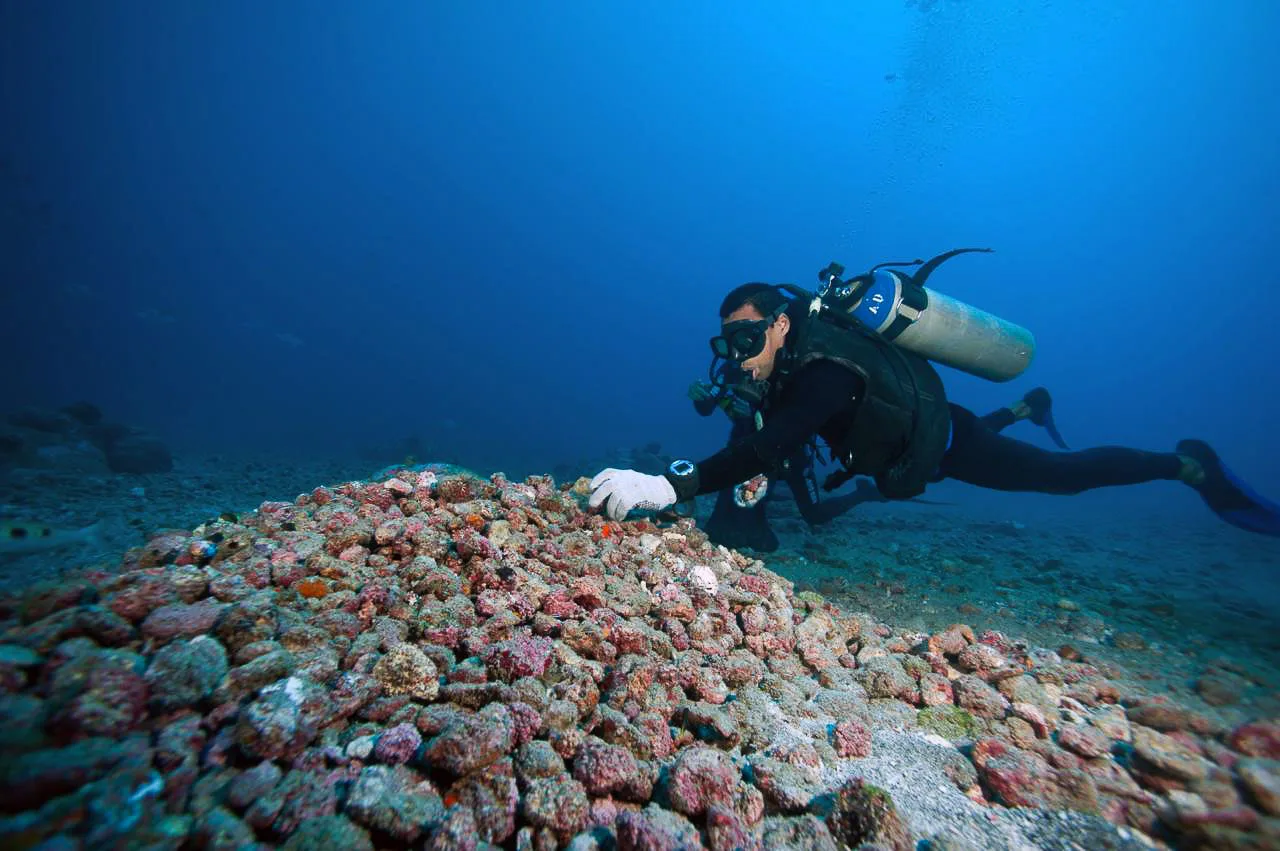
A pink stone lifted from the seabed can carry an entire community of organisms. That is the case with rhodoliths, structures made of living calcareous algae that build up over time and create crevices, surfaces and cavities used by marine animals. A study based on samples collected in Bahia and São Paulo identified more than 450 species associated with just two Brazilian beds and estimated that they hold between 0.2% and 1% of the marine diversity known on the planet.
The research was carried out by scientists at the Institute of the Sea of the Federal University of São Paulo and published on September 18, 2026, in the journal Biological Conservation. It analyzed the Abrolhos Bank, in Bahia, and the formation around Queimada Grande Island, off the coast of São Paulo. Although the two sites lie hundreds of miles apart and differ greatly in size, both revealed a biological variety that does not show up when the nodules are examined only from the outside.
What lives inside a living stone
The Abrolhos Bank is considered the largest continuous area covered by rhodoliths known in the world, at about 20,000 square kilometers (about 7,700 square miles). The bed studied at Queimada Grande Island measures roughly 1 square kilometer (0.4 square miles). Comparing the two helped the researchers assess how formations of very different scales can sustain complex communities.
Among the organisms found are algae, sponges, sea squirts, bryozoans, nematodes, ribbon worms, small crustaceans, marine mites, sea stars, sea cucumbers and sea urchins. Shrimp, swimming crabs, crabs and other animals were also detected through their link to the beds, even though they were not necessarily attached to the nodules that were analyzed.
According to the São Paulo Research Foundation (FAPESP), the study identified more than 450 species in samples from the rhodolith beds of the Abrolhos Bank and Queimada Grande Island, analyzed in Brazil in 2026.
DNA widened the inventory of marine life
The team combined visual identification with metabarcoding, a method that extracts and sequences, all at once, the genetic material of the organisms present in a sample. The technique works like a collective reading of biological barcodes and can detect larvae, microscopic animals and forms hidden in the cavities of the nodules.
The procedure found 1,837 unique genetic signatures, known as ESVs. They represent different DNA sequences, but they cannot be automatically converted into known species. For that, each sequence has to be compared with reference databases that hold genetic material already identified.
That limitation changes how the results should be read. In the most conservative calculation, based on species recognized directly, the two beds correspond to 0.2% of the roughly 200,000 marine species known worldwide. In the broadest scenario, in which each genetic signature could stand for a distinct species, the estimate reaches 1%. That figure is a possibility calculated from the data, not confirmation that every sequence belongs to a new organism.
New records and possible new species
The survey pointed to four potential new species of algae. One of them belongs to the genus Dissimularia, which so far includes four known species, all recorded in the Pacific Ocean. A Brazilian specimen may indicate a species not yet described, but confirmation depends on further analysis.
Organisms already known from other areas, such as the North Atlantic and the Caribbean, but never recorded in the South Atlantic, also turned up. Among the sponges, Pione vastifica and Protosuberites denhartogi were identified for the first time in the southwestern Atlantic. Hooperia anfractuosa had an even broader record, becoming the first documented occurrence for the entire Atlantic.
In all, 21 genera observed in the material had no previous record on the Brazilian coast or in the Atlantic Ocean. The finding does not mean these organisms appeared only now. It shows how much of the fauna associated with rhodoliths had remained outside traditional inventories.
A large ecosystem that is still little known
Rhodoliths occur in different regions of the planet, from shallow areas down to about 200 meters (about 660 feet) deep. The estimated global area of these beds reaches 4 million square kilometers (about 1.5 million square miles). Coral reefs, by comparison, are recognized for supporting about 25% of marine species.
Earlier studies cited by the researchers indicate that, at the regional scale, rhodolith beds can gather up to 30% of local biodiversity. For that reason, the group coordinated by Professor Guilherme Pereira Filho argues that these formations should be evaluated as possible megadiverse ecosystems, a category that also includes tropical forests and coral reefs.
A comparison with the Amazon helps frame the debate. The rainforest is estimated to shelter about 10% of global biodiversity and became an international reference after decades of research. In the ocean, rhodoliths still face a basic gap: of the nearly 17,000 marine species recorded in Brazil, only 3,700 have DNA sequences deposited in public databases.
Mining and oil put pressure on the beds
In Brazil, rhodoliths can still be exploited as a source of calcium carbonate, which is used in agriculture to correct soil acidity. The activity removes from the environment structures that took a long time to form and can eliminate the shelters used by other organisms. Offshore oil exploration is also a risk because of drilling into the seabed and possible spills.
For Guilherme Pereira Filho, expanding knowledge is a necessary step before priority conservation areas can be defined. The research also points to potential interest for bioprospecting, since organisms associated with rhodoliths may produce molecules useful in medicines and biotechnological processes. That potential, however, still depends on new investigations and does not mean ready-made products exist.
The next stage of the work seeks to verify whether the interior of the nodules holds reproductive structures that are hard to observe, as if rhodoliths worked as marine seed banks. The researchers plan to combine the genetic evidence with morphological analyses to determine how many life forms remain unidentified.
Continued sampling, larger genetic reference libraries and the definition of protection measures are the next steps to test the biodiversity estimate and reduce the risk of loss before these species are even known.
Reporting: Natália Santos / Amazonia Mag

Editor · Amazonia Mag
Anne Silva is the editor of Amazonia Mag, the English-language edition of Revista Amazônia. She curates, translates and adapts the outlet's science and environment coverage for an international audience, reporting on Amazon wildlife, flora, rivers, climate and research. Every story she edits is grounded in peer-reviewed studies, official data and on-the-ground reporting from the Revista Amazônia newsroom in Belém, Pará, Brazil. More by Anne Silva →