
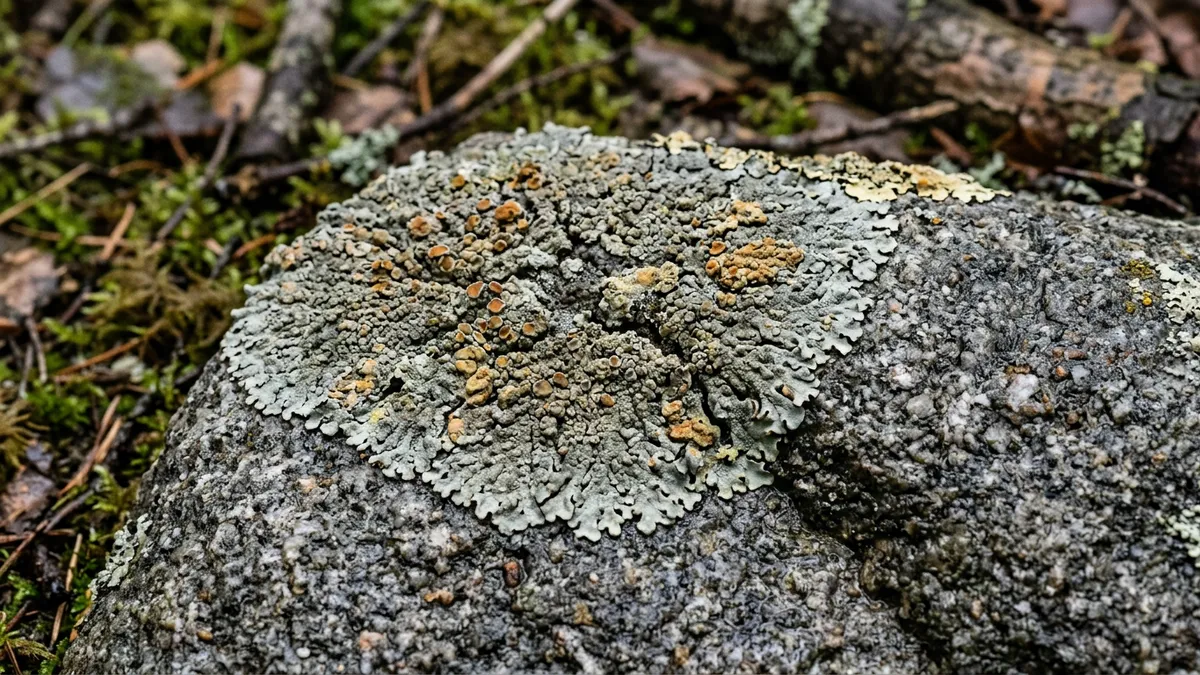
On a bare rock, where there is almost no soil, available water or organic matter, a crust can look like nothing more than a patch of color. Often, though, it is a lichen: a lasting partnership between a fungus and an organism able to photosynthesize, usually a green alga or a cyanobacterium. The pair works as one visible unit, but its members keep different jobs. The fungus provides structure, protection and moisture retention. The alga or cyanobacterium makes organic compounds from light, water and carbon dioxide. That cooperation is what lets a lichen occupy surfaces where few living things can stay.
The association turns surfaces with no apparent life into places where soil can begin to form.
Two organisms on the same surface
The look of a lichen changes with the species and the environment. Some form crusts stuck tight to the stone, others grow as small leaf-like blades, and some produce branching structures. The partnership does not turn the organism into a measuring device, but it makes it a biological record of the conditions it has been exposed to. A piece of equipment can show the concentration of a certain pollutant at one specific moment, while a lichen accumulates the effects of long periods. For that reason, its presence, absence, distribution and condition can help compare areas with different levels of air contamination. Reading the signs correctly depends on the species, the climate, the surface and complementary analyses.
Slow growth that starts to change the rock
Once it is established, a lichen grows very slowly. The speed depends on the species, the temperature, the humidity, the light, the supply of nutrients and the type of surface. In many cases, the advance is on the scale of about 0.04 inches (1 millimeter) a year, although important variations exist. This slowness means a colony can stay in the same place for many years, recording environmental changes that would never show up in a quick look. The growing edge spreads over the stone, while the older parts remain at the center or in the portion already colonized.
During this process, the lichen contributes to the gradual transformation of the rock. Filaments of the fungus push into small cracks, and the water it holds helps keep up cycles of wetting and drying on the surface. Compounds produced by the organism can also take part in the chemical wearing down of minerals. Mineral fragments, remains of the lichen’s own structures and particles carried by the wind pile up. In time, this mixture forms an initial layer of material that can support other organisms, such as mosses and microorganisms.
A lichen does not create a complete soil by itself, and it does not quickly turn a stone into fertile ground. It takes part in a slow ecological succession, in which the mineral surface starts to gain organic matter and conditions for new forms of life.
Pollution shows up in the body of the lichen
The sensitivity to air pollution is tied to the way a lichen gets its water and nutrients. Unlike many plants, it has no roots that select the elements absorbed from the soil. An important part of the water and substances it uses stays in direct contact with the surface of the organism. When the air holds an excess of compounds, particles or metals carried through the atmosphere, these materials can be held or taken up. The exposure can reduce growth, change pigmentation, damage the photosynthetic tissue and alter the make-up of the communities found in an area.
This behavior makes it possible to use lichens as bioindicators. In a survey, researchers can note which species appear at different points, measure the coverage of the colonies or analyze substances accumulated in their tissues. The more sensitive species tend to disappear in places with a heavier load of certain pollutants, while tolerant species may stay. The result is an integrated picture of exposure over time, not an instant reading.
Even so, the method does not replace sensors, monitoring stations or chemical analyses. Rain, wind, humidity, altitude, lighting, the age of the colony and the characteristics of the rock also change how a lichen develops. Interpreting the results means separating the effect of pollution from other environmental causes.
A living indicator, not a universal meter
The partnership between a fungus and an alga or cyanobacterium explains both the toughness and the vulnerability of a lichen. The fungus builds an architecture that protects its photosynthetic partner, but the whole depends on delicate exchanges and on minimum conditions to keep its metabolism going. Where the atmosphere changes, the lichen community can shift before visible changes take place in larger plants. This helps reconstruct differences among urban, industrial, rural and preserved environments, as long as the places are compared by similar criteria.
It is also important not to read each lichen as isolated proof of clean or polluted air. A rock without lichens may be under heavy shade, abrasion, drought, cleaning, or may simply have had no time to be colonized. An abundant colony may include resistant species and does not mean the absence of contaminants. In Brazil, the technique can complement assessments in cities, industrial areas, mining regions and protected areas, but always with taxonomic identification and instrumental data.
The lichen does not compete with technology: it adds memory to the diagnosis. Its discreet mark shows that air quality can also be read on the slow scale of the life that turns rock into the start of soil.
Reporting: Natália Santos / Amazonia Mag

Editor · Amazonia Mag
Anne Silva is the editor of Amazonia Mag, the English-language edition of Revista Amazônia. She curates, translates and adapts the outlet's science and environment coverage for an international audience, reporting on Amazon wildlife, flora, rivers, climate and research. Every story she edits is grounded in peer-reviewed studies, official data and on-the-ground reporting from the Revista Amazônia newsroom in Belém, Pará, Brazil. More by Anne Silva →