
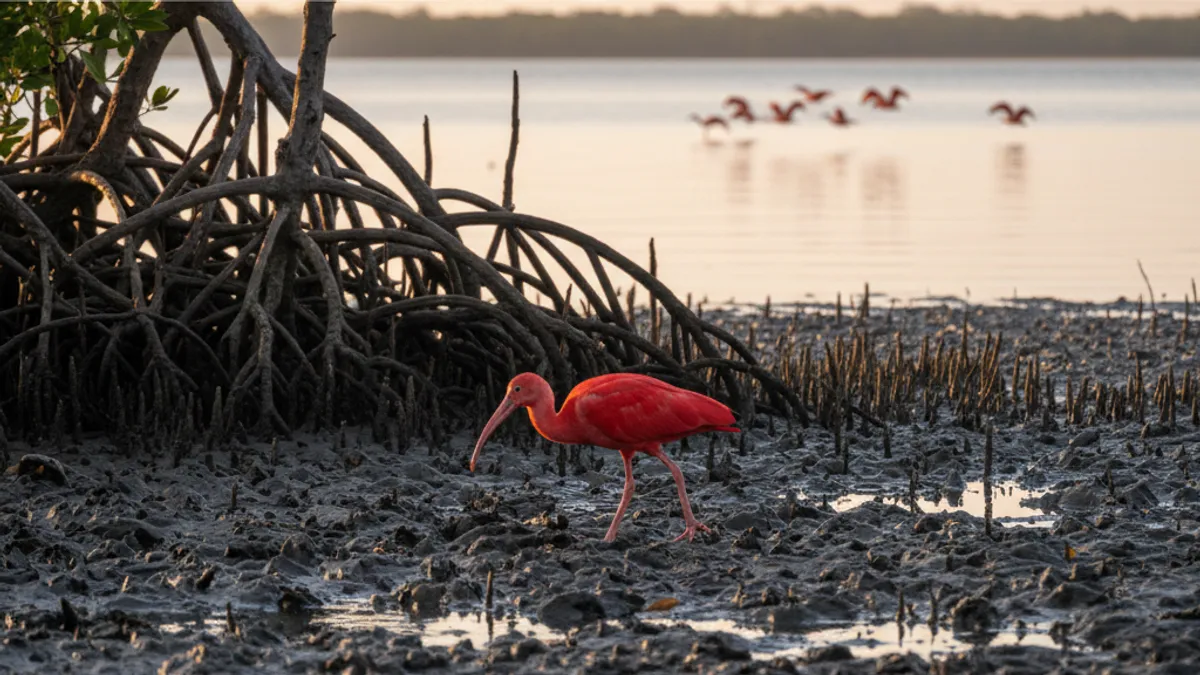
At Porto do Cajá, in Maragogipe, in the Recôncavo Baiano region of Bahia, the landscape changes as soon as the tide starts to fall. The water that covers part of the estuary slowly withdraws and leaves a dark, muddy floor cut by mangrove roots. In the gap between open water and exposed mud, scarlet ibises, known in Brazil as guarás, tend to take flight in flocks at dawn and in the late afternoon.
The birds follow the daily movement of the estuary, and that draws attention to something beyond the red of their plumage. The scarlet ibis depends on a working environment, one in which water, sediment, vegetation and living organisms are connected. The scene in Maragogipe shows only the visible part of processes that unfold below the surface and among the roots of the mangrove.
Low tide opens the ibis’s feeding ground
Known scientifically as Eudocimus ruber, the scarlet ibis carries its color in its name. The scientific name combines Greek and Latin roots tied to the idea of a bird of glorious red, while the popular name, guará, comes from Tupi-Guarani. The species occurs in several South American countries and is not considered at risk of extinction.
Even so, its presence in any given estuary depends on specific conditions: food availability, the rhythm of the tides and the existence of extensive mangrove areas. For this reason, a flock over the Recôncavo works as a sign of the ecological complexity of large tropical estuaries. For the ibises to find food, the environment has to sustain a chain of relationships that involves fish, crustaceans, mollusks, microorganisms and many other species.
During low tide, the exposed sediment concentrates small crabs, shrimp, mollusks and other invertebrates. The ibis walks slowly across this damp, uneven ground and sweeps its long, curved bill through the mud, locating prey that may lie beneath the surface. The movement looks simple, but it rests on a food chain built over a long time.
A food chain that starts in fresh water
Rivers carry nutrients to the estuary. The organic matter produced by mangrove trees breaks down, and a variety of organisms develop in the resulting environment. The bird finds food because this set of processes keeps the sediment biologically active. Each probe of the bill in the mud therefore makes visible one stage of a mechanism that begins in fresh water and extends to coastal areas influenced by the Atlantic Ocean.
When the tide returns, the same mangrove changes function. The space that was exposed now offers shelter to juvenile fish, crustaceans and other species that depend on the estuary while they grow, before moving on to the Atlantic. This alternation between water and land creates different opportunities for different animals and keeps matter and energy moving through the system.
Mangrove vegetation also stabilizes the soil, reduces erosion, traps sediment and helps conserve the nutrients brought by the rivers. The scarlet ibis takes part in this system as a consumer of the organisms found in the mud. Its presence also shows that an ecological base exists that is able to support the bird’s diet. The red flock is not an isolated event. It rests on the productivity of an ecosystem that changes its configuration several times a day.
Todos os Santos Bay holds a network of mangroves
The Recôncavo Baiano brings together conditions that help explain why scarlet ibises occur there. Todos os Santos Bay has roughly 1,000 square kilometers (about 390 square miles) of open water and holds a singular position on the Brazilian coast. Dozens of municipalities, fishing communities, protected areas and remnants of mangrove are spread along its shores. Together they form one of the largest estuarine systems in the country, with high biological productivity.
Within the bay, the network of mangroves and salt flats, known locally as apicuns, is shaped by the meeting of fresh water coming down from the interior of Bahia, the Paraguaçu River and the daily influence of the Atlantic. The result is a transition environment with different conditions of salinity, depth and exposure of the sediment. For the ibises, this variety means access to feeding areas tied to the rhythm of the tides.
The importance of the Recôncavo becomes clearer when it is compared with changes seen along other stretches of the Brazilian coast. Many mangroves lost part of their extent to urban expansion, industrial activity and other forms of coastal occupation. In Todos os Santos Bay, however, remnants still exist that sustain fishing communities and a web of ecological relationships.
The mangrove works as a feeding area for birds, fish and invertebrates, and it also retains sediment and nutrients carried by the rivers. In the Iguape Bay lagoon system, the interaction between fresh and salt water maintains conditions for the development of organisms that enter the ibis’s food chain. The bird, in this sense, brings an everyday landscape close to the idea of conservation. While it walks on the mud, it depends on a territory that also supports human activities and other forms of life.
What the flock tells us about the estuary
Watching the scarlet ibises at Porto do Cajá means following the visible result of a chain that begins before the birds arrive. Organic matter produced by mangrove trees feeds the process of decomposition. Rivers carry nutrients to the estuary. The sediment provides conditions for small crabs, shrimp, mollusks and other invertebrates.
At low tide these organisms become accessible in the mud, and the ibis moves across the surface with its curved bill in search of food. At high tide, juvenile fish and crustaceans find shelter among the roots and in flooded areas. The same landscape shifts from an exposed feeding ground to a protected space for growing animals.
This daily transformation explains why scarlet ibises depend on extensive mangroves and why conserving an estuary involves far more than protecting a single species. The most important point lies in the sequence of events the tide leaves in plain sight: the water withdraws, the sediment concentrates invertebrates, the bird searches for food and the mangrove shows its productivity. When the water returns, the same space serves other functions for fish, crustaceans and countless species.
The scarlet ibis turns this dynamic into an image that is easy to recognize, yet the value of the estuary also lies in what stays hidden among roots, sediment and moving water. The flock is a reminder that conservation begins with the continuity of these relationships, which can sustain life even when the observer sees only a bird crossing the red sky of the Recôncavo.
Reporting: Natália Santos / Amazonia Mag

Editor · Amazonia Mag
Anne Silva is the editor of Amazonia Mag, the English-language edition of Revista Amazônia. She curates, translates and adapts the outlet's science and environment coverage for an international audience, reporting on Amazon wildlife, flora, rivers, climate and research. Every story she edits is grounded in peer-reviewed studies, official data and on-the-ground reporting from the Revista Amazônia newsroom in Belém, Pará, Brazil. More by Anne Silva →