
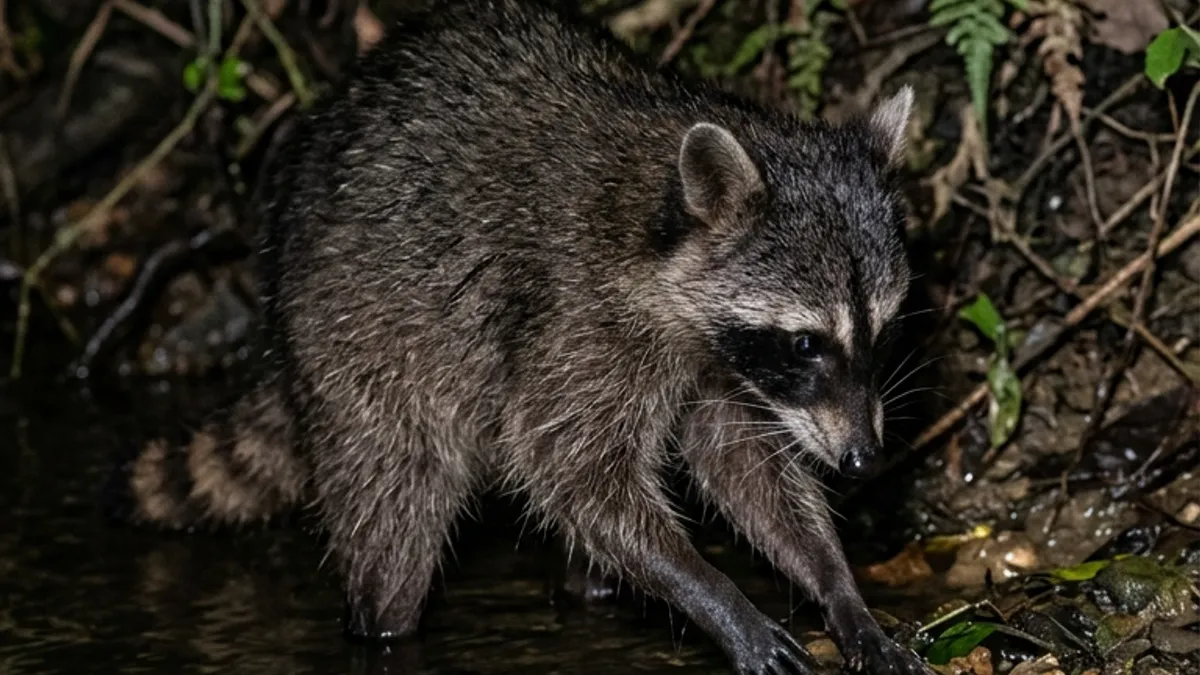
The crab-eating raccoon (Procyon cancrivorus) explores food with its forepaws because those paws concentrate a large number of mechanoreceptors, structures able to detect pressure, contact, texture and movement. When it touches the shallow bottom of a river or stream, the mammal receives tactile information that helps it locate prey and other food items, even when the water reduces visibility.
Wet paws become even more sensitive to contact with their surroundings. The animal then rummages through the food in the water, a behavior that is usually interpreted as if it were washing its meal. In reality, the gesture is tied to the tactile exploration of a nocturnal omnivore that looks for resources along riverbanks and in flooded areas.
Paws that work as contact sensors
Mechanoreceptors respond to the physical stimuli produced when the paw meets its surroundings. They report that something has been touched, pressed or displaced, or that it has a particular texture. In the crab-eating raccoon, the high density of these structures in the forepaws favors a detailed reading of what lies underwater, among leaves, in the mud or against stones.
This kind of perception is not the same as sight. The animal does not see with its paws. It uses touch to build information about objects that the eyes may not identify clearly. A small prey animal, a hidden morsel or an uneven surface can be sensed through the combination of finger movement, the pressure applied and the tactile response that comes back.
That is why the forepaws matter so much to the search. Every contact delivers a signal, and every signal can steer the next movement. A surface can be pressed, pushed aside or touched again while the paw stays in constant interaction with the water and the substrate.
Why water makes touch more useful
On entering a shallow stretch, the crab-eating raccoon moves its fingers and stirs the material that has settled on the bottom. This procedure enlarges the area explored and creates contact with objects that were lying still or only partly covered.
Water also reduces the usefulness of vision in certain situations, especially when the bottom holds sediment, leaves or organic matter. In that scenario, touch offers a direct way to investigate whatever lies within reach of the paws. The animal can touch, shift and assess different elements before deciding whether food is available, without depending on sight alone.
Wetness adds to the effect. Paws that are wet respond even more strongly to contact with the environment, which turns a shallow stream into a practical place for tactile foraging. The water is not an obstacle to the search. It is part of the way the search works.
Stirring the water is not washing the food
The gesture of rummaging through food in water is often described as washing, but that interpretation oversimplifies the behavior. The action is linked to how the crab-eating raccoon looks for and identifies resources. By handling something with its paws, the animal receives signals about consistency, shape and resistance, information that helps separate a food item from other materials.
The repeated movement can give the impression of a cleaning purpose similar to a human one. Even so, the behavior should be understood within the ecology of a mammal that depends on exploring its surroundings to find food. Water is part of the search space, and not necessarily a container used to sanitize a meal before it is eaten.
Seen this way, the scene changes meaning. What looks like a ritual is closer to reading: the animal handles, presses and moves things around until the paws report what they are.
A nocturnal omnivore at the water’s edge
The crab-eating raccoon is an omnivore that is active at night and makes use of riverside environments. Foraging in such places means dealing with shallow water, sediment, leaves, stones and other materials that can hide resources. In this context the forepaws offer an advantage, because they make it possible to investigate what is not immediately obvious to the eyes.
Night makes any mechanism that helps locate food with less reliance on vision especially relevant. The animal can travel along the bank, step into shallow water and explore the substrate with its paws. Touch does not fully replace the other senses, but it adds a source of information that guides the search in an environment with obstacles and variable visibility.
The forepaws take part directly in investigating and handling objects. With them, the animal touches surfaces, moves material around and stirs the bottom of shallow habitats. Having many mechanoreceptors makes this region especially important for gathering information during the search, mainly when resources are hidden or hard to see.
Reading the river with the body
By stirring the water and the material on the bottom, the crab-eating raccoon interacts with a small part of the riverside environment. The action shows how the animal responds to the physical conditions of the place, using the structure of its paws to reach resources that are mixed into the substrate.
The behavior is tied to an individual’s search for food, but it also shows the importance of riverbanks as feeding areas. As an omnivore, the crab-eating raccoon can exploit different kinds of resources, and the ability to examine objects by touch widens its options. A sensitive paw means the animal does not depend on a single way of finding food.
Instead of only watching the surface, it examines the environment in direct contact with the water. An apparently simple margin becomes a space full of tactile information.
Looking for food can be as much an act of perception as of movement. In stirring the water, the crab-eating raccoon is not performing a gesture without purpose, nor automatically repeating a supposed washing ritual. It uses its forepaws to read the surroundings by contact, drawing on the sensitivity of its mechanoreceptors at a moment when vision may help less. Noticing this detail changes how the scene is understood: the riverbank is no longer just the place where the animal finds food, but also a surface it investigates with its own body.
Reporting: Natália Santos / Amazonia Mag

Editor · Amazonia Mag
Anne Silva is the editor of Amazonia Mag, the English-language edition of Revista Amazônia. She curates, translates and adapts the outlet's science and environment coverage for an international audience, reporting on Amazon wildlife, flora, rivers, climate and research. Every story she edits is grounded in peer-reviewed studies, official data and on-the-ground reporting from the Revista Amazônia newsroom in Belém, Pará, Brazil. More by Anne Silva →